Table of Contents
ToggleFire Door Closer Replacement: What Contractors Should Check
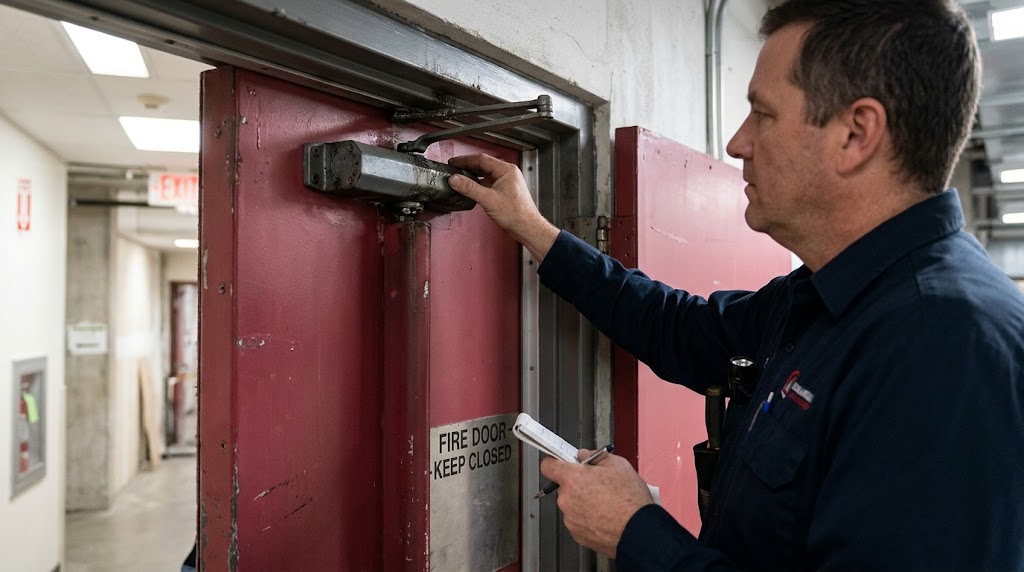
Replacing a fire door closer involves more than removing an old component and installing a new one. A fire door closer forms part of a fire-resistant doorset, and an unsuitable replacement can affect closing performance, latching and the integrity of the door assembly.
For Australian fire protection contractors, door hardware installers and facility maintenance teams, the key is to confirm compatibility before installation and verify correct operation afterwards.
This guide explains the main checks for fire door closer replacement, relevant Australian Standards, common installation problems and maintenance documentation.
Why Fire Door Closer Selection Matters
Fire-resistant doorsets help limit the spread of fire and smoke between building areas. Their performance depends on the complete assembly, including the door leaf, frame, hinges, latches, seals and associated hardware.
A door closer helps return the door to its closed position after use.
However, installing a closer with the correct weight rating does not automatically make it suitable for a particular fire door.
The replacement must be compatible with the doorset and supported by the relevant manufacturer information and evidence.
1. Check the Existing Fire Door Assembly
Before selecting a replacement closer, identify the existing fire-resistant doorset and its requirements.
Important checks include:
- Door and frame identification tags or labels.
- Door manufacturer and available assembly documentation.
- Required Fire Resistance Level (FRL).
- Door leaf dimensions, thickness and weight.
- Frame construction and hinge arrangement.
- Existing latch, lockset and other hardware.
- Door opening direction and mounting configuration.
- Any electromagnetic hold-open device or automatic release arrangement.
Where the original doorset documentation is unavailable, contractors should seek appropriate technical clarification before making changes that could affect the assembly’s fire resistance.
A replacement closer should not be selected solely because it looks similar to the original component.
2. Confirm Door Closer Compatibility
Fire door closers are available in different designs, sizes, mounting arrangements and operating configurations.
When comparing products, contractors should consider the following:
| Check | Why it matters |
|---|---|
| Door size and weight | Helps establish whether the closer has adequate operating capacity |
| Door opening direction | Determines compatibility with the intended mounting arrangement |
| Closer type and arm | Affects installation geometry and door operation |
| Door and frame construction | Determines mounting and fixing requirements |
| Closing and latching performance | Helps confirm that the door can close and latch correctly |
| Opening force and accessibility | May affect ease of use and applicable access requirements |
| Existing hardware | Hinges, seals and latches can influence closing performance |
| Supporting evidence | Helps establish whether the proposed closer is suitable for the fire-resistant doorset |
A closer’s advertised door weight capacity is useful product information, but it is not proof that the closer is acceptable for every fire-rated door.
Contractors should review the exact product model, manufacturer instructions and relevant doorset documentation before installation.
3. Understand the Relevant Australian Standards
Several Australian Standards may be relevant to fire door closer replacement, depending on the building and door assembly.
AS 1905.1 – Fire-Resistant Doorsets
AS 1905.1 addresses requirements for fire-resistant doorsets.
When replacing hardware, contractors should check the applicable edition and supporting doorset evidence to establish whether the proposed replacement is suitable.
A door closer should not be treated as independently establishing the fire resistance performance of the complete doorset.
AS 1851 – Routine Service of Fire Protection Systems and Equipment
AS 1851—2012, Section 12, addresses routine servicing of passive fire and smoke systems, including relevant fire-resistant doorsets.
Routine service activities can include checking the condition and operation of door closers, hinges, latches, seals and other relevant components.
The applicable service requirements depend on the installed doorset, the relevant standard and the jurisdiction.
AS 1530.4 – Fire Resistance Testing
AS 1530.4 provides methods for determining the fire resistance performance of building elements, including relevant doorset assemblies.
Fire resistance evidence for a doorset should not be assumed to cover every alternative closer or hardware configuration.
National Construction Code (NCC)
The NCC includes fire resistance and protection-of-openings provisions relevant to fire-resistant doorsets.
Contractors should confirm the NCC edition and any state or territory variations applicable to the project.
The standards and project documentation should be considered together. Product suitability and installation compliance cannot be established from a general product description alone.
4. Test Self-Closing and Self-Latching Performance
After installing a suitable replacement closer, the door’s operation must be checked.
A fire door may appear to close correctly but fail to engage its latch consistently.
Contractors should check:
- Whether the door closes from the opening positions required by the applicable test or service procedure.
- Whether the door fully reaches the closed position.
- Whether the latch engages correctly where required.
- Whether the door binds against the frame, threshold or seals.
- Whether the closer causes excessive slamming or uncontrolled movement.
- Whether hinges, pivots and other hardware operate correctly.
- Whether the closing action remains reliable under the relevant operating conditions.
Closing speed, latching action and other adjustable functions should be set according to the manufacturer’s instructions and applicable doorset requirements.
A fire door that does not close or latch as required should not be recorded as having passed the relevant operational check.
Any defect should be documented and addressed through the appropriate maintenance process.
5. Check Electromagnetic Hold-Open Devices
Some fire-resistant doorsets are designed to remain open during normal building use through an approved automatic hold-open arrangement.
These systems may release the door when triggered by an associated fire detection or control system.
When replacing a closer on a door with a hold-open device, contractors should verify:
- Compatibility with the existing hold-open arrangement.
- Correct operation of the release mechanism.
- Closing and latching after release.
- Relevant power supply and control interfaces.
- Applicable manufacturer instructions and project requirements.
The door’s complete operating sequence should be tested using the appropriate procedure.
An ordinary mechanical doorstop or an unauthorised device should not be used to prevent a fire door from closing.
6. Common Fire Door Closer Replacement Mistakes
Selecting a Closer Based Only on Door Weight
Door weight is important, but it does not establish compatibility with the fire-resistant doorset.
Installing the Wrong Arm or Mounting Arrangement
Incorrect mounting can affect closing force, opening angle, clearances and latch engagement.
Ignoring Door Alignment Problems
A closer may not correct problems caused by damaged hinges, frame distortion, worn hardware or excessive friction.
Using an Unverified Replacement Model
A different closer may require additional evidence to establish its suitability for the existing doorset.
Failing to Test the Complete Door
Testing only the closer mechanism is insufficient. The complete doorset should be checked against the relevant operating requirements.
Failing to Record the Replacement
Without adequate records, future technicians may not know which component was installed or whether the door was tested after replacement.
7. Fire Door Maintenance and Inspection Records
Routine maintenance records help contractors and building managers monitor fire door condition and identify recurring defects.
Useful records for fire door closer replacement include:
- Building and door identification.
- Date of inspection and replacement.
- Existing closer manufacturer and model, where identifiable.
- Replacement closer manufacturer and model.
- Relevant doorset compatibility evidence.
- Installation and adjustment details.
- Operational test results.
- Identified defects and corrective actions.
- Technician or service provider details.
These records can support ongoing fire door inspections and maintenance planning.
AS 1851 Passive Fire Logbooks
Fire Factory Australia offers a Passive Fire Logbook designed to support routine service documentation for passive fire and smoke systems.
The logbook includes inspection records for fire-resistant doorsets and relevant components such as door closers, hinges, latches, seals and door frames.
It also provides fields for inspection results, defects, comments, corrective actions and completed repairs.
A maintenance logbook supports record keeping but does not replace competent inspection, correct installation or the required evidence of doorset compliance.
8. Fire Door Hardware from Fire Factory Australia
Fire Factory Australia supplies fire protection equipment and door hardware for Australian contractors and building maintenance businesses.
Our product catalogue includes fire door hardware and selected door closer models.
Before ordering, customers should confirm:
- The exact closer model and current availability.
- Door size and weight suitability.
- Mounting and installation requirements.
- Applicable manufacturer documentation.
- Compatibility with the intended fire-resistant doorset.
- Any additional project-specific requirements.
A product described as fire-rated should not automatically be assumed suitable for every fire door assembly.
For product enquiries, contact Fire Factory Australia to request available specifications and supporting documentation.
Frequently Asked Questions
Can Any Door Closer Be Installed on a Fire Door?
No. The selected closer must be suitable for the fire-resistant doorset and supported by relevant documentation.
Can I Replace a Fire Door Closer with a Different Brand?
A different brand may be acceptable where appropriate evidence supports its use with the existing doorset.
Brand substitution should not be based only on similar dimensions or weight ratings.
Does a Fire Door Closer Need to Be Fire-Rated?
The closer must be suitable for use as part of the relevant fire-resistant doorset. A standalone product claim does not establish compatibility with every assembly.
How Often Should Fire Door Closers Be Inspected?
The inspection frequency depends on the applicable maintenance requirements.
AS 1851—2012 Section 12 includes routine service schedules for fire-resistant doorsets, generally including six-monthly servicing of hinged and pivoted fire-resistant doorsets. Certain residential apartment entry doors may be subject to a permitted yearly interval.
The applicable requirements should be confirmed for the specific building and jurisdiction.
What If a Fire Door Does Not Close Properly After Replacement?
The installer should investigate the closer selection, adjustment, hinges, latch, seals, alignment and other relevant components.
The defect should be recorded and appropriately rectified before the relevant operational check is treated as satisfactory.
Should Fire Door Closer Replacement Be Recorded?
Yes. Recording the replacement model, installation details, test results and corrective actions supports ongoing maintenance and future inspections.
Conclusion
Fire door closer replacement requires more than matching the size or appearance of an existing component.
Contractors should confirm the fire-resistant doorset’s requirements, select compatible hardware, verify the applicable documentation and test closing and latching performance after installation.
Accurate maintenance records also help building owners and fire protection teams track repairs and maintain a clear service history.
For fire door hardware enquiries and passive fire maintenance record products, contact Fire Factory Australia for available product information, specifications and stock enquiries.