Table of Contents
ToggleAustralian Hospital Study Reports 1,000-Fold Reduction in Bushfire Smoke
Australian researchers have reported promising results from a hospital ventilation study, showing how advanced air filtration could help protect patients from bushfire smoke while reducing energy consumption.
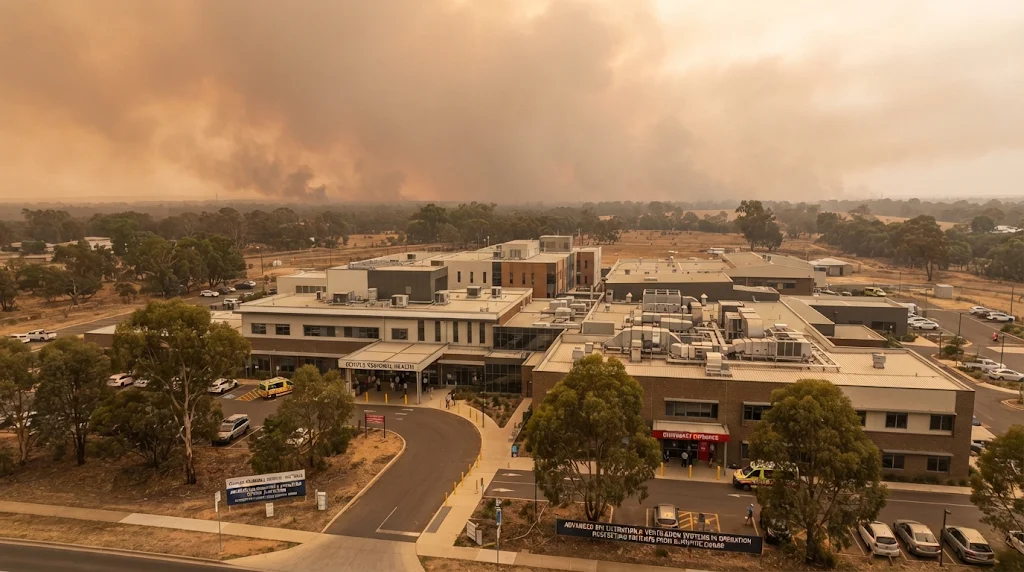
Research involving Adelaide University and its partners examined ventilation configurations at Echuca Regional Health in Victoria during the January 2026 bushfire smoke period.
According to the university’s published research summary, an advanced filtration configuration reportedly reduced incoming smoke by approximately 1,000 times while using 34% less energy.
The findings highlight the importance of effective ventilation design in hospitals and other buildings where indoor air quality is critical.
Why Bushfire Smoke Is a Serious Risk for Hospitals
Bushfire smoke can travel significant distances and affect communities far beyond the fire itself.
Smoke contains fine airborne particles, including PM2.5, which can enter buildings through ventilation systems, openings and air leakage.
Hospitals face particular challenges because many patients have respiratory conditions, cardiovascular problems or other health concerns that make them more vulnerable to poor air quality.
Healthcare facilities must maintain suitable indoor air quality while continuing to provide ventilation for clinical operations.
This creates an important engineering challenge: reducing outdoor smoke exposure without compromising the building’s ventilation requirements.
What Did the Australian Hospital Study Find?
The research examined different hospital ventilation configurations during bushfire smoke conditions at Echuca Regional Health.
The advanced filtration configuration delivered two significant reported outcomes.
| Performance Measure | Reported Result |
|---|---|
| Incoming bushfire smoke | Approximately 1,000-fold reduction |
| Energy consumption | 34% reduction |
The results suggest that carefully designed ventilation and filtration systems can significantly improve protection against outdoor smoke while also supporting energy efficiency.
The reported performance relates to the specific configuration and conditions examined in the study.
It should not be assumed that every hospital or commercial building will achieve the same results without appropriate engineering assessment.
How Can Advanced Ventilation Protect Buildings from Bushfire Smoke?
Building ventilation systems can introduce outdoor air to maintain indoor air quality.
During bushfire events, however, this outdoor air may contain elevated concentrations of smoke particles.
Effective smoke filtration strategies may involve several coordinated measures.
1. High-Efficiency Air Filtration
Suitable air filters can capture fine airborne particles before outdoor air enters occupied spaces.
Filter selection must consider particle removal performance, airflow resistance, compatibility with existing equipment and maintenance requirements.
2. Outdoor Air Management
Ventilation controls can help manage the amount of outdoor air entering a building during smoke events.
Any adjustment must remain consistent with the facility’s ventilation, pressure and clinical safety requirements.
3. Air Handling System Performance
Air handling units must provide suitable airflow through the intended filtration path.
Poor filter installation, air leakage or inadequate maintenance can reduce filtration effectiveness.
4. Maintenance and Monitoring
Regular inspection and maintenance help ensure ventilation equipment continues to perform as intended.
Monitoring indoor air quality and filter condition can also support decisions during extended bushfire smoke events.
Bushfire Smoke Filtration vs Building Fire and Smoke Control
Although both systems involve managing smoke-related risks, bushfire smoke filtration and building fire and smoke control serve different purposes.
Bushfire smoke filtration focuses on reducing outdoor smoke particles entering occupied spaces.
Building fire and smoke control systems are designed to manage smoke movement during a fire within a building and support occupant safety and evacuation.
These systems may involve different equipment, operating sequences and regulatory requirements.
For Australian fire protection and mechanical services professionals, it is important not to treat the findings of this hospital filtration study as evidence of compliance with building fire and smoke control requirements.
The research does not introduce new requirements under the National Construction Code or AS 1851.
What Does This Research Mean for Australian Facilities?
The findings may be useful for hospitals, aged care facilities, commercial buildings and other sites where occupants are particularly vulnerable to poor indoor air quality.
Facility managers and engineering teams can use the research to inform future discussions about:
- Ventilation system performance during bushfire smoke events.
- Suitable filtration upgrades for existing buildings.
- Outdoor air management and control strategies.
- Energy efficiency during smoke protection operations.
- Inspection, maintenance and operational documentation.
However, any changes to a building’s ventilation system should be assessed by appropriately qualified professionals.
Healthcare facilities may have specific ventilation and pressure requirements that must be maintained even during severe outdoor smoke events.
Why Maintenance Documentation Matters
Even a well-designed ventilation system depends on correct operation and ongoing maintenance.
Building operators should maintain suitable records of inspections, equipment condition, filter replacement and relevant control system testing.
Where a building also includes dedicated fire and smoke control systems, those systems must be maintained in accordance with their applicable requirements.
For fire protection contractors, clear maintenance documentation helps distinguish routine mechanical services activities from the inspection and testing of regulated fire safety systems.
Fire Factory Australia supplies fire safety logbooks, including a Mechanical Services Logbook for recording relevant routine servicing activities associated with fire and smoke control systems under AS 1851.
The logbook is not a substitute for ventilation filtration design, testing or clinical air quality assessment.
Frequently Asked Questions
How much bushfire smoke did the hospital filtration system remove?
The Australian research summary reported an approximately 1,000-fold reduction in incoming smoke under the advanced filtration configuration tested.
Did the advanced filtration system increase energy consumption?
No. The study summary reported approximately 34% lower energy use for the tested configuration.
Can hospitals use existing ventilation systems to reduce bushfire smoke?
Existing systems may be suitable for improvement, depending on their filtration capacity, airflow arrangements and controls. Each facility requires an appropriate engineering assessment.
Does this study change Australian fire safety standards?
No. The research provides information about ventilation and filtration performance. It does not establish new requirements under AS 1851 or the National Construction Code.
Is bushfire smoke filtration the same as fire and smoke control?
No. Bushfire smoke filtration primarily addresses outdoor smoke pollution, while building fire and smoke control systems manage smoke during building fires.
Conclusion
The Australian hospital ventilation study highlights the potential for advanced filtration to improve indoor air quality during bushfire smoke events.
The reported 1,000-fold reduction in incoming smoke and 34% reduction in energy use demonstrate the value of examining both air quality and energy performance when designing ventilation systems.
For hospitals and other sensitive facilities, the findings provide a useful starting point for reviewing smoke protection strategies, equipment performance and maintenance practices.
As Australian buildings face ongoing bushfire smoke risks, effective ventilation design and reliable maintenance will remain important considerations for protecting occupants.
For fire protection equipment and routine servicing documentation, visit Fire Factory Australia or contact our team.
Source: Adelaide University – Protecting Hospital Patients from the Dangers of Bushfire Smoke
Research location: Echuca Regional Health, Victoria, Australia
Reported study period: January 2026