Table of Contents
ToggleFRNSW Issues New Fire Safety Position for Lithium-Ion Batteries and Diesel Generators in Data Centres
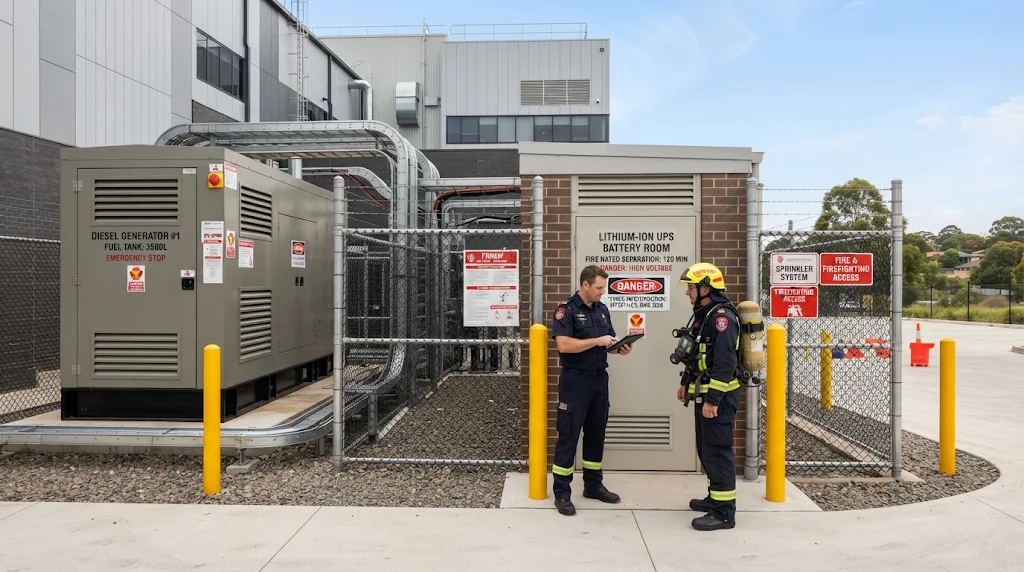
Fire and Rescue NSW (FRNSW) has published a new fire safety position statement addressing lithium-ion UPS battery rooms and diesel generator structures in data centres.
Effective from 3 June 2026, the position outlines important fire protection considerations, including fire-rated separation, sprinkler system design and firefighting access.
The guidance is particularly relevant to fire protection contractors, fire engineers, electrical contractors, data centre developers and building operators across NSW.
The official FRNSW Position Statement highlights three key areas that should be considered during data centre fire safety design.
1. Fire-Rated Separation for Lithium-Ion UPS Battery Rooms
Lithium-ion batteries are increasingly used in data centres to provide uninterrupted power supply (UPS) during electrical interruptions.
However, battery fires can present complex fire protection challenges, particularly when battery units are installed inside enclosed rooms.
FRNSW states that lithium-ion UPS battery rooms should be appropriately separated from the remainder of the building using fire-rated construction.
The position expresses a preference for the following Fire Resistance Levels (FRL):
| Construction Element | FRNSW Preferred FRL |
|---|---|
| Load-bearing elements | 240/240/240 |
| Non-load-bearing elements | -/240/240 |
These ratings represent four-hour fire resistance performance in the relevant FRL criteria.
FRNSW also states that it does not support reducing fire-resistance levels for rooms containing lithium-ion battery units.
Importantly, these figures represent the fire service’s stated position and preference. They should not be interpreted as a new nationwide legal requirement applying to every data centre.
Why Fire Separation Matters
The FRNSW document explains that lithium-ion battery fires may produce temperatures and fire conditions that differ from those used in conventional fire-resistance testing.
Testing individual battery cells or modules may not fully represent the behaviour of an entire battery installation inside an enclosed room.
Heat accumulation and interaction with surrounding surfaces can influence fire growth and duration.
For this reason, effective compartmentation and suitable fire protection measures are important considerations in limiting fire spread to adjacent areas.
2. Sprinkler System Design for Battery Groups Above 50 kWh
Another important part of the FRNSW position concerns sprinkler protection for energy storage systems.
For Energy Storage System (ESS) groups with capacities greater than 50 kWh, FRNSW recommends sprinkler system designs verified against representative large-scale fire test data.
The guidance refers to NFPA 855:2026 and its approach to validating sprinkler design criteria and separation distances through fire testing.
This is important because conventional sprinkler design assumptions may not adequately represent the risks associated with different lithium-ion battery configurations.
What If Large-Scale Fire Testing Is Unavailable?
FRNSW recognises that representative testing may not always be available.
In these circumstances, relevant international standards or guidelines applicable to the battery system may be used to determine suitable sprinkler design criteria.
Designers should consider factors such as:
- Battery chemistry and capacity.
- Battery configuration and installation arrangement.
- Room layout and separation distances.
- Fire protection performance and available testing evidence.
- Applicable international standards and technical guidance.
Fire protection contractors should work with the responsible fire engineer and system designer to ensure that the installed sprinkler system matches the approved design.
The 50 kWh threshold in this position relates to the specified sprinkler design approach. It does not mean that smaller battery systems have no fire safety requirements.
3. Fire Protection for Stacked Diesel Generator Structures
Data centres commonly use diesel generators to maintain power during extended electrical outages.
Some facilities install generators and diesel tanks in detached structures with equipment arranged across multiple levels.
FRNSW identifies these arrangements as requiring careful consideration because they may contain substantial quantities of combustible liquids.
The position highlights several fire safety measures:
- Appropriate fire resistance of the structure.
- Fire separation from relevant fire source features.
- Suitable suppression and firefighting equipment.
- Measures supporting occupant life safety.
- Facilities that allow effective fire brigade intervention.
FRNSW also considers that the use and fire load of these structures are more closely associated with a Class 8 use than a typical Class 10 structure.
This is a fire service position concerning the risk presented by these structures, not an automatic reclassification of every generator building.
What Does This Mean for Fire Protection Contractors?
The new FRNSW position is relevant to professionals involved in designing, installing and maintaining fire protection systems for data centres.
It highlights the importance of considering fire safety early in a project rather than treating battery rooms and generator areas as ordinary plant spaces.
Key considerations include:
Fire-rated construction: Confirm that walls, floors, doors and service penetrations are consistent with the approved fire separation design.
Sprinkler protection: Ensure the sprinkler design is supported by appropriate technical evidence for the battery installation.
Fire detection and alarm systems: Coordinate detection and alarm provisions with the approved fire safety strategy.
Fire brigade access: Consider access, firefighting equipment and emergency response arrangements during the design stage.
Documentation: Maintain appropriate technical records, installation details, inspection reports and maintenance documentation.
These measures help project teams manage complex fire risks and support effective coordination between fire engineers, electrical contractors, builders and building operators.
Is the FRNSW Position a New Australian Fire Safety Regulation?
No. The document is a formal position statement issued by Fire and Rescue NSW.
It communicates the fire service’s expectations and preferred approaches for managing specific risks in data centres.
It does not independently create a new nationwide building regulation or replace the National Construction Code (NCC).
The applicable legal requirements will depend on the project, its approval conditions, building classification and relevant legislation.
Project teams should refer to the current FRNSW document and obtain appropriate professional advice when developing or reviewing fire safety designs.
Fire Protection Products and Maintenance Documentation
Data centre fire safety depends on coordinated passive and active fire protection measures.
Fire protection contractors may need suitable equipment, technical documentation and maintenance records to support the approved fire safety strategy.
Fire Factory Australia supplies fire protection products to Australian fire companies, electrical contractors and commercial facilities.
FFA also provides fire safety logbooks for documenting routine servicing of relevant fire protection systems and equipment.
Products and maintenance documentation should always be selected according to the applicable requirements and approved system design.
Frequently Asked Questions
What is the new FRNSW data centre fire safety position?
It is a position statement effective from 3 June 2026 addressing lithium-ion UPS battery rooms and detached structures containing stacked diesel generators or diesel tanks.
Does FRNSW require four-hour fire separation for all battery rooms?
FRNSW expresses a preference for FRL 240/240/240 for load-bearing elements and -/240/240 for non-load-bearing elements in the specified lithium-ion UPS battery rooms. This is not a blanket nationwide legal requirement.
What is the 50 kWh sprinkler threshold?
For ESS groups exceeding 50 kWh, FRNSW recommends sprinkler system designs verified using representative large-scale fire testing. Where this evidence is unavailable, relevant international standards or guidelines may inform the design criteria.
Why are stacked diesel generators a fire safety concern?
Vertically stacked generators and diesel tanks can introduce significant combustible liquid fire loads across multiple levels. FRNSW highlights the need for appropriate fire separation, suppression and firefighting access.
Does this guidance apply outside NSW?
The document expresses the position of Fire and Rescue NSW. Projects in other Australian jurisdictions must follow their applicable requirements and consult the relevant authorities.
Conclusion
The June 2026 FRNSW position statement highlights important fire protection considerations for modern data centres.
Its focus on fire-rated battery room separation, evidence-based sprinkler design and appropriate protection of stacked diesel generator structures provides valuable guidance for fire engineers, contractors and building operators.
As data centre infrastructure continues to develop, early coordination between electrical, building and fire protection professionals remains essential.
For fire protection products and routine servicing logbooks, visit Fire Factory Australia or contact our team.
Official Source: Fire and Rescue NSW – Lithium-ion Batteries and Diesel Generators in Data Centres, Position Statement Summary, Version 01, June 2026
Effective Date: 3 June 2026