Table of Contents
ToggleWhat Is the Purpose of a Fire Logbook?
A fire protection system may remain installed in a building for decades.
During that time it can be inspected and serviced by many different technicians and fire protection companies.
A properly maintained fire safety logbook provides continuity between those service visits.
Rather than simply showing that someone attended the site, a well-designed logbook can provide a structured history of:
- inspection and testing activities
- service dates and intervals
- Pass / Fail / N/A results
- equipment and asset identification
- pressure and flow measurements
- operating times
- system performance information
- defects and non-conformances
- comments and observations
- corrective actions
- completed repairs
- technician and service provider details
- signatures and supporting service information.
The exact information required depends on the fire protection system being serviced.
That is why a fire extinguisher logbook, for example, should not necessarily use the same record layout as a fire pumpset, sprinkler, passive fire or mechanical services logbook.
What Is an AS 1851 Fire Logbook?
An AS 1851 logbook is a routine service record used for fire protection systems and equipment serviced under the applicable requirements of AS 1851—2012.
AS 1851 deals with routine servicing, including inspection, testing, preventive maintenance and survey activities for fire protection systems and equipment. The purpose is to help ensure these systems continue to perform as required.
The Standard covers a broad range of fire protection systems, which is why there is no single ideal record layout for every system.
Different sections of AS 1851 address different fire protection systems and equipment.
What Fire Protection Systems Are Covered by AS 1851—2012?
AS 1851—2012 is structured around different categories of fire protection systems and equipment.
| AS 1851 Section | Fire Protection System / Equipment |
|---|---|
| Section 2 | Automatic Fire Sprinkler Systems |
| Section 3 | Fire Pumpsets |
| Section 4 | Fire Hydrant Systems |
| Section 5 | Water Storage Tanks for Fire Protection Systems |
| Section 6 | Fire Detection, Alarm, Warning, Control & Intercom Systems |
| Section 7 | Special Hazard Fire Suppression Systems |
| Section 8 | Delivery Lay Flat Fire Hose |
| Section 9 | Fire Hose Reels |
| Section 10 | Portable & Wheeled Fire Extinguishers |
| Section 11 | Fire Blankets |
| Section 12 | Passive Fire & Smoke Systems |
| Section 13 | Fire & Smoke Control Features of Mechanical Services |
This means the term fire logbook can refer to many different types of service record.
A person searching for an AS 1851 logbook may actually need a sprinkler logbook, fire pump logbook, hydrant logbook, extinguisher logbook, passive fire logbook or another system-specific record.
What Information Is Recorded in a Fire Logbook?
The information recorded depends on the system and the applicable service schedule.
Most professional fire service logbooks contain basic service information such as:
Site Name | Site Address | System Location | Service Date | Service Provider | Technician | Licence Details | Signature
The service record then contains system-specific inspection and test information.
For example, a fire pumpset service record may require actual values for:
Suction Pressure | Discharge Pressure | Flow | Starting Pressure | Run Time | Battery Information
A jacking pump record may require:
Cut-In Pressure | Cut-Out Pressure
A sprinkler logbook may require:
Pressure Readings | Alarm Operating Times | Main Drain Test Results | Water Supply Flow & Pressure
A passive fire logbook may instead focus on:
Asset Number | Location | Element Type | Condition | Defect | Corrective Action
This is one reason system-specific logbooks can make fire service records easier to complete and review.
What Is Recorded When a Defect Is Found?
Routine servicing is not simply about marking an inspection as completed.
When a defect or problem is identified, the service record may need to document what was found and what happened next.
A structured fire service record may therefore include fields such as:
Item Number | Defect Type | Results / Comments | Corrective Action | Completed Repairs
This creates a more useful history for the next technician or service provider reviewing the logbook.
How Often Are Fire Logbooks Updated?
There is no single service frequency that applies to every fire protection system.
Depending on the equipment and applicable requirements, routine service activities may occur at intervals such as:
Monthly | Three-Monthly | Six-Monthly | Yearly | Five-Yearly | Six-Yearly | Ten-Yearly | Twenty-Five-Yearly | Thirty-Yearly
Not every interval applies to every system.
For example, fire pumps, sprinkler systems, passive fire elements and mechanical fire/smoke control systems have different routine service schedules.
A good AS 1851 service logbook should therefore clearly separate the relevant service frequencies rather than treating every fire safety system the same way.
Types of Fire Logbooks
Because fire protection systems have different service requirements, dedicated logbooks can provide a clearer way of recording the applicable activities.
The major types of fire safety logbooks include the following.
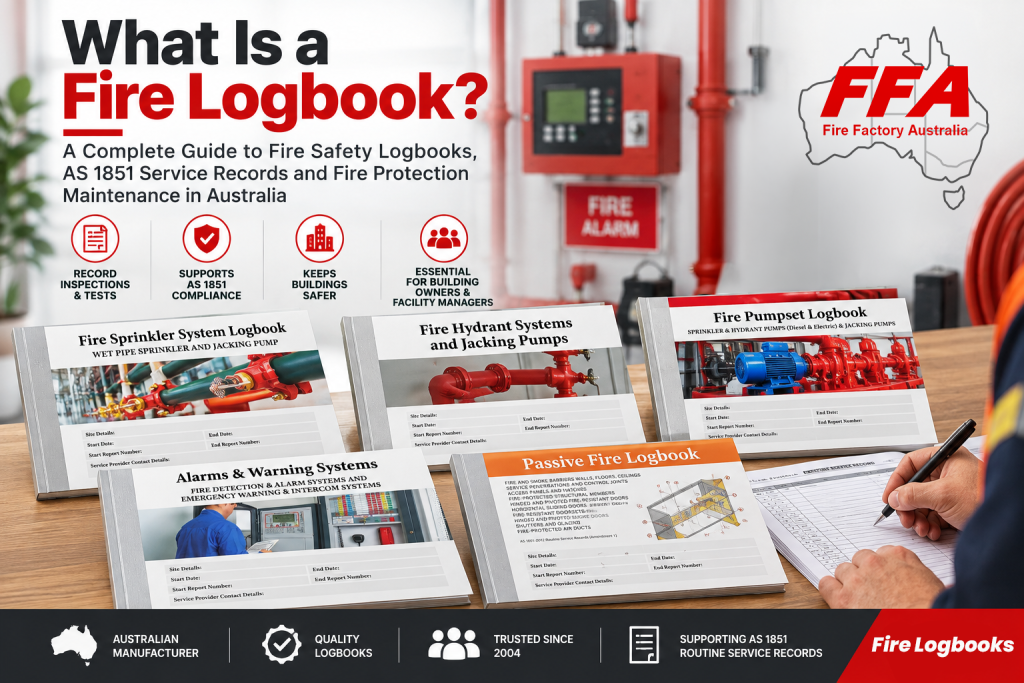
Fire Sprinkler Logbook
An automatic fire sprinkler logbook records applicable inspection, testing and routine service activities associated with sprinkler systems.
Different records may be required for:
Wet Pipe Sprinkler Systems
Dry Pipe Systems
Pre-Action Systems
Deluge Systems
Water Spray Systems
These systems are addressed under Section 2 of AS 1851—2012.
Fire Factory Australia therefore provides separate logbook formats for Wet Pipe Sprinkler & Jacking Pump Systemsand Dry-Pipe / Pre-Action / Deluge & Water Spray Systems, rather than treating every sprinkler installation as identical.
Fire Pumpset Logbook
A fire pump logbook records applicable servicing and testing of fire pumpsets under Section 3 of AS 1851—2012.
Depending on the pumpset, records can include:
- pump starting
- automatic operation
- manual operation
- suction pressure
- discharge pressure
- flow rate
- engine or motor information
- battery information
- operating time
- defects and corrective actions.
Different logbook configurations can be used for diesel fire pumps, electric fire pumps, sprinkler pumps, hydrant pumps and jacking pumps.
Fire Hydrant Logbook
A fire hydrant logbook provides routine service records for fire hydrant systems covered by Section 4 of AS 1851—2012.
Depending on the installation and service activity, records may relate to:
- hydrants
- valves
- booster assemblies
- system pressures
- flow testing
- pressure-reducing valves
- pressure-relief valves
- associated jacking pumps.
A dedicated hydrant logbook allows these records to remain together as an identifiable service history for the hydrant system.
Water Storage Tank Logbook
Fire protection water supplies can include dedicated water storage tanks.
A fire water storage tank logbook provides records associated with the applicable requirements of Section 5 of AS 1851—2012.
Records may include:
- water levels
- level indicators
- float valves
- pressure tanks
- tank condition
- corrosion
- foundations
- liners
- structural condition
- cleaning
- sludge
- defects and corrective actions.
Fire Detection & Alarm System Logbook
Fire detection and alarm systems require their own routine service records.
A Fire Detection and Alarm Systems Logbook can document applicable servicing of detection, alarm, control and associated equipment under Section 6 of AS 1851—2012.
Depending on the system, this can involve fire indicator panels, detectors, alarm functions, interfaces, control equipment and other system components.
Emergency Warning & Intercom Systems Logbook
Emergency warning and intercom systems can also require dedicated service records under the applicable Section 6 requirements.
These can be maintained in a separate Emergency Warning & Intercom Systems Logbook or, where appropriate, together with fire detection and alarm records in a combined logbook.
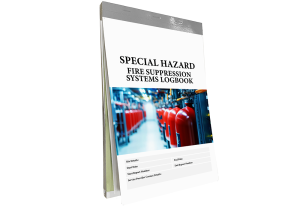
Special Hazard Fire Suppression Systems Logbook
Special hazard suppression systems are addressed under Section 7 of AS 1851—2012.
A dedicated Special Hazard Fire Suppression Systems Logbook can provide records for applicable system components such as:
- suppression agent containers
- valves
- pipework
- nozzles
- detection and control equipment
- discharge systems
- protected hazards
- measurements and test results.
Fire Hose Logbook
Delivery lay flat fire hose is addressed under Section 8 of AS 1851—2012.
Routine service records can include applicable inspection and testing information, including hose condition and relevant pressure-testing records.
Fire Hose Reel Logbook
Fire hose reels are addressed under Section 9 of AS 1851—2012.
A fire hose reel logbook provides a record of applicable routine service activities associated with the hose reel installation.
Where jacking or pressure-maintenance pumps form part of the installation, additional pump records may also be required.
Fire Extinguisher Logbook
Portable and wheeled fire extinguishers are covered by Section 10 of AS 1851—2012.
A fire extinguisher logbook can provide a structured record of applicable routine service activities for multiple extinguishers across a building or site.
Fire Factory Australia also provides a combined routine service format incorporating:
Delivery Lay Flat Fire Hose | Fire Hose Reels | Portable & Wheeled Fire Extinguishers | Fire Blankets
This can reduce the need for separate record books where these equipment categories are serviced together.
Fire Blanket Logbook
Fire blankets are addressed under Section 11 of AS 1851—2012.
A fire blanket service record provides a location for documenting applicable routine service information relating to installed fire blankets.
Passive Fire Logbook
Passive fire protection is different from active systems such as sprinklers or fire alarms.
A Passive Fire Logbook provides structured records for applicable Section 12 elements such as:
- fire and smoke barriers
- fire-rated walls, floors and ceilings
- service penetrations
- control joints
- access panels and hatches
- fire doors
- smoke doors
- fire shutters
- fire-rated glazing
- structural fire protection
- fire-protected air ducts.
Because buildings can contain large numbers of passive fire assets, asset identification and location records are particularly important.
Mechanical Services Fire & Smoke Control Logbook
Section 13 of AS 1851—2012 addresses fire and smoke control features of mechanical services.
These can include:
- fans and motors
- fire dampers
- smoke dampers
- air control dampers
- smoke exhaust systems
- smoke control systems
- fire-isolated exit pressurisation systems
- fire and smoke curtains
- automatic smoke and heat vents
- motor control centres
- power supplies
- variable frequency inverters
- other mechanical equipment required to operate in fire mode.
A dedicated Mechanical Services logbook can therefore require equipment registers, functionality records and performance measurements that would not make sense in a generic fire equipment logbook.
Are Emergency & Exit Lighting Logbooks Covered by AS 1851?
This is an important distinction.
Not every fire safety-related logbook is an AS 1851 logbook.
For example, emergency and exit lighting is not covered by AS 1851—2012. Current NSW Government guidance specifically identifies emergency exit lighting as an example of a fire safety measure outside the scope of AS 1851.
Emergency and exit lighting therefore requires maintenance and records in accordance with the requirements applicable to that system rather than being incorrectly treated as an AS 1851 fire protection system.
Fire Factory Australia supplies an Emergency and Exit Lighting Maintenance Logbook as a separate product for this reason.
Fire Logbook vs Fire Safety Schedule
A fire logbook should not be confused with a Fire Safety Schedule (FSS).
A Fire Safety Schedule identifies the fire safety measures applying to a building and the standards of performance to which those measures must be maintained.
A fire logbook, by contrast, is used to record applicable routine service, inspection and testing activities.
They serve different purposes.
In NSW, Fire Safety Schedules are also subject to specific regulatory requirements, including use of the NSW Government’s standard template when a new FSS is issued or an existing FSS is reissued in applicable circumstances.
Fire Logbook vs Fire Service Tag
A service tag or label and a fire logbook are also not necessarily interchangeable.
A service tag can provide an equipment-level indication of servicing, while the logbook provides the more detailed site service record.
A logbook can contain test results, measurements, defects, corrective actions and technician information that cannot practically be captured on a small equipment tag.
For many fire protection systems, both forms of documentation can play different roles in the overall service record.
Physical vs Digital Fire Logbooks
Electronic fire maintenance software is increasingly common, but this does not necessarily eliminate the need for physical records.
In NSW, current government guidance states that AS 1851—2012 requires a hardcopy logbook to be left on site at the completion of testing. An electronic system can be offered for recording inspection and test results, but it does not currently replace the physical logbook required on site.
This makes a professionally organised physical fire logbook particularly relevant for NSW building owners and fire protection service providers.
How Long Must Fire Logbooks Be Kept in NSW?
From 13 February 2026, NSW legislation requires applicable AS 1851 records to be kept on site for at least seven years and made available for inspection by the Fire Commissioner or relevant council.
This is one reason good record design matters.
A fire logbook is not simply being completed for the technician working on the building today. The information may need to remain understandable to building owners, regulators and future contractors years later.
Is AS 1851—2012 Mandatory in NSW?
From 13 February 2026, NSW legislation requires maintenance activities for applicable essential fire safety measures to be undertaken in accordance with AS 1851—2012 where the activity is addressed by AS 1851 and is not instead addressed by an approved Performance Solution.
NSW Government guidance states that this applies to new and existing Class 1b and Class 2 through Class 9 buildings.
The NCC classifies buildings according to their use, with classifications running from Class 1 through Class 10.
Requirements outside NSW can differ, so building owners and service providers should check the applicable legislation and requirements for their jurisdiction.
Who Is Responsible for Fire Safety Service Records?
In NSW, the building owner is responsible for ensuring applicable essential fire safety measures are maintained in accordance with the required maintenance standard.
The NSW Government advises building owners to engage suitably qualified fire contractors to perform inspection and testing work.
Depending on the building, people involved with fire logbooks may include:
- fire protection contractors
- fire service technicians
- fire safety practitioners
- specialist tradespeople
- building owners
- owners corporations
- strata committees
- facility managers
- building managers
- property managers.
A logbook provides the record. It does not replace the competency, licensing or qualification requirements applicable to the person performing the work.
Does Having a Fire Logbook Make a Building Compliant?
No.
Simply purchasing or keeping an AS 1851 fire logbook does not make a building, system or service compliant.
A logbook is a record-keeping tool.
Compliance depends on matters including:
- the fire protection system installed
- applicable legislation
- approved design requirements
- relevant Australian Standards
- required inspection and testing
- preventive maintenance
- system performance
- identified defects
- corrective actions
- competent servicing
- proper completion and retention of records.
For this reason, wording such as “designed to support routine service record keeping in accordance with the applicable requirements of AS 1851—2012” is more accurate than suggesting that the logbook itself creates compliance.
What Makes a Good Fire Logbook?
A good fire logbook should make technical service information easier to record and easier to understand later.
Important features can include:
Clear Service Frequencies
Monthly, three-monthly, six-monthly, yearly and longer-term activities should be easy to distinguish where applicable.
System-Specific Service Schedules
A fire pump technician should not have to navigate irrelevant passive fire records, and a passive fire technician should not have to work through sprinkler pump tables.
Dedicated Measurement Fields
Where the service requires actual values, the logbook should provide suitable recording areas for values such as:
Pressure | Flow | Time | Voltage | Current | Equipment ID | Asset Number
Defect & Corrective Action Records
Technicians need enough space to explain what was found and what action was taken.
Clear Site & Technician Identification
The record should make it easy to determine who performed the service, where it occurred and when it was completed.
Practical On-Site Layout
A technically complete record is less useful if the physical layout makes it unnecessarily difficult to complete during actual service work.
Why System-Specific Fire Logbooks Matter
A single generic fire logbook may appear convenient, but different fire protection systems require very different information.
Consider these examples:
A fire pump may require flow and pressure readings.
A wet pipe sprinkler system may require alarm operating times and main drain test results.
A jacking pump may require cut-in and cut-out pressures.
A water storage tank may require water level, structural and condition records.
A passive fire system may require individual asset identification.
A mechanical smoke-control system may require functionality and measurable performance information.
System-specific fire logbooks can therefore provide more relevant recording space while making each service record easier to navigate.
Fire Factory Australia Fire Safety Logbooks
Fire Factory Australia is a leading Australian manufacturer and supplier of professional fire safety logbooks.
With experience in the Australian fire protection industry since 2004, our logbook range has been developed with a focus on quality, practical on-site use, clear layouts, efficient recording and sufficient space for the information technicians need to document.
Our range includes professional service record logbooks for:
- Fire Detection & Alarm Systems
- Emergency Warning & Intercom Systems
- Combined Fire Detection, Alarm, Emergency Warning & Intercom Systems
- Wet Pipe Sprinkler & Jacking Pump Systems
- Dry-Pipe / Pre-Action / Deluge & Water Spray Systems
- Fire Pumpsets – Diesel, Electric & Jacking Pumps
- Fire Hydrant Systems & Jacking Pumps
- Hose Reels & Jacking Pumps
- Water Storage Tanks
- Special Hazard Fire Suppression Systems
- Delivery Lay Flat Fire Hose
- Fire Hose Reels
- Portable & Wheeled Fire Extinguishers
- Fire Blankets
- Passive Fire
- Mechanical Services – Fire & Smoke Control Features
- Emergency & Exit Lighting.
The existing Fire Factory Australia range already uses this system-specific approach rather than trying to put every type of fire protection record into one generic document.
Frequently Asked Questions About Fire Logbooks
What is a fire logbook?
A fire logbook is a physical service record used to document applicable inspections, tests, preventive maintenance, measurements, defects, corrective actions and other routine service information for fire protection systems and equipment.
What is an AS 1851 logbook?
An AS 1851 logbook is a service record designed to document applicable routine service activities for fire protection systems and equipment covered by AS 1851—2012.
What should be recorded in a fire logbook?
Depending on the system, records can include service dates, inspection results, Pass / Fail / N/A outcomes, test measurements, equipment identification, defects, comments, corrective actions, completed repairs, technician information and signatures.
Are all fire logbooks the same?
No. Different fire protection systems have different service schedules and record requirements. Sprinklers, fire pumps, hydrants, alarms, portable fire equipment, passive fire and mechanical smoke-control systems can therefore benefit from different logbook formats.
Is a fire extinguisher logbook the same as a fire sprinkler logbook?
No. Fire extinguishers are addressed under Section 10 of AS 1851—2012, while automatic fire sprinkler systems are addressed under Section 2. Their inspection, testing and service records are different.
Is a fire logbook required in NSW?
For applicable AS 1851 servicing in NSW, current government guidance states that a hardcopy logbook must be left on site after testing.
Can fire logbooks be digital?
Electronic recording systems can be used, but current NSW Government guidance states that they do not replace the required physical on-site logbook for applicable AS 1851 records.
How long must AS 1851 fire service records be retained in NSW?
NSW legislation requires the applicable records to be retained on site for at least seven years.
Does AS 1851 cover emergency and exit lighting?
No. Emergency and exit lighting is not covered by AS 1851—2012 and needs to be maintained and recorded according to the requirements applicable to that system.
Does buying an AS 1851 logbook make a system compliant?
No. A logbook supports record keeping. Compliance depends on the actual system, servicing, inspection and testing performed, applicable requirements, competent personnel, system performance and other regulatory obligations.
Where can I buy professional fire safety logbooks in Australia?
Fire Factory Australia supplies a comprehensive range of professional fire safety service logbooks for different fire protection systems and equipment throughout Australia.
Fire Logbooks for Professional Fire Protection Service Records
A fire logbook is more than a checklist. It is an ongoing record of the inspection, testing, maintenance and condition of a building’s fire protection systems.
The right logbook should make it easier to determine:
What was serviced?
When was it serviced?
What was tested?
What were the results?
Was a defect identified?
What corrective action was recorded?
Who completed the service?
For fire protection professionals searching for a fire logbook, AS 1851 logbook, fire safety logbook, fire service logbook, fire maintenance logbook, fire equipment logbook or routine service record book, Fire Factory Australia provides a comprehensive range of purpose-designed physical logbooks for fire protection systems and equipment.
Designed for professional fire protection service records. Built for practical on-site use.
Official References
-
- NSW Government – Building Fire Safety Requirements under AS 1851—2012
- NSW Government – Responsibilities of Building Owners under AS 1851—2012
- NSW Legislation – Environmental Planning and Assessment (Development Certification and Fire Safety) Regulation 2021
- National Construction Code – Building Classifications
- Standards Australia
Our Fire Safety Logbooks
Fire Factory Australia is a leading Australian manufacturer and supplier of professional fire safety logbooks.Since 2004, we have supported the Australian fire protection industry with quality fire safety products and practical solutions.
Our comprehensive range of AS 1851—2012 fire safety logbooks includes dedicated service record logbooks for wet pipe sprinkler systems, dry pipe systems, pre-action systems, deluge and water spray systems, fire pumpsets, hydrants, fire detection systems, water storage tanks, passive fire, mechanical services and other fire protection systems.
Our professional fire safety logbooks are developed with a focus on quality, clear layouts, practical on-site use and efficient routine service recording, providing Australian fire protection professionals with purpose-designed records for different fire protection systems.
Explore the complete Fire Factory Australia range when searching for AS 1851 logbooks, fire safety logbooks, sprinkler logbooks, fire service logbooks, maintenance logbooks or routine service record books.
- Fire Detection and Alarm Systems
- Emergency Warning & Intercom Systems
- Fire Detection & Alarm Systems and Emergency Warning & Intercom Systems
- Automatic Fire Sprinkler System Logbook – Wet Pipe Sprinkler and Jacking Pump
- Automatic Fire Sprinkler System Logbook – Dry-Pipe / Pre-Action, Deluge & Water Spray
- Special Hazard Fire Suppression Systems
- Fire Pumpset Logbook – Sprinkler & Hydrant Pumps (Diesel & Electric) & Jacking Pumps
- Diesel Fire Pumpset Logbook – Sprinkler & Hydrant Pumps & Jacking Pumps
- Electric Fire Pumpset Logbook – Sprinkler & Hydrant Pumps & Jacking Pumps
- Hose Reel & Jacking Pumps Logbook
- Fire Hydrant Systems & Jacking Pumps Logbook
- Water Storage Tanks Logbook
- Routine Service Logbook – Delivery Lay Flat Hose, Fire Hose Reels, Fire Extinguishers & Fire Blankets
- Passive Fire Logbook
- Mechanical Services Logbook – Fire/Smoke Control Features
- Emergency and Exit Lighting Maintenance Logbook