Table of Contents
ToggleVehicle Fire Extinguisher Brackets in Australia
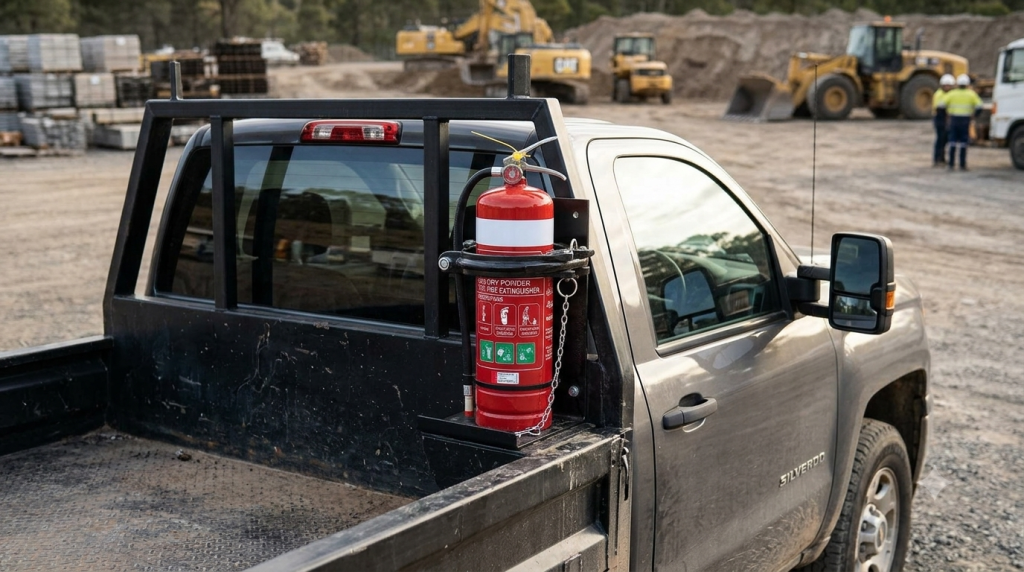
A vehicle fire extinguisher bracket secures an extinguisher during travel and allows it to be removed when needed. Choosing the right bracket starts with the fire risks, the required extinguisher rating and the exact cylinder being installed. The mounting position and the strength of the attachment also matter.
For fleet managers, fire protection contractors and vehicle fitters, the best purchase is a matched extinguisher and mounting arrangement. A bracket that appears to fit can still be unsuitable for the direction of installation, the vehicle’s vibration or the extinguisher’s total weight.
Fire Factory Australia supplies heavy duty vehicle fire extinguisher brackets, including options for 4.5 kg and 9 kg extinguishers. This guide explains Australian requirements, extinguisher selection, installation and the checks that help keep the equipment ready for use.
Why a vehicle extinguisher needs a suitable bracket
Road vibration, braking and movement can affect an extinguisher and its mount. A loose cylinder can become a hazard to occupants or other road users. Equipment should remain restrained while allowing the intended user to operate the release without searching for tools.
NT WorkSafe has documented an incident in which an extinguisher detached from a horizontally mounted bracket on a generator being transported. It struck an oncoming vehicle’s windscreen. The alert identified a mount that did not prevent horizontal movement and deteriorated rubber components. The lesson is practical: retention depends on the bracket design, its condition and how it is installed. [1]
Vehicle bracket or wall bracket
A wall hanger and a vehicle bracket serve different installation conditions. Do not assume a bracket supplied for a building wall is suitable for a moving vehicle. Check the manufacturer’s approved application, the retention mechanism and the installation instructions.
Fire Factory lists wall brackets separately from its vehicle bracket range. This makes it easier to specify the mounting equipment for the intended use. Confirm the exact extinguisher and bracket combination before ordering.
Australian vehicle fire extinguisher requirements
There is no single extinguisher size or mounting specification that should be applied to every Australian vehicle. The applicable requirements depend on the vehicle category, its operation, the load and the jurisdiction. The vehicle’s age and approval arrangements can also affect which rules apply.
The following examples show why the vehicle’s use must be established before choosing equipment.
| Vehicle or activity | Requirement or selection consideration |
|---|---|
| Private cars and recreational 4WDs | Confirm the rules and any event requirements that apply to the particular vehicle. A specification written for a bus or dangerous goods vehicle should not be treated as a universal private-car rule. |
| Work utes, vans and fleet vehicles | Check applicable transport requirements, workplace risk assessments and site or contract specifications. Assess the tools, batteries, fuels and materials carried. |
| Tow trucks | ADR 44/02 contains a specific extinguisher requirement for tow trucks. Confirm the applicable ADR and state licensing conditions. [2] |
| Caravans and motorhomes | ADR 44/02 requires extinguishers selected and located in accordance with the Australian Standard it references. [2] |
| Buses | The NHVR inspection manual sets out requirements for passenger-carrying vehicles, including extinguisher rating, number, accessibility and hose provision. Check the relevant operating category and local requirements. [3] |
| Vehicles transporting a placard load of dangerous goods | Apply the relevant dangerous goods transport law and ADG Code requirements. The load determines the extinguisher provision. In NSW, extinguishers must be secured in quick-release brackets. [4, 5] |
Motorhome mounting height
NHVR’s motorhome conversion guidance requires at least one extinguisher with a minimum 5B rating. At least one must be securely mounted in the living space, readily visible and accessible, no higher than 1.2 metres from the floor. The bracket must retain it during travel and withstand forces associated with braking or impact. [6]
This is guidance for the heavy motorhomes covered by NHVR. It should not be copied as a universal mounting-height rule for every car, truck or machine. Light-vehicle conversions also need the relevant state or territory requirements checked.
Dangerous goods require a separate assessment
NSW EPA’s guidance shows how requirements change with the load. Certain packaged placard loads require a 30B dry powder extinguisher in a specified position. Other load configurations require additional extinguishers and different ratings. Each extinguisher must be mounted securely in a quick-release bracket. A generic purchase described only as a truck fire extinguisher may therefore be insufficient. [4]
The National Transport Commission identifies ADG Code edition 7.9 as the current edition. The Code operates with each jurisdiction’s dangerous goods transport laws, so operators should confirm the requirements with the relevant regulator. [5]
Australian Standards to check
AS 2444 addresses extinguisher selection and location. AS 1851 addresses routine servicing, including portable and wheeled extinguishers in Section 10. These cover different parts of the equipment’s life. Buying a bracket does not complete the selection, installation or maintenance obligations. [3, 7]
For product supply, the ACCC explains that the Consumer Goods (Portable Non-aerosol Fire Extinguishers) Safety Standard 2021 draws on specified provisions of the AS/NZS 1841 series. Product construction and labelling requirements should be checked separately from mounting suitability. Where a law references a particular edition of a standard, that reference needs to be considered. [8]
How to choose the right extinguisher type
Identify what could burn before selecting the agent. For a vehicle, this may include trim, fuel, electrical equipment, cargo or cooking facilities. Check the fire classes and restrictions marked on the actual extinguisher.
| Fire risk | Australian classification | Selection consideration |
|---|---|---|
| Paper, timber, textiles and similar combustibles | Class A | Select an extinguisher with an appropriate A rating. |
| Petrol and other flammable liquids | Class B | Select a suitable B-rated agent and rating for the hazard. |
| Flammable gases | Class C | Check the agent’s suitability. Do not extinguish a gas flame unless the gas supply has been shut down. |
| Combustible metals | Class D | Requires specialist assessment and a suitable metal-fire agent. |
| Energised electrical equipment | Class E | Use equipment marked suitable for energised electrical risks. |
| Cooking oils and fats | Class F | Select suitable cooking-fire equipment, commonly wet chemical, with a fire blanket where appropriate. |
Fire and Rescue NSW publishes guidance connecting these fire classes with suitable extinguishing agents. [9]
ABE dry chemical powder
An appropriately rated ABE dry powder extinguisher is an option where combustible solids, flammable liquids and electrical equipment need to be considered together. CFA identifies these as applications for ABE powder and distinguishes it from BE powder. [10]
Fire Factory’s ABE dry chemical powder extinguishers include compact models and larger 4.5 kg and 9 kg options. Selection should follow the required rating, user capability and installation space. The letters ABE should not be interpreted as covering every hazard carried in a vehicle.
CO2 and cooking fire equipment
CO2 may be considered for particular electrical risks. It should not automatically replace a multipurpose extinguisher chosen for a vehicle’s wider hazards. CFA warns of asphyxiation risks when CO2 is used in enclosed spaces. Ordinary water and foam extinguishers should not be used on energised electrical equipment. Check the extinguisher label. [10]
Vehicles with cooking facilities need a separate assessment of hot oils and fats. An ordinary ABE extinguisher should not be assumed to provide Class F protection. Fire Factory also supplies CO2 extinguishers and fire blankets for applications where those products are suitable.
Electric vehicles and lithium ion batteries
A Class E marking does not establish that an extinguisher can stop thermal runaway in a lithium-ion traction battery. Fire and Rescue NSW explains that dry chemical powder and CO2 may help limit fire spread to surrounding materials but are unlikely to fully extinguish a lithium-ion battery fire. [11]
For a smoking or burning EV battery, move away and call Triple Zero (000). SafeWork NSW advises evacuation and an immediate emergency call for lithium-ion battery fires or explosions. A portable extinguisher should not encourage a driver to approach a failing battery pack. [12]
How to choose the extinguisher size
Extinguisher capacity, fire rating and total mass are different specifications. Capacity describes the quantity of agent. The rating identifies tested fire performance and suitability. Total mass includes the cylinder, valve, hose and agent, and is the load the mount must support.
Start with any mandatory rating and number of extinguishers. Then assess the hazard, access, available space and whether the intended user can safely remove and handle the selected unit.
| Capacity to consider | Practical buying consideration |
|---|---|
| 1 kg | Compact where space is limited. Confirm that the actual fire rating and hose or nozzle arrangement meet the application. |
| 1.5 kg or 2.5 kg | Compare compact options where there is room for a larger cylinder. Confirm the required rating and a compatible vehicle mount. |
| 4.5 kg | Consider where the assessed risk calls for this capacity and the vehicle has adequate mounting space. Check removal and handling. |
| 9 kg | Consider where the assessment calls for a larger unit. Allow for its greater total mass, mounting loads and handling demands. |
These are purchasing considerations, not prescribed minimum sizes for those vehicle types. The bracket should be selected after the extinguisher specification is established.
Compare fire ratings as well as kilograms
Fire Factory’s published specifications illustrate why kilograms alone are insufficient.
| Fire Factory model | Agent capacity | Published fire rating | Approximate total mass |
|---|---|---|---|
| FFA45ABE | 4.5 kg | 4A:60B:E | 7.14 kg |
| FFA45ABEHP | 4.5 kg | 4A:80B:E | 7.14 kg |
| FFA90ABE | 9 kg | 6A:80B:E | 13.71 kg |
The standard 4.5 kg model and the high-performance 4.5 kg model have different published B ratings. The 9 kg unit weighs substantially more than its 9 kg agent capacity. Check the current label and data sheet for the supplied model before finalising the installation. [13, 14, 15]
The letters in a rating identify fire suitability. For example, A concerns ordinary combustible materials, B concerns flammable liquids, and E identifies suitability for energised electrical equipment. The rating is not a guarantee of success against a particular real-world fire. [9]
For procurement, compare the 4.5 kg ABE extinguisher and 9 kg ABE extinguisher against the required performance. Ask Fire Factory about the high-performance option where relevant.
How to select a vehicle fire extinguisher bracket
Match the actual cylinder
Confirm the extinguisher model, cylinder dimensions, total height and gross mass. Also allow space for the valve, hose, handle and safety pin. A kilogram description alone does not establish that a cylinder from another range will fit.
Check that the retaining system closes correctly without distorting the cylinder or interfering with the operating components. The extinguisher must be removable in its installed position, including when the nearby seat, door or equipment is in normal use.
Check the retention and mounting direction
Look at how the bracket supports the cylinder and prevents it moving out of the holder. Confirm the approved orientation and installation method. The release should be accessible while remaining secured during normal vehicle operation.
Labels such as heavy duty, quick release or vehicle bracket describe features or intended use. For a job requiring a particular test or performance requirement, request evidence for the actual bracket, extinguisher and mounting arrangement. Do not infer a crash rating from the product name.
Choose materials for the environment
Consider rain, road grime, dust, UV exposure and cleaning chemicals. Inspect exposed steel, coatings, straps, buckles and cushioning components as part of the equipment checks. A corrosion-resistant finish still needs maintenance.
For fleets, consistency also helps. Once a suitable arrangement is confirmed, keeping the same extinguisher model, release mechanism and mounting location across comparable vehicles can make procurement and driver familiarisation easier.
Fire Factory heavy duty vehicle bracket options
Fire Factory’s range includes cannon-style brackets, silver brackets, over-centre models and a web-type option. The product should be matched to the particular extinguisher and installation.
| Model | Listed extinguisher capacity | Listed format or finish |
|---|---|---|
| HDVB45 | 4.5 kg | Cannon style with black galvanised finish |
| HDVB45G | 4.5 kg | Silver bracket |
| HDVB45OC | 4.5 kg | Over-centre mechanism |
| HDVB90 | 9 kg | Cannon style with black galvanised finish |
| HDVB90G | 9 kg | Silver bracket |
| HDVB90OC | 9 kg | Over-centre mechanism |
| HDVB94 | 4.5 kg and 9 kg | Web-type bracket with adjustable strap |
The over-centre models provide a latch-based release. HDVB94 uses an adjustable web strap and buckle. Ask Fire Factory to confirm the fit and installation requirements for the chosen extinguisher, particularly when replacing an existing bracket or ordering for a mixed fleet. [16, 17, 18, 19, 20, 21, 22]
Where to mount an extinguisher in a vehicle
Choose a location that remains accessible after the vehicle has been loaded. The user should be able to identify the equipment and remove it without moving heavy cargo or reaching into a dangerous area.
The following are practical checks for the vehicle fitter and operator:
- Keep the extinguisher clear of pedals, controls, airbags, seat movement and exits.
- Check that doors and nearby equipment do not strike the extinguisher or release catch.
- Use a mounting surface and fixings suitable for the complete load and intended operating conditions.
- Protect the equipment from foreseeable impact and environmental damage.
- Keep inspection labels and operating instructions readable.
- Confirm that any cover or cabinet allows timely access.
Under seat and no drill mounts
An under-seat position needs careful clearance and access checks. A no-drill mount is suitable only where its design is approved for the particular vehicle and load. Do not alter seat or seatbelt fasteners without the appropriate vehicle-specific instructions and competent advice.
Mounting work on an EV also needs awareness of its electrical hazards. SafeWork NSW advises workers to follow manufacturer instructions and stay within their competence when installing aftermarket equipment. [23]
Horizontal or vertical mounting
Use a horizontal arrangement only where the extinguisher and bracket instructions permit it and the restraint prevents movement in that orientation. NT WorkSafe advises that horizontally installed brackets not engineered to prevent horizontal movement should be reinstalled vertically. [1]
A cylinder that remains in place while parked may still become dislodged during transport. The installer should assess the complete mounting arrangement before putting the vehicle into service.
Installation and handover
A suitable bracket relies on suitable installation. Before drilling or fastening, the fitter should confirm the structure, identify hidden wiring or components and follow the vehicle and bracket instructions. Fixing size, grade and tightening requirements should come from the approved installation information.
Once installed, check that the cylinder seats properly, the restraint closes fully, and the hose, pin and operating handle remain unobstructed. Demonstrate removal and refitting to the intended users. Record the extinguisher model, bracket model and location so replacements can be checked against the original specification.
Where a regulated vehicle, workplace or project requires approval, include the mounting arrangement in that process. Procurement and installation records should identify what was fitted and the requirements it was selected to meet.
Inspection and servicing
Include the extinguisher and its bracket in the vehicle’s inspection routine. Look for missing equipment, blocked access, damaged straps or latches, loose fixings, corrosion and movement. Check the pin and seal, readable instructions and pressure indication where a gauge is fitted. A visual check does not replace scheduled servicing.
The NHVR manual notes that vibration can compact powder even when an extinguisher appears charged. It points to AS 1851 Section 10 for inspection and testing. Use a competent service provider to establish the applicable routine and any additional checks for the operating conditions. [3]
Six-monthly inspection is a normal part of an AS 1851 extinguisher service program, with further activities depending on the extinguisher type and schedule. FPA Australia’s consumer guidance also emphasises recorded servicing and recharge after partial discharge. Do not return a used extinguisher to service simply because agent appears to remain. [24]
For recordkeeping and equipment identification, Fire Factory supplies service tags and accessories and vehicle extinguisher location signs. A cover or sign should be selected for the installation and should keep the equipment easy to locate.
Buying for fleets and commercial projects
Compare a complete mounting arrangement when requesting prices. A cheaper bracket may be poor value if it does not fit the cylinder, needs different mounting hardware or creates a replacement problem across the fleet.
Provide the supplier with the vehicle type, operating conditions, extinguisher model and dimensions, required rating, proposed mounting position and quantity. Ask the quote to identify the bracket, extinguisher, any cover or sign, fixings where applicable, and delivery requirements.
Fire Factory can be contacted for product selection guidance and quotes for its extinguisher and bracket range. Discussing these details before ordering helps purchasers choose compatible products and identify any installation requirements that need confirmation.
Frequently asked questions
Choosing an extinguisher and bracket
What is the best fire extinguisher bracket for a car or 4WD?
Choose a vehicle-suitable bracket matched to the actual cylinder, mounting surface and permitted orientation. For rough-road use, discuss the operating conditions with the supplier. A product described as heavy duty still needs the correct installation.
Is a 1 kg extinguisher enough for a vehicle?
Capacity alone cannot answer this. Check the minimum rating, required number of extinguishers and the hazards. A compact extinguisher may suit an assessed application, while a regulated or higher-risk activity may require different equipment.
Will a 4.5 kg bracket fit every 4.5 kg extinguisher?
Do not assume it will. Cylinder dimensions, valve arrangements and total mass can vary. Confirm compatibility with the extinguisher model, including clearance for removal and operation.
Can a 9 kg extinguisher use a 4.5 kg bracket?
Only use the combination where the bracket manufacturer expressly permits it. Fire Factory lists dedicated 4.5 kg and 9 kg models, plus HDVB94 for the listed 4.5 kg and 9 kg applications. Confirm the exact fit. [16, 17, 18, 19, 20, 21, 22]
Mounting and maintenance
Can an extinguisher stay in a hot vehicle?
Check the extinguisher manufacturer’s storage and operating temperature limits and the conditions at its actual mounting position. Avoid placing it near a heat source or where impact can damage it. Have heat-affected or damaged equipment assessed before use.
Does a vehicle extinguisher need a location sign?
Check the applicable vehicle rules, standard and workplace requirements. Signage can help identify equipment in an enclosure, but the sign must remain visible and the extinguisher accessible. A sign does not compensate for an unsuitable location.
Does a green pressure gauge mean the extinguisher is ready?
The gauge is one check. It does not confirm the condition of the powder, hose, valve, bracket or service history. NHVR specifically warns that vibration-related powder compaction can occur despite an apparently charged extinguisher. [3]
When should the bracket be replaced?
Arrange assessment or replacement if the bracket is cracked, badly corroded, distorted, loose, or no longer retains the cylinder correctly. Include worn straps, buckles and cushioning components in the checks. Reassess compatibility whenever the extinguisher model changes.
Does a vehicle extinguisher expire after five years?
Do not treat five years as a universal expiry date. Fire Factory’s listed FFA45ABE and FFA90ABE specifications identify a five-yearly cylinder pressure-test requirement. The service provider should check the applicable schedule, cylinder history and condition to determine whether testing, recharge or replacement is due. [13, 15]
Electric vehicle fires
Can a portable extinguisher put out an EV battery fire?
A standard vehicle extinguisher should not be relied on to stop a traction battery fire. Move away, keep others clear and call Triple Zero (000). Fire and Rescue NSW warns that lithium-ion batteries can reignite and that portable powder or CO2 units may not fully extinguish them. [11]
Prices and ordering
How much does a heavy duty vehicle bracket cost?
Cost depends on the model, quantity and any associated equipment. Fire Factory’s bracket listings direct customers to log in to view prices. Contact the team for a quote based on the required extinguisher and mounting arrangement. [16, 17, 18, 19, 20, 21, 22]
Get help choosing the right extinguisher and bracket
For a new vehicle fit-out, bracket replacement or fleet order, contact Fire Factory Australia for product selection guidance. Send the extinguisher model, cylinder dimensions, vehicle details and proposed mounting position so the team can discuss suitable options from the range.
Browse the heavy duty vehicle extinguisher brackets and ABE extinguisher range, or call 1300 367 744 to discuss the equipment needed for the application.
Sources
- NT WorkSafe — Transportation risk of horizontally mounted fire extinguishers on plant and equipment.
- Federal Register of Legislation — ADR 44/02 Specific Purpose Vehicle Requirements, clauses 44.4.5 and 44.8.3.
- NHVR — National Heavy Vehicle Inspection Manual V3.2, Section 13, Buses.
- NSW EPA — Safety equipment for dangerous goods transport.
- National Transport Commission — Australian Dangerous Goods Code.
- NHVR — VSG5 Converting a vehicle into a motorhome.
- Building Commission NSW — Good practice guide for implementing AS 1851 2012.
- ACCC Product Safety — Portable non-aerosol fire extinguishers mandatory standard.
- Fire and Rescue NSW — Portable fire extinguisher information for business.
- CFA — Fire extinguishers.
- Fire and Rescue NSW — What should I do if my battery is smoking or on fire.
- SafeWork NSW — Lithium-ion batteries.
- Fire Factory — FFA45ABE specifications.
- Fire Factory — Catalogue file published under March 2026, FFA45ABEHP specification.
- Fire Factory — FFA90ABE specifications.
- Fire Factory — HDVB45.
- Fire Factory — HDVB45G.
- Fire Factory — HDVB45OC.
- Fire Factory — HDVB90.
- Fire Factory — HDVB90G.
- Fire Factory — HDVB90OC.
- Fire Factory — HDVB94.
- SafeWork NSW — Electric vehicles.
- FPA Australia — Servicing Fire Extinguishers A Guide for Consumers.