Table of Contents
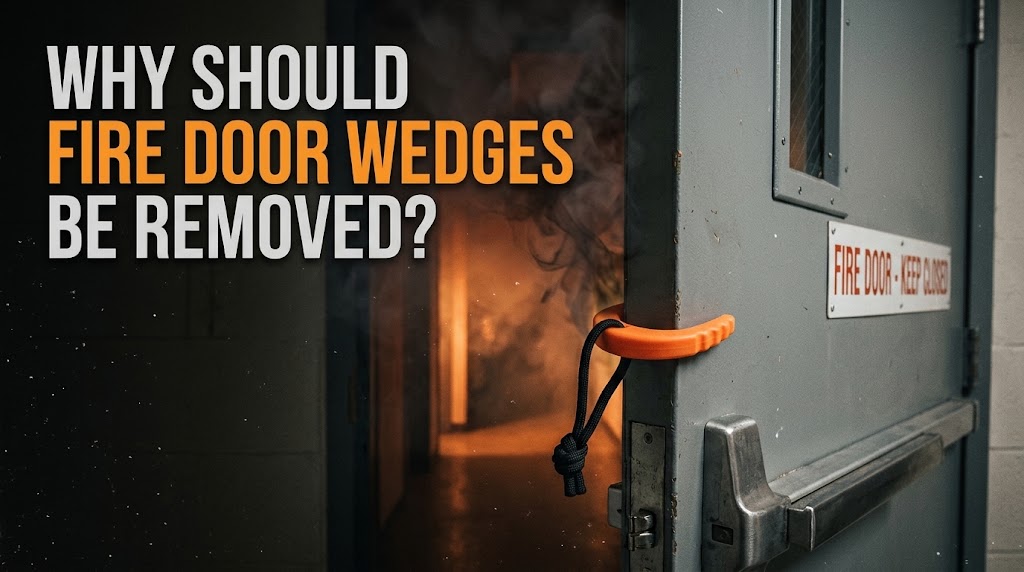
ToggleWhy Should Fire Door Wedges Be Removed?
Quick Answer: Fire door wedges should be removed because they can prevent fire-resistant doors from closing and performing their intended safety function. A wedged-open fire door may allow fire and smoke to spread between building areas. Where a fire door needs to remain open during normal use, a suitable automatic hold-open system may be an alternative, provided it is compatible with the doorset and meets the applicable requirements.
Fire doors are an important part of fire protection in Australian commercial buildings. They help maintain fire-resistant compartments and protect designated escape routes by limiting the spread of fire and smoke.
However, even a correctly installed fire door may not perform its intended function if it is held open with a wedge, doorstop or another unauthorised object.
In busy commercial environments, staff may use wedges to make it easier to move equipment, receive deliveries or access storage areas. Although convenient, this practice can interfere with the building’s fire safety arrangements.
For fire protection contractors, facility managers and maintenance teams, understanding the risks of fire door wedgesis essential for maintaining effective fire protection.
1. Why Are Fire Door Wedges Dangerous?
A fire-resistant doorset is designed to provide a specified level of fire resistance when installed and operated in accordance with its approved configuration.
Many fire doors are required to be self-closing or automatic-closing, depending on the building and the applicable requirements.
When a wedge prevents the door from closing, it can compromise the intended protection of the opening.
Fire and Smoke Can Spread Through the Opening
An open fire door may allow smoke, flames and hot gases to move between areas that are intended to be separated.
This can affect the protection provided by fire-resistant compartments and designated escape routes.
The Door Cannot Close Automatically
A wedge can prevent a self-closing door from returning to its closed position.
Even if the door has a correctly functioning closer, the closer cannot perform its intended function while the door is physically obstructed.
Fire Safety Systems May Not Perform as Intended
A building’s fire safety strategy may rely on certain doors closing during a fire.
An unauthorised wedge can interfere with that arrangement, even when the door and its hardware are otherwise in good condition.
A fire door held open by an ordinary wedge should not be considered equivalent to an approved automatic hold-open arrangement.
2. Why Do People Wedge Fire Doors Open?
Fire door wedging is often caused by everyday operational needs rather than deliberate misuse.
Common examples include:
- Staff moving stock between storage areas and retail floors.
- Frequent movement of equipment through corridors.
- Deliveries entering warehouses and loading areas.
- Workers requiring repeated access to plant rooms.
- Doors that are difficult to open or close.
- Ventilation or comfort concerns.
- Accessibility difficulties caused by heavy doors.
These situations may explain why wedges are used, but they do not establish that wedging the door is acceptable.
If a fire door is repeatedly held open, the building manager should investigate the underlying problem and consider a suitable solution.
3. Fire Door Wedges vs Magnetic Door Holders
An ordinary door wedge and an electromagnetic door holder perform different functions.
A wedge physically prevents a door from closing and does not provide an automatic fire-related release function.
An electromagnetic door holder, when installed as part of a suitable automatic hold-open arrangement, can keep a door open during normal operation and release it when the required conditions occur.
Key Differences
| Feature | Ordinary Door Wedge | Electromagnetic Door Holder |
|---|---|---|
| Holds a door open | Yes | Yes |
| Automatic release function | No | Can release when correctly integrated and controlled |
| Release on loss of power | No | Common fail-safe designs release when power is removed |
| Fire alarm integration | No | May be required, depending on the approved arrangement |
| Suitable for fire doors | Not an acceptable substitute for required closing operation | May be suitable with appropriate system and doorset evidence |
| Installation requirements | No fire-related release system | Requires compatible equipment, installation and testing |
Important: An electromagnetic door holder is not automatically suitable for every fire-resistant doorset.
The complete arrangement, including the holder, release controls, power supply, closer and door hardware, must be assessed against the applicable requirements.
4. How Do Electromagnetic Door Holders Work?
An electromagnetic door holder typically uses an electrically powered magnet to hold a door in its open position.
A compatible armature plate is attached to the door and makes contact with the magnet.
In a common fail-safe arrangement, the magnet releases the door when electrical power to the holder is removed.
The door closer can then return the door to its closed position.
Depending on the approved system design, release may occur through:
- A relevant fire detection or alarm signal.
- A local smoke detection or release arrangement.
- A manual release control.
- Loss of electrical power.
- Another specified release condition.
The required release method depends on the building’s fire safety design and the applicable requirements.
Why Door Closers Still Matter
A magnetic door holder does not replace the function of a door closer.
After release, the closer must be capable of returning the door to the required closed position, with appropriate latching where required.
If the closer is damaged, incorrectly adjusted or incompatible with the doorset, releasing the magnet may not result in correct door closure.
5. Australian Standards and Fire Door Requirements
Several Australian Standards and building requirements may be relevant to fire door operation and automatic hold-open arrangements.
AS 1905.1 – Fire-Resistant Doorsets
AS 1905.1 addresses requirements for fire-resistant doorsets.
The compatibility of door hardware, including closers and hold-open arrangements, should be considered as part of the complete doorset.
AS 1851 – Routine Service of Fire Protection Systems and Equipment
AS 1851—2012, Section 12, addresses routine servicing of passive fire and smoke systems, including relevant fire-resistant doorsets.
Routine servicing may include checking whether doors are obstructed, whether closing hardware operates correctly and whether relevant defects are present.
Other applicable service requirements may also cover the fire detection or control equipment associated with an automatic hold-open system.
AS 1670.1 – Fire Detection and Alarm Systems
AS 1670.1 may be relevant where an automatic door release arrangement is connected to a fire detection and alarm system.
The correct release interface and operating sequence must reflect the approved system design.
National Construction Code (NCC)
The NCC includes requirements for fire-resistant doors and relevant self-closing or automatic-closing arrangements.
The applicable provisions depend on the building classification, location of the door, adopted NCC edition and relevant state or territory variations.
Contractors should verify the requirements for the specific installation rather than assuming the same arrangement is acceptable for every fire door.
6. What Should You Do If You Find a Fire Door Wedged Open?
If a fire door is found held open by an ordinary wedge or unauthorised object, the issue should be addressed promptly.
Step 1: Remove the Obstruction
Where safe and appropriate, remove the wedge or object preventing the door from closing.
Do not interfere with an installed automatic hold-open system without understanding its intended operation.
Step 2: Check Door Closing Performance
Observe whether the door closes fully under its own closing mechanism.
Check that the door is not binding against the frame, floor or other hardware.
Step 3: Check Latching
Where the doorset is required to latch, confirm that the latch engages correctly.
A door that reaches the frame but does not latch may still have an operational defect.
Step 4: Identify Hardware Problems
Check for obvious issues involving:
- Door closers.
- Hinges and pivots.
- Latches and locking hardware.
- Door alignment.
- Damaged frames or seals.
- Objects obstructing the closing path.
Step 5: Report and Record Defects
If the door does not operate correctly, report the defect and arrange assessment by an appropriately competent person.
Record the location, condition, identified issue and corrective action in the relevant maintenance documentation.
A defective fire door should not be treated as satisfactory simply because the wedge has been removed.
7. Safer Alternatives to Fire Door Wedges
Where a fire door needs to remain open for operational reasons, the building manager should consider whether a suitable solution is available.
| Option | Purpose | Important Consideration |
|---|---|---|
| Electromagnetic door holder | Holds a door open and releases it under specified conditions | Must form part of a suitable automatic release arrangement |
| Compatible door closer | Returns the door to its closed position | Must suit the doorset and required closing performance |
| Manual release control | Allows release of a compatible electromagnetic holder | Must suit the system design and intended function |
| Door hardware adjustment or repair | Addresses difficult operation or closing defects | Must preserve the doorset’s required performance |
| Operational changes | Reduces the need to hold the door open | Must not compromise fire safety or access requirements |
Not every option is appropriate for every building.
Changes to fire-resistant doorsets and their associated systems should be assessed against the applicable requirements before installation.
8. Fire Door Inspection and Maintenance Records
Regular inspection and maintenance help identify fire doors that are obstructed, damaged or unable to close correctly.
Common inspection issues include:
- Doors held open by wedges or other objects.
- Damaged or missing door closers.
- Incorrectly adjusted closing mechanisms.
- Loose hinges or damaged latches.
- Obstructions around the door opening.
- Damaged or missing fire and smoke seals.
- Unauthorised modifications to door hardware.
- Automatic hold-open devices that do not release as required.
Maintenance records should identify the door location, observed condition, inspection results, defects and corrective actions.
Passive Fire Logbooks
Fire Factory Australia’s passive fire maintenance record products are intended to support structured documentation of routine inspections and maintenance activities.
A Passive Fire Logbook can help contractors record door condition, defects, repairs and follow-up actions.
However, a logbook does not replace competent inspection or establish compliance by itself.
9. Magnetic Door Holders from Fire Factory Australia
Fire Factory Australia supplies fire protection products and selected door hardware for Australian fire protection contractors, installers and facility maintenance businesses.
Our product range includes magnetic door holders and related accessories.
MDH400/15 Magnetic Door Holder
The MDH400/15 Magnetic Door Holder is listed in the Fire Factory Australia product range.
It is a magnetic hold-open device intended for use in a compatible installation arrangement.
Before purchasing, customers should verify the product specifications, operating voltage, mounting requirements and suitability for the proposed system.
MDHREM Remote Door Release Plate
The MDHREM Remote Door Release Plate is a related accessory for compatible magnetic door holder systems.
The release control must be selected and installed according to the relevant product documentation and system requirements.
Choosing the Correct Equipment
Before ordering magnetic door holders or related hardware, contractors should confirm:
- Exact product model and specifications.
- Required holding force.
- Operating voltage and power requirements.
- Mounting location and dimensions.
- Compatible release controls.
- Door closer and doorset compatibility.
- Available supporting documentation.
- Current product availability.
A magnetic door holder’s product specifications do not independently confirm that a complete installation complies with the NCC or relevant Australian Standards.
For product information and availability, contact Fire Factory Australia.
Frequently Asked Questions
Can a Fire Door Be Left Open with a Wedge?
A fire door required to close automatically should not be held open with an ordinary wedge.
The wedge can prevent the door from performing its intended fire safety function.
Are Magnetic Door Holders Allowed on Fire Doors?
They may be permitted when installed as part of a suitable automatic hold-open arrangement supported by the relevant doorset and system documentation.
The correct arrangement depends on the specific door and building requirements.
Does a Magnetic Door Holder Need to Connect to a Fire Alarm System?
Not every installation uses the same release arrangement.
The required connection and release method depend on the approved building design and applicable requirements.
What Happens to a Magnetic Door Holder During a Power Failure?
Many electromagnetic door holders use a fail-safe design that releases the door when power is removed.
However, the actual behaviour must be verified for the specific product and system.
Can a Magnetic Door Holder Replace a Door Closer?
No. A magnetic door holder and a door closer perform different functions.
The holder keeps the door open when permitted, while the closer returns it to the closed position after release.
What Should Be Done If Staff Keep Wedging a Fire Door Open?
The building manager should identify why the door is repeatedly wedged.
Possible causes include heavy door operation, frequent deliveries, access difficulties or inadequate operational arrangements.
Any proposed hardware change should be assessed for suitability before installation.
How Often Should Fire Doors Be Inspected?
Inspection and maintenance should follow the applicable requirements, including relevant provisions of AS 1851 and any additional jurisdictional or building-specific obligations.
The required frequency should be confirmed for the particular doorset and installation.
Conclusion
Fire door wedges may appear convenient, but they can prevent fire-resistant doors from performing their intended safety function.
Removing unauthorised wedges, maintaining door closers and checking the condition of fire door hardware are important parts of effective building fire safety.
Where a fire door needs to remain open during normal operation, a suitable automatic hold-open system may provide an alternative, provided it is compatible with the doorset and meets the applicable requirements.
For magnetic door holders, release accessories and other fire protection products, explore Fire Factory Australia or contact our team for product specifications and availability.