Table of Contents
ToggleWhat Is a Yearly Fire-System Condition Report?
Quick Answer: A yearly fire condition report documents the assessed state of fire systems and key components at scheduled intervals. It identifies faults, wear, missing parts, and compliance risks, while supporting maintenance records for owners, insurers, and auditors. The report differs from routine service entries and statutory annual statements.
What a Yearly Fire Condition Report Documents
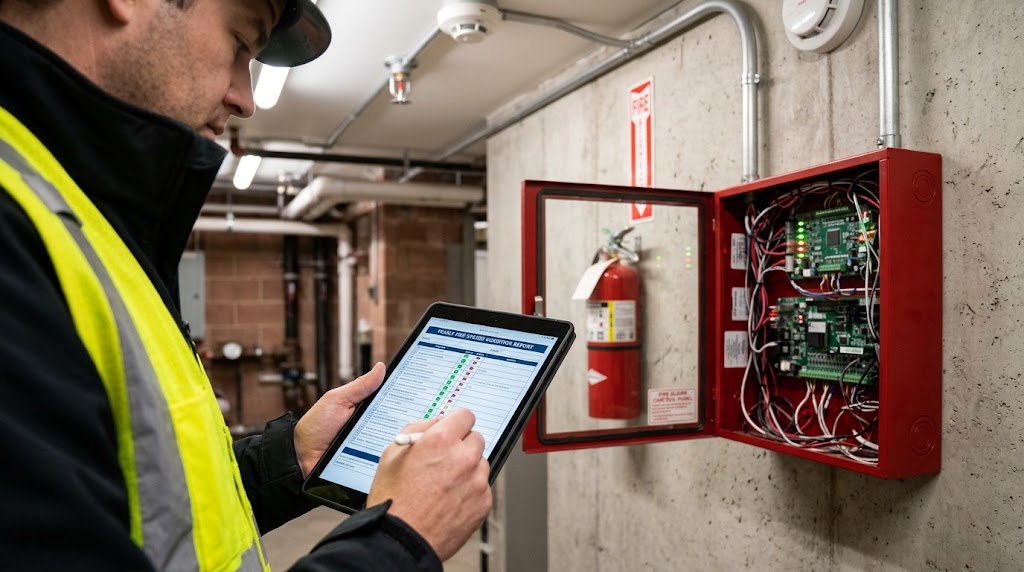
A condition report records the condition of fire protection systems and associated equipment at a scheduled interval. It does not only list work completed. It records whether components are serviceable, degraded, damaged, missing, or inaccessible.
Typical items include:
- Detection devices, call points, sounders, and control equipment where included in the scope.
- Panel status, power supplies, battery condition, fault indications, and monitoring connections.
- Suppression components, such as nozzles, valves, hydrants, extinguishers, or specialist equipment.
- Water supply components, pressure indicators, valve lockers, and access arrangements.
- Signage, manuals, keys, equipment schedules, and maintenance documentation.
The report should state what was inspected, what was not inspected, and why. Where access was limited or equipment was out of service, the report should say so plainly.
How an AS 1851 Condition Report Differs From Routine Service Entries
Routine service entries record maintenance activity. They show what was tested, what parts were changed, what faults were cleared, and what next service date applies. A condition report answers a different question: what is the state of the system at the time of assessment?
| Document type | Main purpose | Common content |
|---|---|---|
| Yearly fire condition report | Record system and component condition at a scheduled interval | Findings, faults, wear, missing items, access issues, risk comments, and recommended actions |
| Routine service entry | Record maintenance work completed | Tasks performed, parts replaced, tests passed or failed, and next due date |
| Statutory annual statement | Support a legal, insurance, or contractual declaration where required | Statement details, responsible person, scope, and mandatory declarations required by the relevant authority |
These documents often sit together. A service entry may show that a detector was cleaned or a valve was exercised. The condition report may still record that the detector is degraded, the valve locker is corroded, or replacement planning is needed.
Because the boundary between service, condition, and statutory reporting can vary by site and jurisdiction, teams should check the current applicable standard and local requirements before finalising wording. The relevant standard can be confirmed through the official Standards catalogue search, find the current Australian Standard.
Practical Inspection and Reporting Points for Fire Systems
A useful condition assessment follows a consistent sequence. The inspector confirms the system scope, identifies the equipment present, checks access, performs the applicable condition checks, and records findings in a way the owner or maintenance team can act on.
Common inspection points include:
- Visual condition of equipment, including damage, corrosion, staining, impact marks, or heat damage.
- Access to panels, valves, extinguishers, hydrants, detectors, and control devices.
- Panel status, fault lights, power supply, battery condition, and communication to monitoring.
- Component labelling, device identification, zone mapping, and maintenance documentation.
- Physical security, such as locked valve lockers, sealed panels, and tamper evident covers.
Common failure points in commercial facilities are often operational. A detector may be serviceable but obstructed by a partition change. A valve may be locked, but the key is unavailable. A panel may be in operation, but the manual is missing. These findings matter because they affect how quickly the system can respond during an incident.
When reporting findings, the writer should separate confirmed faults from observations. A panel fault is a confirmed finding. Dust on a detector lens is an observation that may require cleaning or further assessment. A missing key is an operational risk. This distinction helps owners prioritise repairs without overestimating immediate safety risk.
Commercial Facility and Compliance Considerations
Commercial facilities add complexity because fire protection systems are rarely isolated. Detection, alarms, suppression, emergency lighting, access control, and building management systems may interact. A condition report should reflect the actual operating environment, not just a checklist of components.
Key commercial considerations include:
- Occupancy type and operating hours, especially for retail, food service, healthcare, office, and industrial sites.
- Access arrangements for after hours, tenancy changes, and shared building services.
- Asset tracking for replacement parts, end of life equipment, and manufacturer support.
- Insurance and audit requirements that may request evidence of periodic condition assessment.
- Coordination with electrical, mechanical, and building maintenance teams to avoid conflicting records.
Compliance language should be precise. A report can state that a condition finding was recorded, that a component was not serviceable, or that a repair recommendation was made. It should not overstate legal effect unless the writer is authorised to make that determination. Where a statutory annual statement applies, the responsible person should confirm the required form, content, and submission channel.
Purchasing Considerations When a Condition Report Identifies Work
A condition report is often the trigger for procurement. When a finding recommends replacement or repair, the purchasing decision should be based on compatibility and availability, not only price. The maintenance team should confirm manufacturer, model, part number, voltage, connector type, mounting requirements, and system specific constraints before ordering.
For B2B fire protection and electrical maintenance teams, practical purchasing questions include:
- Does the replacement match the existing system architecture and device type?
- Is the part suitable for the installed environment, including humidity, dust, temperature, and location?
- Are there storage or shelf life requirements for batteries, chemicals, seals, or specialist components?
- Can the part be installed without disrupting a larger system or requiring a specialist contractor?
- Can the supplier provide documentation, traceability, and consistent B2B supply terms?
FireFactory supports Australian B2B buyers with fire protection products for maintenance, replacement, and facility readiness. Its product range can help contractors and building teams source components, signage, and related fire protection items when a condition report identifies work. Teams should verify that the selected product is appropriate for the specific system and site requirements before installation.
Frequently Asked Questions
What is the difference between a yearly fire condition report and an annual service report?
A yearly fire condition report focuses on the state of fire systems and components at a scheduled interval. An annual service report typically records the maintenance tasks completed during the service visit, such as tests, cleaning, and parts replacement.
Does an AS 1851 condition report mean a legal inspection is complete?
Not automatically. Where used, an AS 1851 condition report records a technical condition assessment. Its legal effect depends on the standard edition, local requirements, and the report writer’s authority. Always verify the applicable standard and any statutory obligations.
Who should prepare a yearly fire condition report?
The report should be prepared by a person or company competent to assess the relevant fire protection system. For complex or regulated systems, a qualified fire safety contractor, electrical technician, or specialist assessor may be required depending on scope and jurisdiction.
What should a condition report say when a component is damaged?
It should identify the component, location, observed damage, system impact, and recommended action. If the damage creates an immediate safety risk, the report should state that clearly and recommend urgent isolation, repair, or temporary controls.
How often should a fire system condition report be completed?
Frequency should follow the applicable standard, maintenance plan, insurance requirements, or statutory rules. In many commercial programs, yearly condition reporting is used, but the correct interval must be confirmed for the specific system and site.
Conclusion
A yearly fire condition report gives building owners, fire companies, and maintenance teams a practical record of what is working, what is degraded, and what needs attention. It supports safer facilities, clearer procurement decisions, and stronger evidence for audits and insurance discussions. The key is to keep the report factual, site specific, and aligned with the current applicable requirements.
FireFactory supplies B2B fire protection products for Australian contractors, electrical businesses, retail operators, and facility teams. If your condition report identifies replacement parts, signage, or maintenance components, contact the FireFactory team for product guidance and B2B supply options.