Table of Contents
TogglePassive Fire Product Substitution: What Evidence Is Needed?
Quick Answer: Before substituting a passive fire product, contractors should verify that the proposed alternative is suitable for the specified fire protection system. This includes checking the relevant fire test reports, assessment reports, substrate, service configuration, Fire Resistance Level (FRL), installation requirements and project approval process. Two products with the same advertised fire rating are not automatically interchangeable.
Passive fire protection systems help maintain fire-resistant barriers in buildings by limiting the spread of fire and smoke.
These systems may include firestop sealants, fire collars, intumescent seals, fire-resistant doorsets and other components designed to protect openings and penetrations.
During construction, maintenance or renovation, contractors may need to replace a specified passive fire product because of availability, pricing, design changes or installation requirements.
However, passive fire product substitution is not simply a matter of choosing another product with a similar description or fire rating.
The proposed replacement must be supported by suitable technical evidence and accepted through the applicable project process.
This guide explains what evidence should be checked before substituting passive fire protection products in Australian buildings.
1. What Is Passive Fire Product Substitution?
Passive fire product substitution means replacing a product or system specified in the project documentation with an alternative.
Examples include:
- Replacing one firestop sealant with another brand.
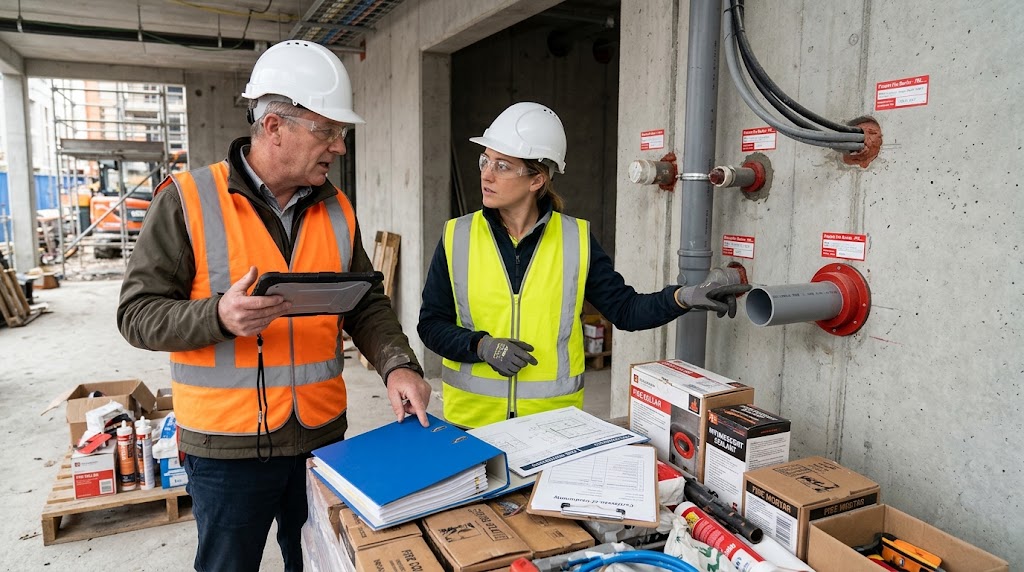
- Using a different fire collar for a pipe penetration.
- Changing an intumescent seal within a fire-resistant doorset.
- Replacing a specified firestop board or penetration sealing system.
- Selecting an alternative fire protection product because the original is unavailable.
These changes may appear minor, but passive fire products are often tested as part of complete systems rather than as independent components.
For example, a firestop sealant may have been tested with a particular wall construction, penetration size, service type and installation depth.
Changing the sealant without checking the supporting evidence may affect the documented performance of the complete system.
A product substitution should be evaluated against the original specification and the actual installation conditions.
2. Why the Same Fire Rating Does Not Mean Two Products Are Equivalent
A common mistake is assuming that two passive fire products are interchangeable because they advertise the same Fire Resistance Level (FRL).
In Australia, an FRL expresses fire resistance performance using three criteria, where applicable:
- Structural adequacy.
- Integrity.
- Insulation.
An FRL may be expressed as -/120/120, indicating that structural adequacy is not applicable to that element and that the specified integrity and insulation periods are 120 minutes.
However, this rating relates to a particular tested or assessed construction or system.
It should not automatically be treated as a universal rating for an individual sealant, collar or other component.
Example: Two Firestop Sealants with the Same FRL
Consider two firestop sealants advertised for systems achieving FRL -/120/120.
Product A may have supporting evidence for a specific service penetration through a concrete wall.
Product B may have supporting evidence for a different penetration arrangement in a plasterboard wall.
Although both systems may achieve the same advertised FRL, this does not establish that Product B can replace Product A in the original installation.
The contractor must compare the relevant test or assessment evidence, including:
- Wall or floor construction.
- Substrate thickness.
- Service type and dimensions.
- Opening and annular gap dimensions.
- Sealant depth and backing material.
- Installation method.
- Required fire resistance performance.
The replacement is suitable only where the supporting evidence covers the intended application and the applicable project requirements are satisfied.
3. What Evidence Is Needed Before Substituting a Passive Fire Product?
Before approving or installing an alternative product, the project team should compare the proposed system against the original specification.
| Evidence Required | What to Check | Why It Matters |
|---|---|---|
| Original specification | Specified product, system, drawings and performance requirements | Establishes what the replacement must satisfy |
| Product identification | Manufacturer, exact model and product version | Prevents reliance on evidence for a different product |
| Fire test evidence | Relevant test report and tested configuration | Establishes the performance demonstrated by testing |
| Assessment evidence | Applicable assessment report, scope and limitations | May support specified variations from tested configurations |
| Substrate compatibility | Wall or floor type, thickness and construction | Different substrates can affect fire resistance |
| Service configuration | Pipe or cable type, diameter, quantity and arrangement | Penetration systems are often service-specific |
| Installation dimensions | Opening size, gap width, seal depth and fixing requirements | Installation details can affect system performance |
| Fire resistance requirements | Required FRL and other applicable performance criteria | Confirms the system addresses the specified performance |
| Project acceptance | Specification requirements, relevant approval process and responsible decision-maker | Establishes whether the substitution can be accepted for the project |
If the proposed replacement is not covered by suitable evidence, it should not be assumed equivalent.
Additional technical assessment or a different product may be required.
4. Fire Test Reports vs Assessment Reports
Understanding the difference between a fire test report and an assessment report is important when evaluating alternative passive fire products.
Fire Test Report
A fire test report documents the results of a fire resistance test performed on a particular specimen or system.
It may identify:
- Tested materials and components.
- Substrate construction.
- Service penetration details.
- Installation dimensions.
- Test method.
- Observed performance.
- Achieved fire resistance classification.
A fire test report provides evidence of the tested configuration.
However, it does not automatically establish performance for every variation of that system.
Assessment Report
An assessment report may evaluate whether a specified variation or configuration can achieve a particular fire resistance performance based on relevant test evidence and technical assessment.
For example, an assessment may address certain variations in dimensions, construction or installation arrangements.
However, the assessment must be appropriate for the proposed application and satisfy the relevant evidence and acceptance requirements.
An assessment report should not be treated as unrestricted permission to modify a passive fire system.
Contractors should check its scope, limitations, referenced evidence and applicability to the project.
5. Australian Standards and NCC Requirements
Several Australian Standards and National Construction Code provisions may be relevant to passive fire product substitution.
The applicable requirements depend on the product, system and building.
AS 1530.4 – Fire Resistance Testing
AS 1530.4 provides methods for fire resistance testing of building elements.
Test evidence prepared using the relevant method can support assessment of specified fire-resistant constructions and systems.
The test configuration and any permitted variations must be checked before relying on the evidence for a replacement product.
AS 4072.1 – Protection of Openings
AS 4072.1 addresses service penetrations and control joints in fire-resistant separating elements.
It is particularly relevant when evaluating firestop sealants, fire collars and other penetration sealing systems.
The proposed system must be considered against the applicable requirements and the configuration covered by its supporting evidence.
AS 1905.1 – Fire-Resistant Doorsets
AS 1905.1 addresses fire-resistant doorsets.
Replacing an intumescent door seal or another doorset component requires consideration of the complete door assembly.
A replacement component should not be assumed suitable simply because it has similar dimensions or an equivalent product description.
National Construction Code (NCC)
The NCC establishes requirements for demonstrating compliance with relevant building performance requirements.
Depending on the application, evidence of suitability and the NCC assessment methods may be relevant to evaluating the proposed alternative.
The project team should identify the applicable NCC edition, relevant state or territory variations and the correct compliance pathway.
For further information, refer to the Australian Building Codes Board guidance on NCC Assessment Methods.
Important: A test report, assessment report or product certificate must be considered within its stated scope. No single document automatically establishes that every installation or substitution complies with the NCC.
6. What Should Contractors Check for Firestop Sealant Substitution?
Firestop sealants are commonly used to protect specified joints and service penetrations in fire-resistant building elements.
When replacing a specified sealant, contractors should verify:
- The required fire resistance performance.
- The wall or floor construction.
- The type and dimensions of the penetration or joint.
- The service materials and configuration.
- The required sealant depth and backing material.
- The permitted movement or joint conditions, where relevant.
- The installation instructions.
- The applicable fire test or assessment evidence.
A sealant suitable for one penetration arrangement may not be suitable for another.
Similarly, a product tested for a particular joint configuration should not automatically be used for a different application.
The correct selection depends on the complete system and the available supporting evidence.
7. What Should Contractors Check When Replacing Fire Collars?
Fire collars are commonly used as part of tested systems for certain combustible pipe penetrations.
Some systems may also cover particular conduit or service configurations, depending on the available evidence.
When substituting a fire collar, contractors should check:
- Pipe or conduit material.
- Outside diameter and wall thickness.
- Wall or floor construction.
- Required FRL.
- Collar type and dimensions.
- Mounting position.
- Fixing type and quantity.
- Required clearance and penetration sealing details.
- Relevant fire test or assessment evidence.
A collar tested for one type of plastic pipe should not automatically be considered suitable for another pipe material or electrical conduit.
The proposed replacement must be supported by evidence covering the actual installation.
8. Common Passive Fire Product Substitution Mistakes
Selecting Products Based Only on FRL
Matching advertised fire resistance ratings does not prove that two systems are interchangeable.
Ignoring Substrate Differences
A system tested in concrete may not automatically be suitable for plasterboard, masonry or another construction.
Using Evidence for a Different Product Model
A manufacturer’s test evidence may apply only to specific products and configurations.
Changing Installation Dimensions
Different seal depths, opening sizes, backing materials or fixing arrangements can affect system performance.
Relying Only on a Supplier’s Equivalence Statement
A supplier may identify a possible alternative, but the relevant project requirements and supporting evidence must still be checked.
Installing Before Obtaining Acceptance
A technically plausible alternative may still require review and acceptance under the project’s specification or approval process.
Failing to Update Project Records
Changes should be reflected in relevant installation records, product schedules and as-built documentation.
9. Who Is Responsible for Approving a Passive Fire Product Substitution?
The supplier, installer, designer, building certifier and other project participants may have different responsibilities.
The correct process depends on the project documentation, contractual arrangements, applicable legislation and compliance pathway.
Product Supplier
A supplier can provide available product information, technical data sheets, installation instructions and supporting reports.
However, supplying a product or describing it as an alternative does not automatically establish project compliance.
Installer or Contractor
The installer should follow the applicable installation requirements and identify any differences between the proposed installation and the supporting evidence.
Where a substitution requires further review, the installer should seek the appropriate approval before proceeding.
Designer, Specifier or Other Responsible Project Party
The person or organisation authorised under the relevant project arrangements should review the proposed change and determine whether the available evidence satisfies the requirements.
Where necessary, additional specialist assessment or regulatory approval may be required.
The final acceptance process should be established before the alternative product is installed.
10. Choosing Passive Fire Products from Fire Factory Australia
Fire Factory Australia supplies passive fire protection products for Australian fire protection contractors, builders, electrical contractors and maintenance businesses.
Our passive fire product range includes categories such as:
- Firestop Sealants.
- Fire Collars.
- Intumescent Fire Seals.
- Fire Door Seals.
- Other Passive Fire Protection Accessories.
When sourcing an alternative passive fire product, customers should identify the required application and request the relevant product documentation.
Important information may include:
- Product name and model.
- Technical specifications.
- Installation instructions.
- Available fire test or assessment reports.
- Relevant application limitations.
- Product availability and lead time.
Customers and project teams remain responsible for confirming that the selected product is suitable for the intended installation and accepted under the applicable project requirements.
Explore Fire Factory Australia’s Passive Fire Solutions or contact our team for product information and availability.
Frequently Asked Questions
Can Two Passive Fire Products with the Same FRL Be Substituted?
Not automatically.
The FRL relates to a particular tested or assessed system. Products with similar advertised ratings may have different installation requirements, substrate limitations or service configurations.
What Evidence Is Needed for an Equivalent Firestop Sealant?
Relevant evidence may include fire test reports, assessment reports, technical specifications and installation instructions.
The evidence must cover the intended substrate, penetration or joint configuration, required performance and installation details.
Is a Fire Test Report Enough to Approve a Substitution?
Not necessarily.
The report must be relevant to the proposed configuration, and the project must satisfy the applicable compliance and acceptance requirements.
Additional assessment or approval may be required.
Can an Assessment Report Support a Product Substitution?
Yes, where the assessment is appropriate for the proposed application and satisfies the relevant evidence requirements.
Its scope, limitations and acceptance under the project requirements must be checked.
Can a Fire Collar Be Replaced with Another Brand?
A different brand may be acceptable where suitable evidence supports the proposed system and the relevant project acceptance requirements are met.
Matching pipe size or advertised FRL alone is not sufficient.
Does a Supplier’s Equivalence Statement Prove Compliance?
No.
A supplier’s statement may help identify an alternative product, but it does not replace the supporting technical evidence or the applicable project acceptance process.
Should Product Substitutions Be Documented?
Yes.
Records should identify the original specified product, proposed replacement, supporting evidence, installation details and relevant acceptance information.
This supports future inspections, maintenance and building documentation.
Conclusion
Passive fire product substitution requires more than comparing product names, dimensions or advertised fire ratings.
The proposed alternative must be evaluated against the original specification, actual installation conditions and relevant supporting evidence.
Fire test reports, assessment reports, substrate compatibility, service configurations and installation requirements all play an important role in determining whether a replacement is suitable.
Contractors should also establish the appropriate project acceptance process before installation and maintain accurate records of approved changes.
For passive fire protection products, technical documentation and availability enquiries, explore Fire Factory Australia’s Passive Fire Solutions or contact our team.