Table of Contents
ToggleSouth Australia Introduces New Fire Safety Requirements for EV Charging Stations
For fire companies, electrical contractors, retail operators, and fire protection teams, EV charging fire safety isolation signage is a key compliance control when installing electric vehicle charging stations under MBS 013. The Ministerial Building Standard addresses covered or underground charging stations that require approval, and it brings together separation and siting, fire service signage, master electrical isolation, and collision protection. Projects should check the current statutory instrument, including scope exclusions and existing approvals, before finalising design, signage, or installation works. PlanSA records the publication date as 18 June 2026, and the linked July edition applies from 1 July 2026.
For B2B fire protection equipment and project support, contact FireFactory.
What MBS 013 Covers for EV Charging Stations
MBS 013: Installation of Electric Vehicle Charging Stations sets out requirements for covered or underground charging stations that require approval. The instrument focuses on areas where charging infrastructure is exposed to vehicle movement, fire service access, or building services constraints. It adds site specific controls that fire and electrical teams must address during design and installation.
The scope is important because a charging location may already have an approval, or it may fall outside the instrument. Before selecting or installing EV charging fire safety isolation signage, the project team should confirm the station type, approval status, and any exclusions in the current statutory instrument.
Key Requirements for Covered and Underground Charging Areas
Covered and underground charging stations create different access and response challenges. MBS 013 requires consideration of separation and siting so that charging equipment is positioned safely for users, maintenance crews, and emergency responders. The requirements also cover collision protection and fire service signage, which helps prevent vehicles from striking critical infrastructure and supports safe emergency operations.
| Requirement | Practical implication | Common check point |
|---|---|---|
| Separation and siting | Charging infrastructure is located to support safe use, maintenance, and emergency access. | Confirm the approved location before finalising signage and isolation points. |
| Fire service signage | Signage supports fire crew decisions at the charging station. | Ensure the signage warns against using available hose reels on an EV fire. |
| Master electrical isolation | The isolation point should be clear, identifiable, and protected. | Match the signage to the installed isolation arrangement and handover documentation. |
| Collision protection | Protection helps prevent vehicle impact to critical charging equipment. | Check that protection does not obscure signage or block fire service access. |
Fire Service Signage and Master Electrical Isolation
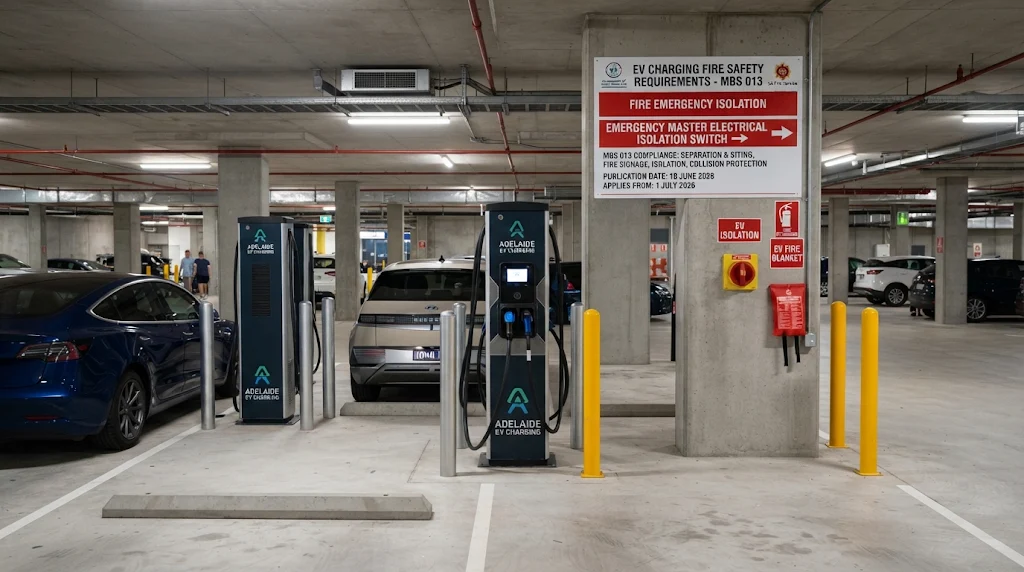
EV charging fire safety isolation signage is part of the emergency response strategy. Under MBS 013, fire service signage must warn against using available hose reels on an EV fire. This warning gives fire crews a clear restriction at the point of response. Signage should be clear and visible to fire crews and site staff.
Master electrical isolation works with that signage. The isolation point should be identifiable, protected, and supported by clear direction. For commercial facilities, the signage should align with the installed isolation arrangement, the emergency plan, and any site fire strategy. If the isolation point changes during design or construction, the signage should be reviewed before handover.
Practical Compliance Checks for Fire and Electrical Teams
- Confirm whether the charging station is covered or underground and whether approval is required.
- Check the current statutory instrument for scope exclusions and existing approvals.
- Verify the separation and siting arrangement for the charging location.
- Confirm the collision protection design and its relationship to fire access.
- Install EV charging fire safety isolation signage that identifies the master electrical isolation point and warns against using available hose reels on an EV fire.
- Record the signage location, isolation details, and approval references for handover and maintenance.
These checks help fire companies and electrical contractors deliver a consistent installation. They also give retail and commercial facility teams a clear reference point for inspection, maintenance, and future changes.
Purchasing and Installation Considerations
When selecting EV charging fire safety isolation signage, the product must match the site conditions and the approved design. The signage should be readable, durable, and positioned where fire crews can see it quickly. It should also coordinate with other electrical and fire protection signage so that the message does not conflict with existing warnings or isolation labels.
For B2B projects, FireFactory can supply fire protection equipment and signage for EV charging installations where MBS 013 applies. Product selection should be based on the approved fire strategy, isolation arrangement, and site access requirements rather than generic labels. This supports a safer handover and makes it easier for facility teams to maintain the controls over time.
Frequently Asked Questions
What does MBS 013 require for EV charging fire safety isolation signage?
MBS 013 applies to covered and underground EV charging stations that require approval. It includes fire service signage, master electrical isolation, collision protection, separation, and siting. The signage must warn against using available hose reels on an EV fire.
Which EV charging stations are covered by MBS 013?
The instrument addresses covered and underground charging stations requiring approval. Teams must check the current statutory instrument for scope exclusions and existing approvals before assuming the standard applies.
What message must the signage include?
The signage must warn against using available hose reels on an EV fire. It should also support the approved fire service strategy and make the master electrical isolation arrangement clear to responders.
When does the July edition apply?
PlanSA records the publication date as 18 June 2026. The linked July edition applies from 1 July 2026. Projects should confirm which instrument applies to their approval or construction stage.
How should electrical and fire teams coordinate on isolation signage?
Both teams should agree on the master electrical isolation point and the location of the warning signage. The signage should match the final installation and be included in handover documentation.
Conclusion
MBS 013 makes EV charging fire safety isolation signage a practical compliance control for covered and underground EV charging stations. Fire companies, electrical contractors, and commercial facility teams should confirm approval status, separation, siting, collision protection, and the hose reel warning before installation. Clear signage and a documented isolation arrangement support safer emergency response and smoother handover.
For B2B fire protection equipment, electrical isolation signage, and MBS 013 project support, contact FireFactory to discuss available product options and site specific requirements.