Table of Contents
ToggleSmoke Seals vs Fire Seals: What Is the Difference?
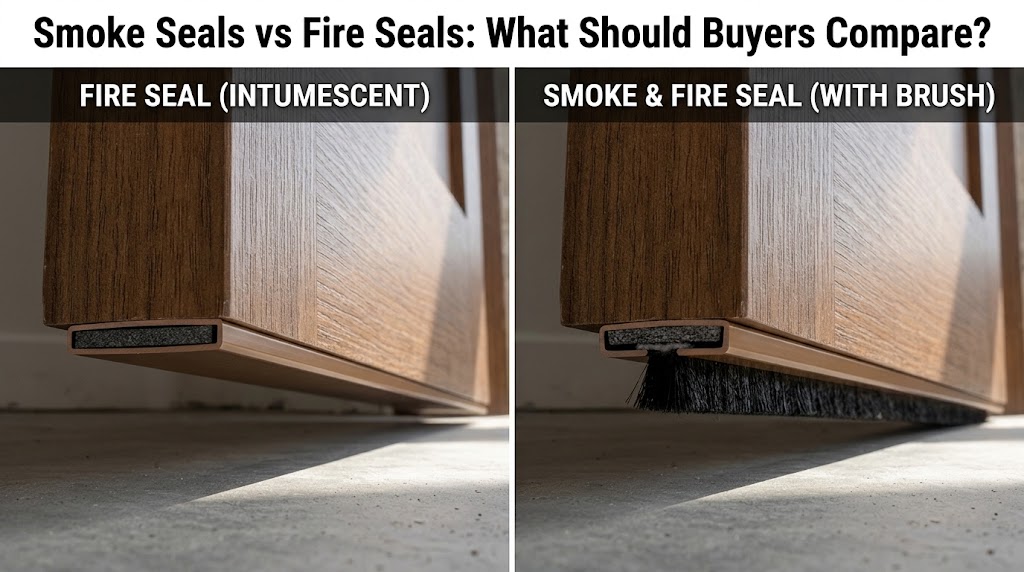
Quick Answer: Smoke seals are designed to help limit smoke movement through gaps around doors, while intumescent fire seals expand when exposed to high temperatures to help protect specified gaps during a fire. Some fire door seals combine both functions. The correct choice depends on the door assembly, required performance, installation conditions and supporting test evidence.
Fire doors play an important role in protecting buildings by helping restrict the spread of fire and smoke between different areas.
However, the performance of a fire-resistant doorset depends on more than the door leaf itself. Door frames, hinges, closers, latches, glazing and seals can all affect the performance of the complete assembly.
For Australian fire protection contractors, builders, door installers and facility maintenance teams, understanding the difference between smoke seals and fire seals is important when selecting products for new installations or replacing existing components.
This guide explains how these products work, their main differences and what contractors should check before purchasing fire door seals.
1. What Is a Smoke Seal?
A smoke seal is designed to help restrict smoke movement through gaps around a door.
Depending on the product design, smoke seals may use flexible blades, rubber-like materials, brushes or other sealing components to reduce leakage.
Some smoke seals are designed to provide sealing performance at ambient temperatures, before significant heat exposure occurs.
This can be important because smoke can spread through a building before temperatures become high enough to activate an intumescent fire seal.
Common Smoke Seal Applications
Smoke seals may be used in suitable door assemblies in:
- Commercial buildings and offices.
- Apartment buildings and residential developments.
- Hotels and accommodation facilities.
- Healthcare and aged care buildings.
- Corridors and other areas where smoke control is required.
The suitability of a smoke seal depends on the door assembly, required smoke leakage performance and applicable project documentation.
Important: A smoke seal does not automatically provide the fire resistance performance required for a fire-resistant doorset.
2. What Is an Intumescent Fire Seal?
An intumescent fire seal contains material designed to expand when exposed to elevated temperatures.
During fire exposure, this expansion helps close specified gaps around a door leaf or frame, supporting the fire resistance performance of the tested doorset assembly.
Intumescent fire seals are commonly installed in prepared grooves or other specified locations in the door leaf or frame, depending on the system design.
How Intumescent Fire Seals Work
Under normal conditions, the intumescent material remains relatively compact.
When exposed to sufficient heat, it expands and helps restrict the passage of flames and hot gases through the gaps it is designed to protect.
The expansion characteristics, installation position and performance depend on the particular product and tested assembly.
Important Limitations
An intumescent fire seal should not automatically be assumed to provide effective ambient-temperature smoke sealing.
Similarly, installing an intumescent seal does not independently establish the Fire Resistance Level (FRL) of a door.
The complete doorset, including its seals and hardware, must be supported by suitable evidence for the required performance.
3. What Is a Combined Fire and Smoke Seal?
Some fire door sealing products combine an intumescent fire seal with a flexible smoke sealing component.
These products are designed to provide two different functions within a suitable door assembly:
- Smoke sealing: Helps reduce smoke leakage through specified gaps, including at ambient temperatures where the product is designed and tested for that purpose.
- Fire sealing: Uses intumescent material that expands during fire exposure to help protect specified gaps.
Combined seals may offer a practical solution where both fire resistance and smoke leakage performance are required.
However, a product described as a fire and smoke seal should not automatically be considered suitable for every fire door.
Its suitability must be confirmed using the relevant product documentation and doorset evidence.
4. Smoke Seals vs Fire Seals: Key Differences
| Feature | Smoke Seal | Intumescent Fire Seal | Combined Fire & Smoke Seal |
|---|---|---|---|
| Primary purpose | Restrict smoke leakage | Help protect specified gaps during fire exposure | Provide both functions |
| Typical mechanism | Flexible blade, brush or other sealing element | Heat-activated intumescent expansion | Smoke sealing element plus intumescent material |
| Ambient-temperature smoke sealing | May be designed for this purpose | Not automatically provided | May be provided, depending on design and evidence |
| Reaction to high temperatures | Depends on product | Expands when sufficiently heated | Intumescent component expands |
| Common installation | Door edges, frames or other specified positions | Door edges or frames | Door edges or frames |
| Main selection requirement | Smoke performance and assembly compatibility | Fire resistance evidence and assembly compatibility | Evidence supporting both required functions |
The main difference is how the products are designed to perform. Smoke seals focus on limiting smoke leakage, while intumescent fire seals respond to heat during a fire.
Where both functions are required, a combined seal may be appropriate if supported by the relevant evidence.
5. Which Seal Should Be Used on a Fire Door?
The correct seal depends on the door assembly and the performance required for the installation.
Contractors should not select a seal based only on its appearance, dimensions or product name.
Before choosing a replacement, check:
- Door assembly identification: Confirm the manufacturer, doorset type and available certification or test documentation.
- Required performance: Determine the fire resistance and smoke sealing requirements applicable to the door.
- Existing seal: Identify its profile, material, dimensions and installation position.
- Door gaps: Check the permitted clearances around the leaf and frame.
- Product compatibility: Confirm that the proposed seal is supported for the particular doorset.
- Installation requirements: Review the manufacturer’s instructions, including fixing methods and any limitations.
- Supporting evidence: Check relevant test reports, assessment reports and other evidence of suitability.
A visually similar replacement may have different materials, expansion properties or smoke leakage performance.
For this reason, fire door seals should not be treated as interchangeable without suitable supporting evidence.
6. Australian Standards for Fire Door Seals
Several Australian Standards and regulatory requirements may be relevant to fire door sealing products.
AS 1905.1 – Fire-Resistant Doorsets
AS 1905.1 addresses requirements for fire-resistant doorsets.
The suitability of door seals and other hardware should be considered as part of the complete doorset assembly.
A seal that is suitable for one fire-resistant doorset may not be appropriate for another.
AS 1530.4 – Fire Resistance Testing
AS 1530.4 establishes methods for fire resistance testing of building elements, including relevant doorset assemblies.
Test evidence can help establish the performance of a particular door construction and sealing configuration.
However, a test result for one arrangement should not automatically be applied to a different door or seal configuration.
AS 1851 – Routine Service of Fire Protection Systems and Equipment
AS 1851—2012, Section 12, addresses routine servicing of passive fire and smoke systems, including relevant fire-resistant doorsets.
Maintenance activities may include checking seals for damage, deterioration, displacement and other conditions affecting their function.
Applicable inspection frequencies and maintenance requirements should be confirmed against the relevant standard, jurisdiction and building documentation.
National Construction Code (NCC)
The NCC establishes fire safety requirements for relevant building elements, including fire-resistant doorsets and protection of openings.
The applicable NCC edition, state or territory variations and project specifications should be checked before selecting or replacing door sealing products.
Important: A seal’s individual product description does not prove that a complete doorset meets the NCC or its required FRL.
7. Common Mistakes When Selecting Fire Door Seals
Assuming Smoke Seals and Fire Seals Are the Same
Although both products may be used around doors, they serve different purposes.
An ambient-temperature smoke seal should not automatically be used as a replacement for an intumescent fire seal.
Choosing a Seal Based Only on Size
Two seals with similar dimensions may have different materials, expansion properties and tested applications.
The correct profile and supporting evidence are essential.
Replacing an Existing Seal with an Unverified Product
Substituting a different seal may affect the documented performance of the doorset.
Contractors should confirm compatibility before replacement.
Ignoring Door Clearances
Incorrect seal dimensions or installation can interfere with closing, latching or the permitted gaps around the door.
The installed seal must be compatible with the complete door assembly.
Overlooking Damaged or Missing Seals
Damaged, displaced, painted-over or missing seals may affect the intended performance of the doorset.
Defects should be documented and addressed through the appropriate maintenance process.
8. Fire Door Seal Inspection and Maintenance
Fire door seals should be included in the applicable routine inspection and maintenance program.
During inspections, contractors may need to check for:
- Missing or damaged sections.
- Loose or displaced seals.
- Cracking, deterioration or physical damage.
- Paint or other materials affecting the seal’s function.
- Incorrect replacement profiles.
- Gaps or clearances outside the permitted configuration.
- Interference with door closing or latching.
Any replacement should be supported by appropriate product and doorset documentation.
Maintenance records should identify the door location, observed condition, defects, corrective actions and replacement components where applicable.
Passive Fire Maintenance Records
Fire Factory Australia’s Passive Fire Logbook is designed to support structured inspection and maintenance records for passive fire protection systems, including relevant fire-resistant doorsets.
A logbook can help technicians document inspection results, defects and corrective actions.
However, maintenance records do not replace the need for competent inspections or appropriate product and installation evidence.
9. Fire Door Seals from Fire Factory Australia
Fire Factory Australia supplies passive fire protection products for Australian fire protection contractors, builders and maintenance businesses.
Our passive fire range includes product categories such as:
- Intumescent Fire Seals.
- Fire and Smoke Seals.
- Door Drop Seals.
- Fire Door Sealing Accessories.
- Other Passive Fire Protection Products.
Before purchasing, customers should confirm the exact product model, dimensions, intended application and available supporting documentation.
Not every seal is suitable for every fire-resistant doorset, and the correct selection must reflect the applicable assembly requirements.
Explore our Passive Fire Protection Products or contact our team for product information and availability.
Frequently Asked Questions
What Is the Main Difference Between a Smoke Seal and a Fire Seal?
A smoke seal is designed to help restrict smoke movement through gaps around a door.
An intumescent fire seal expands when exposed to sufficient heat to help protect specified gaps during fire exposure.
Some products combine both functions.
Can an Intumescent Fire Seal Stop Smoke?
An intumescent fire seal may help restrict smoke and hot gases during fire exposure as it expands.
However, it should not automatically be assumed to provide effective ambient-temperature smoke sealing unless the relevant evidence supports that function.
Are Combined Fire and Smoke Seals Better?
Not necessarily.
A combined seal may be suitable where both fire resistance and smoke leakage performance are required.
The correct product depends on the doorset design, installation conditions and supporting evidence.
Can I Replace a Fire Door Seal with a Different Brand?
A replacement from another manufacturer may be acceptable where suitable evidence supports its use with the existing doorset.
A visual match alone is not sufficient.
Do All Fire Doors Need Smoke Seals?
Not every fire-resistant doorset has the same smoke sealing requirements.
The applicable building requirements, doorset design and supporting documentation determine what sealing performance is required.
How Often Should Fire Door Seals Be Inspected?
Inspection should follow the applicable maintenance requirements, including relevant provisions of AS 1851 where applicable, as well as any additional building or jurisdictional requirements.
The correct inspection frequency should be confirmed for the particular installation.
Conclusion
Understanding the difference between smoke seals and fire seals helps contractors select appropriate products for fire-resistant doorsets.
Smoke seals are designed to help limit smoke leakage, while intumescent fire seals expand during fire exposure to help protect specified gaps.
Combined fire and smoke seals can provide both functions where supported by suitable evidence.
Before purchasing or replacing a seal, contractors should check the door assembly, required performance, product compatibility and relevant test documentation.
For product enquiries, explore Fire Factory Australia’s Passive Fire Solutions or contact our team for available specifications and product information.