Table of Contents
ToggleQueensland Extends Fire Protection Licensing Deadlines to 2035
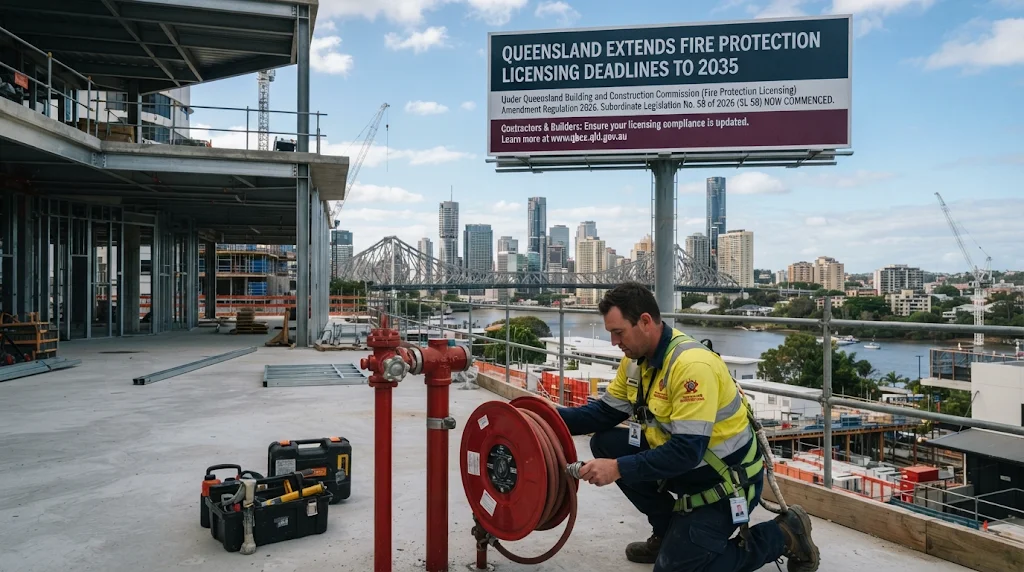
Queensland has extended several fire protection licensing and upskilling transition deadlines to 2035 under the Queensland Building and Construction Commission (Fire Protection Licensing) Amendment Regulation 2026.
The amendment, known as Subordinate Legislation No. 58 of 2026 (SL 58), commenced on 5 June 2026.
It changes specific transitional provisions in the Queensland Building and Construction Commission Regulation 2018, giving affected fire protection licence holders and builders more time to meet certain licensing requirements.
For Queensland fire protection contractors, builders and electrical businesses, understanding which licence classes are affected is essential.
What Changed in Queensland’s Fire Protection Licensing Rules?
The 2026 amendment extends selected transitional deadlines from 2030 to 2035.
These changes relate to certain fire protection occupational licences, existing fire protection licence holders and builder licence provisions.
The main changes are:
| Provision | Previous Deadline | New Deadline |
|---|---|---|
| Section 18A(3) – Specified occupational licence applications | 1 May 2030 | 1 May 2035 |
| Builder – Low Rise | 2 May 2030 | 2 May 2035 |
| Builder – Medium Rise | 2 May 2030 | 2 May 2035 |
| Builder – Open | 2 May 2030 | 2 May 2035 |
| Schedule 7B, Part 2 – Items 3–5 and 8–10 | 1 May 2030 | 1 May 2035 |
These amendments provide additional time for the affected licence holders and workers.
Importantly, the extension does not apply to every fire protection licence in Queensland.
Contractors must check the specific licence class and transitional provision that applies to their work.
The full amendment is available through Queensland Legislation – SL 58 of 2026.
Fire Protection Upskilling Requirements Extended to 2035
The Queensland Building and Construction Commission (QBCC) has also confirmed that affected fire protection licence holders now have until 1 May 2035 to complete specified upskilling requirements.
The extension applies to relevant requirements that previously had deadlines of 1 May 2025 or 1 May 2027.
Queensland introduced its revised fire protection licensing framework on 1 May 2021. As part of that reform, certain existing licence holders were required to complete additional training or qualifications.
Affected licence categories include certain:
- Special hazard fire system licences.
- Fire alarm installation and maintenance licences.
- Emergency lighting certification licences.
- Other fire protection licence classes identified by QBCC.
The required qualifications and any exemptions depend on the individual licence class and the licence holder’s circumstances.
Affected contractors should review the QBCC Fire Protection Upskilling Requirements to confirm their obligations.
Changes to Passive Fire Protection Licensing
The amendment is also important for passive fire protection work.
Passive fire protection includes systems and building elements designed to limit the spread of fire and smoke, such as:
- Fire-rated walls and ceilings.
- Fire and smoke barriers.
- Fire collars.
- Fire-rated penetration sealing.
- Fire-rated joint sealing.
QBCC guidance confirms that certain employees performing or supervising specified passive fire protection work will need the relevant licence from 1 May 2035, subject to applicable exemptions.
The extended transition period gives affected workers and businesses additional time to obtain the required qualifications and licences.
However, the rules differ depending on the type of work, existing licence and applicable exemption.
Builders and contractors should not assume that every passive fire protection activity can be performed without a licence until 2035.
Further information is available through the QBCC Passive Fire Licensing Guidance.
What Does This Mean for Fire Protection Contractors?
The new deadlines give affected Queensland contractors more time to plan their licensing and training requirements.
However, existing obligations