Description
Fire Detection, Control Panels and System Accessories
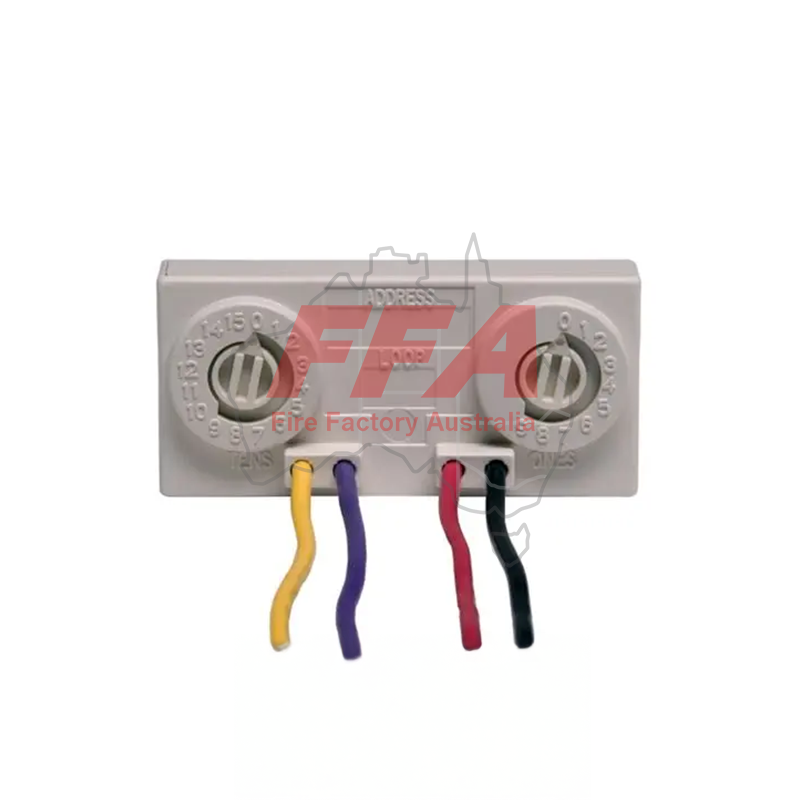
The M501M Mini Addressable Monitor Module is a compact intelligent interface module designed to monitor normally open contact devices and integrate them into compatible addressable fire alarm systems. Its small form factor allows discreet installation behind devices, inside electrical boxes, or within equipment housings where space is limited.
The M501M provides a supervised Style B (Class B) initiating device circuit (IDC) for monitoring external dry-contact devices such as fire alarm initiating devices, supervisory switches, and other approved contact-based inputs. The module communicates directly with the fire alarm control panel through the intelligent signaling line circuit (SLC), providing accurate identification and reporting of device status.
Operating on 15–32 VDC, the M501M features low current consumption and simple rotary decade switch addressing for efficient installation and commissioning. A supplied 47 kΩ end-of-line resistor provides circuit supervision, allowing the system to detect wiring faults including open and abnormal conditions.
Designed for flexible installation, the compact M501M can be mounted behind manual call points, monitoring devices, or within a single-gang electrical box. Its miniature design makes it ideal for retrofit projects and applications where a standard-sized monitor module cannot be accommodated.
Key Features
- Compact intelligent addressable monitor module
- Monitors normally open dry-contact devices
- Supervised 2-wire Style B initiating device circuit
- Rotary decade switch addressing
- Operating voltage: 15–32 VDC
- Low operating current: 350 µA typical
- IDC short circuit current: 600 µA maximum
- Includes 47 kΩ end-of-line resistor
- Compact design for concealed installation
- Flying lead wiring for simplified connection
- Suitable for fire alarm and supervisory monitoring applications
The System Sensor M501M Mini Addressable Monitor Module provides a reliable and space-saving solution for integrating conventional contact devices into intelligent fire alarm systems while maintaining circuit supervision and accurate event monitoring.