Table of Contents
ToggleHow Should Tasmanian Accommodation Sites Organise Fire Service Records?
Quick Answer: Tasmania accommodation fire records and essential services maintenance should be organised by location, asset, service interval, and responsible party. Each fire service record should capture the approved schedule, inspection result, defects, actions, and evidence. This keeps service evidence clear and usable.
Accommodation operators in Tasmania need fire service records that support safe operation, staff handovers, and clear evidence of maintenance. A well built records structure helps fire companies, electrical contractors, retail operators, and site managers see which equipment has been tested, which defects remain, and when the next service is due. For Tasmania accommodation fire records, the key is to treat fire protection and essential services maintenance as one connected asset management system rather than a set of loose service cards, with FireFactory as a source for replacement components.
Why Tasmania Accommodation Fire Records Need a Clear Structure
Accommodation buildings differ from standalone house settings. They can include guest areas, common areas, kitchens, laundry, plant rooms, storage, and multiple access routes. These areas create a larger number of fire protection assets, higher occupancy exposure, and more frequent maintenance tasks. A simple home style log may not provide enough detail for a commercial accommodation site.
The practical starting point is the building’s approved maintenance schedule and the rules that apply to the building. Records should show whether each task was completed on time, what was found, and what action is required next. This approach helps Tasmanian building practitioners follow the expectations reflected in Tasmanian building maintenance guidance for building practitioners, where maintenance is linked to the approved schedule and applicable rules.
Clear structure also supports commercial facility considerations. Management can review open defects, maintenance teams can plan visits, and auditors or inspectors can trace the history of a system. When records are organised by location and asset, the site avoids confusion between similar devices, missed intervals, and incomplete follow up.
Tasmania Accommodation Fire Records and Essential Services Maintenance
Fire service records and essential services maintenance records should be connected because many systems depend on reliable power, isolation, and ongoing inspection. Essential services in an accommodation site may include fire alarm control equipment, detection devices, suppression components, safety signage, emergency lighting, and related maintenance accessories. The record structure should identify each item, its location, its service interval, and its current condition.
| Record type | Purpose | Key details to capture |
|---|---|---|
| Asset register | Identifies every fire protection and essential service asset | Asset ID, manufacturer, model, location, installation date, serial number |
| Approved maintenance schedule | Defines what maintenance is required and how often | Task, interval, reference rule or standard, responsible role |
| Service log | Records completed inspections and maintenance | Date, technician, work performed, observations, result |
| Defect and action register | Tracks issues until closure | Defect description, risk, action, owner, due date, recheck |
| Replacement history | Supports component selection and future maintenance | Old model, new model, supplier, date, installation location |
The register should separate routine maintenance from repairs. A service log that only says “checked” is less useful than a log that states the condition found, the action taken, and the next due date. This level of detail helps the business prove that essential services maintenance was completed in line with the approved schedule.
A Practical File Structure for Fire Service Records
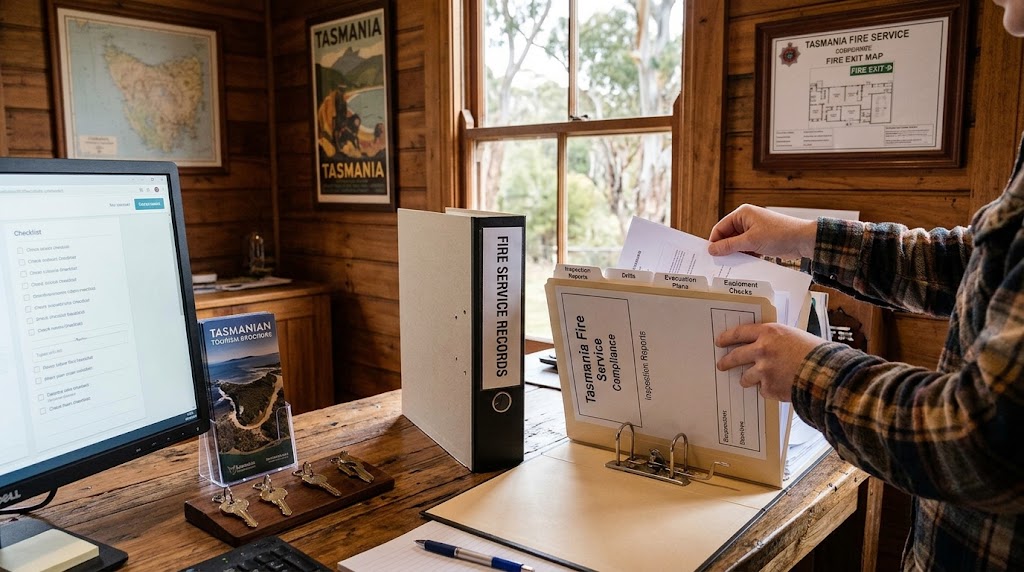
A useful file structure follows the order a technician uses during a site visit. The record should be easy to open, easy to read, and easy to update after each service. The following layout works for both paper and digital systems.
- Building and location: site name, building, floor, zone, room, or external area.
- System type: detection, alarm, suppression, emergency services, or safety equipment.
- Asset identification: unique asset ID, manufacturer, model, serial number, and physical description.
- Approved interval: the maintenance frequency required by the approved schedule or applicable rules.
- Service result: pass, fail, deferred, or observation, with enough detail to explain the result.
- Defects and actions: what was found, what was done, what remains open, and who owns the action.
- Next due date: the next required service date, linked to the interval and any corrective action.
- Evidence: photos, test readings, work orders, parts used, or manufacturer documentation where appropriate.
This structure keeps Tasmania accommodation fire records consistent across shifts and contractors. It also helps management separate completed work from open work, which is especially important in accommodation sites where guest access and staff turnover can create gaps in institutional memory.
Common Record Gaps and How to Avoid Them
- Missing asset IDs: Devices without IDs make it difficult to trace service history. Assign an ID at installation and update the register when components are moved or replaced.
- Vague service outcomes: Terms such as “all okay” do not support compliance evidence. Record the condition, the test performed, and any limitation.
- Untracked defects: A defect left in a general notes field can be missed. Use a separate defect register with an owner and due date.
- Mixed building types: Standalone house guidance may suit a simple owner check, but accommodation and commercial buildings need a more formal record structure.
- Incomplete replacement records: If a component is replaced without recording the old and new model, future maintenance teams may use the wrong part.
- Poor handover information: Handover notes should list open items, restricted areas, and any service that must not be missed before the next visit.
For fire companies and electrical contractors, these gaps increase site time and reduce accuracy. A consistent record file gives the technician a clear starting point and gives the business a defensible trail of maintenance activity.
Purchasing, Selection, and Compliance Considerations
Fire protection purchasing should follow the approved maintenance schedule and the technical evidence for the installed system. Before replacing a component, the maintenance team should confirm the exact model, location, and application. This reduces the risk of fitting an incompatible part or creating a mismatch between the asset register and the physical equipment.
Compliance records should not rely on memory. The business should keep the approved schedule, the relevant rule or standard reference, the service report, and any manufacturer documentation in one place. Where the approved schedule requires a specific test or interval, the record should show that requirement and the result. This is particularly important in Tasmania accommodation fire records, where essential services maintenance may be reviewed by management or contractors.
For B2B suppliers, the value is in supporting accurate selection. FireFactory supplies fire protection components and replacement parts for commercial facilities, while the site team confirms the installed model and follows the approved maintenance requirements.
Conclusion
Accommodation sites in Tasmania should organise fire service records as a controlled asset management system. The records should follow the approved maintenance schedule, separate accommodation and commercial building duties from standalone house guidance, and track essential services maintenance with clear locations, intervals, outcomes, and actions. A strong file structure reduces risk, improves handover, and supports safer operation.
Businesses can contact FireFactory to discuss fire protection components, replacement parts, and record ready documentation for Tasmania accommodation sites.
Frequently Asked Questions
What information should Tasmania accommodation fire records include?
Records should include location, asset ID, system type, approved interval, service date, outcome, defects, actions, next due date, and evidence. The approved maintenance schedule and applicable rules should be visible in the file.
How are accommodation records different from standalone house records?
Accommodation buildings have more assets, higher occupancy exposure, guest areas, and formal maintenance responsibilities. Standalone house guidance may suit simple owner checks, while commercial accommodation needs structured service logs and defect tracking.
Where should essential services maintenance records be kept?
Essential services records should be linked to the fire service file by asset and location. This allows maintenance teams to see the service history, open defects, and next due date in one place.
What should a technician do when a defect is found?
The technician should record the defect, the affected asset, the action taken, the responsible owner, and the recheck date. The defect should remain in the action register until closure and verification.
Can digital records replace paper service cards?
Digital records can replace paper cards when they are complete, searchable, backed up, and accessible during site visits. The same information requirements apply: location, asset, interval, result, defects, and evidence.