Table of Contents
ToggleHow Should SA Contractors Organise a Site’s ESP Maintenance Records?
Quick Answer: Organise records from the issued ESP schedule. Give each fire, life safety, and emergency power asset a unique ID, then link inspection, testing, servicing, fault, and replacement evidence to that ID. Keep MBS 002 compliance evidence separate from routine work orders.
Use the Issued ESP Schedule as the Master Register
The issued ESP schedule is the practical starting point for South Australia fire logbooks and ESP maintenance records. It tells the maintenance team which ESP assets are installed or to be installed and how they are identified in the building documentation. In South Australia, the PlanSA Form 1 Schedule of ESPs installed or to be installed provides an official reference for ESP details, and contractors should use the site specific schedule as the master asset register.
Once the schedule is captured, assign each asset a stable ESP ID that remains unchanged for the life of the asset. Use that same ID in work orders, test certificates, fault reports, calibration records, purchase orders, and the site logbook. If a system has multiple components, such as a fire alarm panel with detectors and call points, follow the way the site schedule classifies the asset. The record structure should match the compliance documentation, not a generic template.
Asset Linked Records for South Australia Fire Logbooks
An asset linked record set separates master data from event data. Master data describes the ESP item. Event data records what happened to that item over time. This structure prevents a common problem where a maintenance report says work was completed but does not clearly identify which ESP asset was serviced.
| Record field | What to capture |
|---|---|
| ESP asset ID | Stable reference from the issued ESP schedule or site asset register |
| ESP type | Fire alarm, emergency lighting, EPO, hydrant, sprinkler, fire pump, or other ESP item |
| Location | Floor, room, riser, zone, or asset reference used by the site team |
| Manufacturer and model | Exact model where known, including panel, device, valve, or pump model |
| Date installed or commissioned | Recorded installation or commissioning date where available |
| Service or test requirement | Requirement as defined by the ESP schedule, applicable MBS 002 requirements, manufacturer instructions, or system design |
| Last completed result | Date, outcome, technician, contractor, and report reference |
| Next due date | Only where a requirement defines an interval |
| Faults and rectification | Open faults, temporary controls, responsible person, and remediation deadline |
| Supporting evidence | Certificate, test report, calibration record, photo, or purchase order |
The table should index the detailed service report rather than replace it. When a contractor uploads a certificate, the file name should include the ESP asset ID, date, and document type. A file named ‘FA-003-fire-alarm-panel-annual-test-2026-05-01.pdf’ is easier to audit than ‘fire-alarm-test.pdf’.
Capturing MBS 002 Compliance Evidence
Where the site ESP schedule or applicable MBS 002 requirements specify inspection, testing, or servicing intervals, the maintenance record should capture that requirement and the completed result. The record should not invent a universal interval. Different ESP types, system designs, occupancy risks, and equipment age can require different evidence.
A compliance file should contain enough detail for a third party to answer three questions: what was required, what was done, and who did it. That may include the ESP asset ID, the applicable requirement, the date and time of the service, the technician or contractor, the result, and the certificate or report. If a component fails, the record should show the fault, the immediate action, the responsible person, and the rectification deadline.
Contractors should also record changes. Replacing a fire pump, readdressing detectors, adding a zone, relocating an EPO switch, or upgrading a panel changes the asset profile. The ESP schedule, the asset register, and the maintenance records should be updated together. An outdated schedule is a common source of noncompliance because the maintenance team may service the wrong item or miss a newly added ESP.
Practical Structure for Site Files
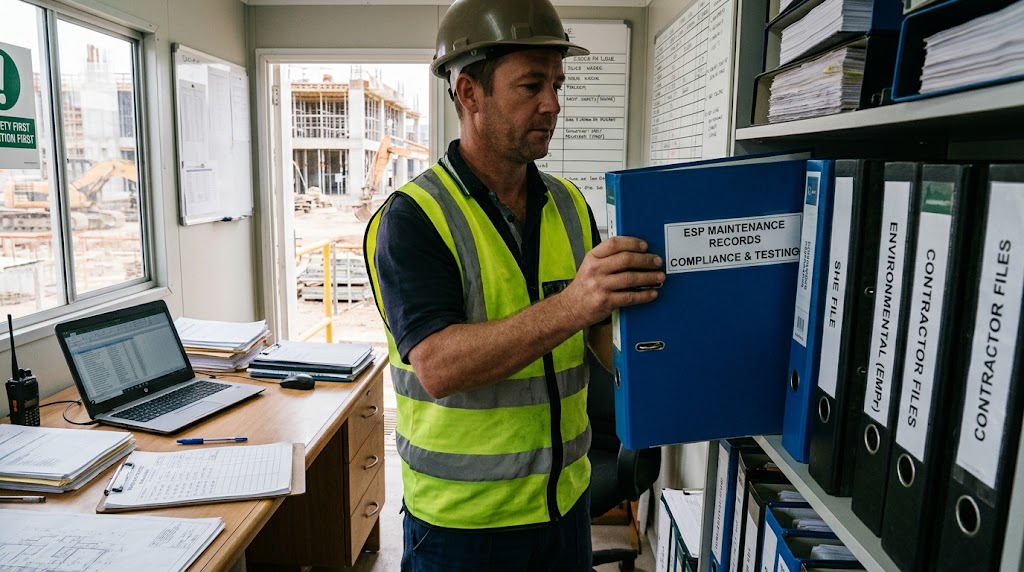
A practical folder structure keeps the audit trail clear and simple. A typical structure includes the following folders:
- 01 ESP schedule and asset register
- 02 Compliance evidence and certificate pack
- 03 Service and test reports
- 04 Faults, rectification, and temporary controls
- 05 As built documents and technical data
- 06 Access, keys, and operational notes
The first folder should contain the current issued ESP schedule, the asset register, and any change logs. The second folder should contain the current certificates and test reports, named by ESP asset ID and date. The third folder should contain service reports with enough detail to explain the work. The fourth folder should contain fault reports, remediation evidence, and temporary risk controls. The fifth folder should contain manufacturer data, installation details, wiring or hydraulic diagrams, and spare part lists. The sixth folder should contain access information and operational notes where they affect the ESP system.
Common Gaps and How to Close Them
- Generic labels. Replace “fire system service” with the ESP asset ID, ESP type, and location.
- Missing intervals. Record the source of each interval, such as the ESP schedule, applicable MBS 002 requirements, manufacturer instructions, or system design documents.
- Orphan documents. Do not store certificates without an asset ID, date, document type, or location.
- Unowned faults. Assign a responsible contractor or manager to every open fault.
- Version confusion. Retain superseded schedules, but mark them clearly as superseded and keep the current schedule easy to find.
- Inconsistent naming. Use one naming convention across all ESP maintenance records so the site team can find the latest evidence quickly.
Purchasing and Replacement Considerations
Records also influence purchasing. When a contractor orders a replacement detector, panel module, EPO switch, pump seal, or valve, the purchase order should reference the ESP asset ID and the model being replaced. This creates a paper trail between the installed asset and the new component. It also helps the next maintenance team confirm that the replacement part is suitable and correctly documented.
For B2B contractors, a supplier that can provide consistent model references, installation data, and replacement components can reduce documentation errors. FireFactory supplies fire protection products for Australian facilities and can help contractors source the correct equipment for the asset already recorded in the site’s ESP schedule.
Frequently Asked Questions
What should be included in a site ESP maintenance record?
Each record should identify the ESP asset, the location, the date, the work carried out, and the result. It should also name the contractor or technician and link to the supporting certificate, test report, or fault report.
Can one South Australia fire logbook cover multiple ESP systems?
Yes, one site logbook can cover multiple ESP systems when it is organised by asset ID. The key is to keep each system, component, and certificate linked to the issued ESP schedule so the record remains traceable.
How should a contractor handle ESP assets with no stated service interval?
Do not invent a universal interval. Check the issued ESP schedule, applicable MBS 002 requirements, manufacturer instructions, and system design documents. If the interval is still unclear, document the review and confirm the requirement with the owner or responsible engineer.
Where should certificates and test reports be stored?
Store them in the asset linked record folder for the relevant ESP ID, with the date and document type in the file name. A separate compliance folder can hold the current certificate pack for quick access during audits or handover.
What is the best naming convention for ESP maintenance records?
Use a consistent format such as ESP ID, ESP type, document type, and date. For example, ‘FA-003-fire-alarm-panel-annual-test-2026-05-01.pdf’ is clearer than a generic file name.
Conclusion
SA contractors should organise site ESP maintenance records around the issued ESP schedule and asset linked files. The goal is simple. Every ESP asset can be traced to its latest result, its open faults, and its supporting evidence. That approach supports South Australia fire logbooks, MBS 002 compliance, and smoother handovers between contractors, owners, and facility teams.
For contractors who need to standardise records, source replacement components, or specify fire protection equipment, FireFactory can help with B2B product selection and supplier documentation. Contact FireFactory to support your site’s ESP maintenance records with the right equipment and replacement parts.