Table of Contents
ToggleHow Should Contractors Handle Missing Fire-System Baseline Data?
Quick Answer: Contractors should treat missing fire baseline data as a compliance and maintenance issue to investigate, not an automatic critical defect. Record what is missing, request evidence from owners or designers, verify AS 1851 requirements and product documentation before classifying, and communicate prescribed actions clearly to stakeholders.
Missing fire baseline data creates risk when a contractor cannot confirm how a fire system was designed, installed, tested, or maintained. The issue can affect fire companies, electrical companies, retail operations, and other commercial facility teams. The objective is not to hide the gap. It is to identify the missing record, determine whether the absence affects system performance, and document the next steps in a way that supports safety and compliance.
For Australian businesses, AS 1851 missing documents often arise during handover, fit out, asset transfers, or poor record retention, a pattern FireFactory commonly sees in B2B fire protection maintenance. A missing certificate, drawing, baseline test report, or specification does not always mean the system is unsafe. It can make it harder to verify prescribed treatment, intervals, and compatibility.
Why missing fire baseline data matters in commercial maintenance
Baseline data gives a contractor a starting point. It can show the system type, component models, design limits, previous test results, and required maintenance actions. Without that information, a contractor may spend time retesting, may request unnecessary replacements, or may miss a condition that needs attention.
Commercial facilities also have practical pressure. Retail stores, warehouses, offices, and mixed use buildings often keep operating during maintenance. Contractors must balance safety, downtime, cost, and evidence. Missing records increase assumptions, which can cause incorrect work orders, poor communication, and later disputes.
The key principle is proportionate response. Missing information should trigger verification, not panic. A contractor should separate what is unknown from what is defective. A missing document is a documentation gap. A failed function, unsafe condition, or nonconforming installation is a different issue. Both need recording, but they do not always carry the same classification.
Investigation steps for AS 1851 missing documents
1. Confirm what is actually missing
The first step is to list absent items with precision. A generic note such as “no records” is not enough. The record should name the missing document, system location, equipment affected, and information needed. Examples include a baseline test report, installation drawing, product data sheet, commissioning certificate, or maintenance log.
This step helps avoid overstatement. It also makes the request to the owner, developer, or previous contractor clearer. A specific request is easier to action than a broad statement that the file is incomplete.
2. Check the physical system and current condition
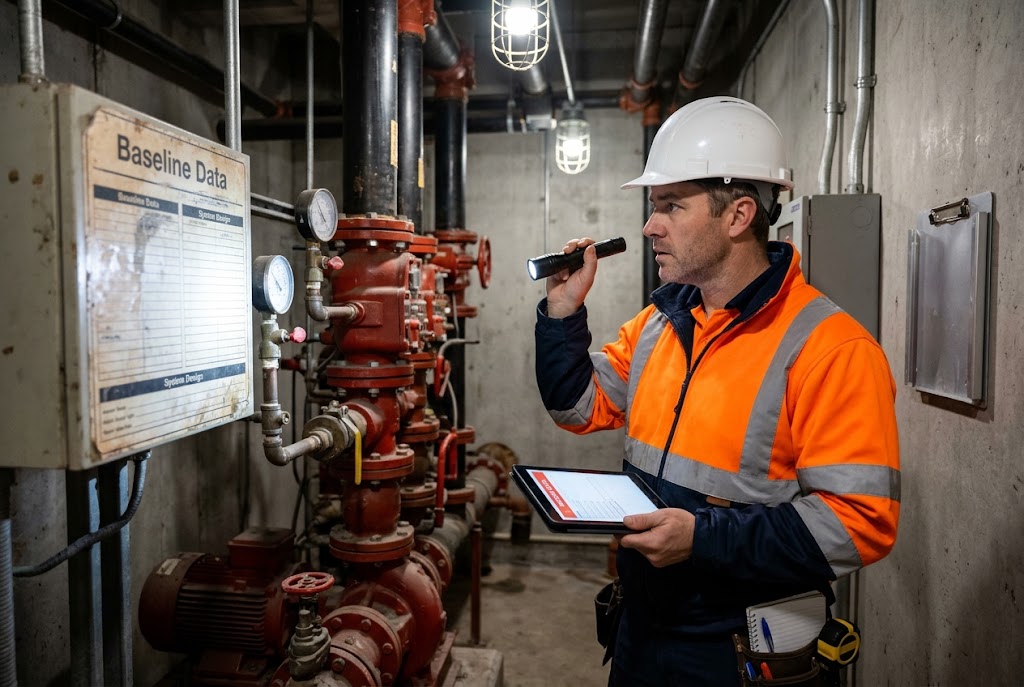
Before relying on documents, the contractor should inspect and test the equipment according to the applicable maintenance procedure. This includes confirming whether components are present, accessible, labelled, and capable of performing their intended function. Where access is restricted, the limitation should be recorded.
Physical verification does not replace baseline data, but it can reduce uncertainty. It may show that a component is operating correctly, that a replacement part is not in service, or that the system has been modified without records. Each observation should be tied to a location and date.
3. Verify the standard, clause, and product claim
Before stating that a missing item creates a nonconformity, the contractor should verify the exact requirement. This means checking the current relevant Australian Standard, the official technical guide, and the exact model evidence for the installed product. A standards catalogue locator is useful for finding the correct edition, but it is not a substitute for the full standard text or official guidance.
Contractors can use Standards Australia’s standard search to locate the applicable standard, then obtain the current document before applying detailed requirements. Product claims should be checked against manufacturer documentation for the exact model in service. This prevents reports based on older editions, assumptions, or general product descriptions.
4. Request evidence and record the response
The contractor should request the missing information in writing. The request should identify the owner or responsible party, the documents required, the reason for the request, and a practical response date. If the owner cannot provide the information, the contractor should record that fact.
This creates an audit trail. It also protects the client by showing that the contractor did not ignore the gap. In commercial settings, a written request can be especially important where multiple trades, asset managers, or facilities teams are involved.
When a missing item is a critical defect and when it is not
A common error is to label every missing fire baseline data item as a critical defect. That approach can mislead the client, inflate risk, and delay simple maintenance. The contractor should apply a clear test.
- Does the missing record prevent confirmation of safe operation?
- Does it prevent verification of the required maintenance interval or treatment?
- Does it hide a change, replacement, or modification that affects system performance?
- Is the installed equipment incompatible with the recorded system design, where the record exists elsewhere?
- Can the condition be verified through physical testing and current official documentation?
If the answer is yes, the item may need a higher classification. If the missing document is administrative and the system can be tested and maintained under the applicable requirements, it may be recorded as a documentation gap with a corrective action. The final classification should reflect the actual safety impact, not only the absence of a paper.
This approach supports client communication. A fire company can explain that the system is serviceable while a record is outstanding. An electrical company can identify whether a control or interface issue needs testing. A retail operator can understand what evidence is required before a landlord, insurer, or regulator asks for proof.
Communication and documentation for compliance risk
Documentation is part of the work. The contractor should record the inspection date, system location, components examined, tests performed, observations, limitations, and agreed actions. Where baseline data is missing, the report should state what is unknown and what verification was done.
The report should avoid vague language. Phrases such as “records may be incomplete” or “further documentation required” are useful when they are followed by details. The document should name the missing item, the responsible party, the verification method used, and the next step. If the contractor cannot complete the assessment, that limitation should be clear.
For commercial facilities, this documentation supports maintenance planning, asset registers, and future visits. It also helps the client demonstrate due care. A clear record shows the contractor identified the gap, verified what could be verified, and recommended a proportionate treatment.
Where replacement parts, accessories, or labels are needed to restore correct identification or support testing, the contractor should use exact model evidence before purchasing. FireFactory supplies B2B fire protection products and can support procurement of compatible items when the model and requirement have been verified.
Frequently Asked Questions
Is missing fire baseline data always a critical defect?
No. Missing fire baseline data is not automatically a critical defect. It becomes critical when it prevents confirmation of safe operation, required maintenance, or system performance. The contractor should investigate, verify the applicable requirement, and classify the item based on the actual risk.
What should a contractor do when AS 1851 missing documents are found?
The contractor should record exactly what is missing, inspect and test the system where possible, and request the documents from the owner or previous service provider. Before stating a nonconformity, the contractor should verify the current standard, clause, and product documentation.
Can a contractor rely on a standards catalogue page for maintenance requirements?
No. A standards catalogue locator helps identify the current edition but does not replace the full standard text or official technical guidance. Contractors should obtain the applicable standard or official guide before applying detailed requirements to a report.
How should missing records be reported to a commercial client?
The report should name the missing document, the affected system or location, the verification steps taken, and the responsible party for providing evidence. It should also state whether the system is serviceable, what limitations exist, and what corrective action is recommended.
Does FireFactory provide products for missing document issues?
FireFactory supports B2B fire protection procurement with compatible products when the exact model and requirement have been verified. Contractors should use the product only after checking the standard, manufacturer documentation, and site conditions.
Conclusion
Contractors should handle missing fire baseline data through investigation, verification, and clear documentation. The goal is to protect people, support compliance, and avoid overstating risk. By confirming the exact requirement, checking the physical system, and recording the response, contractors can turn an unclear file into a practical maintenance decision.
Need compatible fire protection products? Contact FireFactory for B2B pricing, product support, and order options for Australian fire contractors and facility teams.