Table of Contents
ToggleHow Do NCR Fire Logbooks Help On-Site Record Keeping?
Quick Answer: NCR fire logbooks support on site record keeping by producing a carbonless duplicate copy of each fire service entry. The original can stay with system records, while the duplicate supports daily checks, handover notes, and audit trails. They do not replace compliance certificates.
This is valuable in commercial facilities where fire service records may be reviewed by multiple people, including contractors, facility managers, tenancy teams, auditors, and emergency preparedness staff. The value is not that a carbonless copy proves compliance by itself. The value is that the copy supports a consistent, legible, and retrievable record of what was inspected, tested, reported, or completed.
What Is an NCR Fire Logbook?
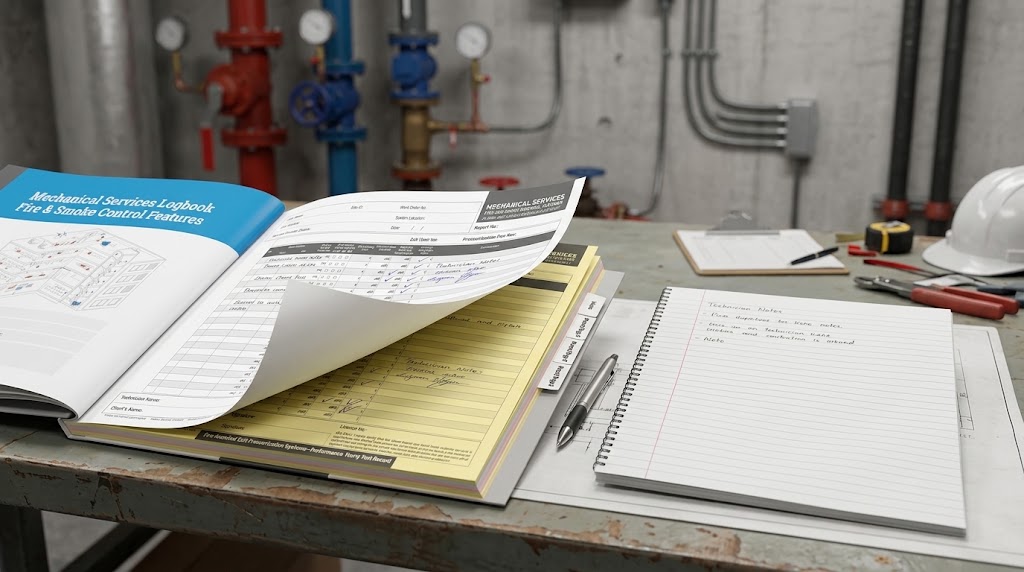
An NCR fire logbook is a record book designed for carbonless duplication. FFA NCR fire logbooks use a carbonless sheet construction, so pressure from the writing instrument transfers the entry from the top sheet to the duplicate sheet below. This creates a copy without separate carbon paper. Buyers should confirm the exact copy count, format, and entry fields for the model in use.
In fire protection and electrical maintenance work, the logbook can be used for system checks, service notes, defect reports, completion entries, and site handover notes. The key feature is the duplicate copy. The original may be filed with the maintenance provider or with the site asset register, while the duplicate can remain at the on site record point or be used to brief the next shift or tenant.
For B2B buyers, the important question is not just whether a logbook is NCR. The question is whether the format, copy count, fields, and storage method match the site’s actual workflow.
How the Duplicate Copy Workflow Works
A well used NCR fire logbook supports a simple sequence. The technician or inspector completes the entry in the original sheet. The duplicate sheet receives a copy of the same information. The original can then be retained with the service file, while the duplicate remains available for on site reference.
- The original supports the maintenance provider’s file and asset records.
- The duplicate supports on site access, shift handover, and daily checks.
- The copy reduces reliance on transcription when information moves between teams.
- The record can be reviewed during audits, tenancy changes, or facility inspections.
This workflow is useful when the same fire service event needs to be visible to more than one responsible party. For example, a maintenance team may need to leave evidence that a defect was reported, while the facility team needs a copy for the on site log. A carbonless fire service record makes that split simple.
| Copy | Typical use | Benefit |
|---|---|---|
| Original | Service file, contractor records, asset history | Keeps the primary record with the maintenance provider or owner’s register |
| Duplicate | On site log, handover notes, daily or weekly checks | Gives site staff immediate access without searching for the original |
Practical Uses and Selection Considerations
NCR fire logbooks are useful where maintenance events need a clear paper trail without creating duplicate data entry at every stage. Fire companies may use them for routine service records, post maintenance notes, and defect follow up. Electrical contractors may use them for inspection notes, isolation checks, or records linked to fire service systems that require coordinated sign off.
Retail and commercial facilities benefit when the logbook supports a predictable location for records. A busy site may have changing staff, seasonal contractors, or multiple tenancy areas. A carbonless duplicate can remain at the on site record point, while the original moves with the service provider. This reduces the risk that a completed service is only visible in a back office file.
The logbook is most effective when the entry includes enough detail for later review. That usually means the date, system or equipment identifier, work performed, observations, outstanding actions, and the name or role of the person completing the entry. The clearer the field structure, the easier the record is to use during an audit or a site walk through.
When selecting NCR fire logbooks for a B2B fire protection or electrical maintenance operation, buyers should consider the workflow rather than only the product label. A logbook that is too small may not capture enough detail. A logbook with too many unused fields may slow down field staff. A logbook without a useful duplicate copy may not solve the on site access problem.
- Confirm whether the logbook produces a usable carbonless duplicate copy.
- Check that the entry fields match the type of service being recorded.
- Consider the size and binding for use in basements, plant rooms, or mobile service bags.
- Confirm that the copy remains legible after repeated use and handling.
- Plan where the original and duplicate will be stored after each entry.
FireFactory supplies B2B fire protection products, and NCR fire logbooks are a relevant option where a site needs a simple on site duplicate record. The best choice is the model that matches the facility’s record format, service frequency, and access requirements. For larger facilities, it can also be useful to align the logbook with existing digital records so that the paper duplicate supports the electronic register rather than replacing it.
Compliance Considerations and Limits of Carbonless Copies
Carbonless fire service records support record keeping, but they do not create compliance by themselves. A copy of an entry shows that a record was produced. It does not, on its own, prove that the system was maintained to a required standard, that the work was performed by a competent person, or that the facility meets a statutory or contractual obligation.
Requirements can vary by state, occupancy type, system, building layout, insurer, and maintenance contract. Before relying on any logbook format, facilities should confirm the current applicable Australian Standard or technical guide for the relevant system. The Standards Australia search for a standard is a useful starting point for locating the current document. Detailed clauses and intervals should be verified against the current official standard and any applicable site obligations.
In practice, a compliant record keeping system usually combines several elements. The logbook entry should be legible, complete, signed or initialed where appropriate, dated, and linked to the correct system. It should be stored where authorized people can find it. It should also align with any digital asset register, maintenance schedule, or certificate of compliance that the facility already uses.
Frequently Asked Questions
What is the main benefit of an NCR fire logbook?
The main benefit is a carbonless duplicate copy of each entry. This allows one record to support both the service provider’s file and the on site facility log.
Do carbonless copies prove compliance?
No. Carbonless copies support record keeping, but they do not by themselves prove compliance. The entry must be complete, accurate, and aligned with the applicable standard, contract, and site obligations.
Who can use an NCR fire logbook?
Fire companies, electrical contractors, facility managers, retail operators, and building owners can use NCR logbooks. The format should match the specific system and maintenance process.
Where should the duplicate copy be kept?
The duplicate copy is often kept at the on site record point, such as a control room, plant room, or tenancy office. The original can be retained by the service provider or in the asset register.
How is an NCR logbook different from a standard notebook?
An NCR logbook is designed to create a carbonless duplicate copy from the entry sheet. A standard notebook usually produces only one record unless the information is re entered or copied separately.
Conclusion
NCR fire logbooks help on site record keeping by giving fire and electrical service teams a practical duplicate copy workflow. They support clearer handover, easier audit review, and better access to maintenance records in commercial facilities. The key is to use the logbook as part of a wider record keeping system, with clear fields, proper storage, and verified compliance references.
FireFactory can help B2B buyers select NCR fire logbooks and carbonless fire service records that fit their site workflow, maintenance process, and record access needs. Contact FireFactory for product guidance and B2B pricing.