Table of Contents
ToggleFire extinguisher labels often carry combinations such as 2A:20B, 3A:40B or 1A:3F. These markings show which classes of fire the extinguisher has been tested for and, where a numerical rating applies, the level of performance achieved in the relevant standard test.
In Australia, portable extinguisher classification and rating are covered by AS/NZS 1850. The letters identify the fire classes for which the extinguisher is suitable. Numbers are used with Classes A, B and F to indicate tested performance. Classes C, D and E do not use a numerical rating in the same way.
How extinguisher ratings are written
A label such as 2A:20B contains several pieces of information.
The A refers to Class A fires involving ordinary combustible materials such as wood, paper and textiles. The number before it is the extinguisher’s tested Class A rating.
The B refers to Class B fires involving flammable liquids. Again, the number indicates performance in the prescribed Class B test.
E identifies suitability where energised electrical equipment is involved. There is no number before E because the electrical classification does not use the same numerical performance scale as A, B or F.
Fire Factory’s guide to fire extinguisher classes and ratings covers the broader fire-class background. The rating printed on the extinguisher adds its tested performance for the applicable class.
What does 2A mean?
For Class A extinguishers, performance testing uses a standardised wooden crib fire. The rating rises as the size of the prescribed test fire increases.
A 2A extinguisher has met the test requirements for the 2A level. A higher A rating indicates performance against a larger Class A test fire under the standard.
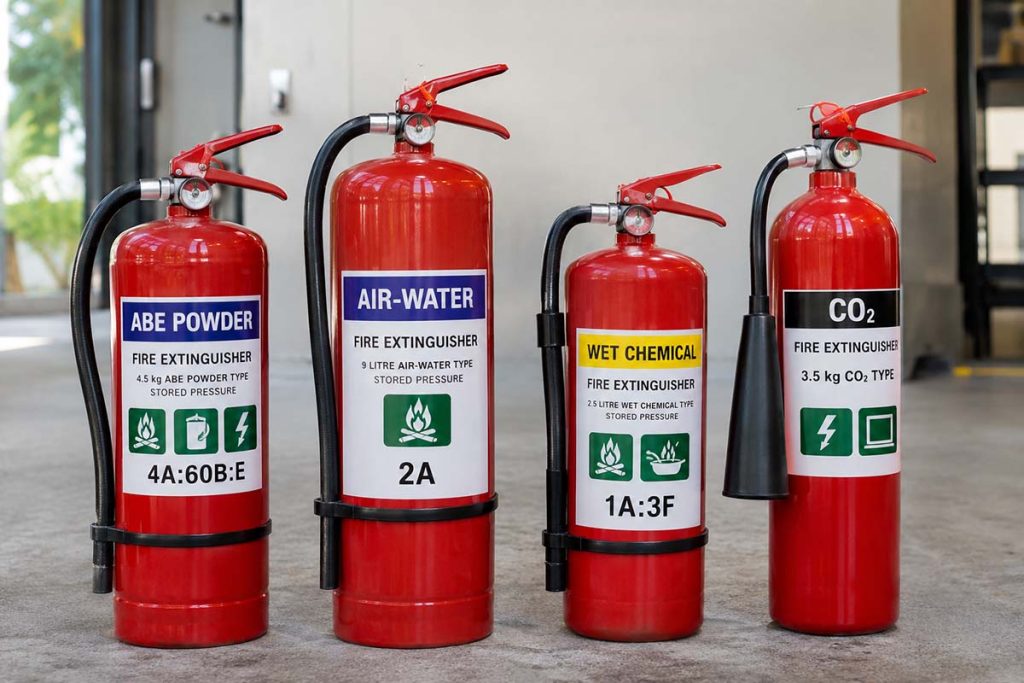
Fire Factory’s 9 litre air-water extinguisher carries a 2A rating. That rating should not be confused with its 9 litre capacity. Capacity describes how much extinguishing agent the cylinder contains. The 2A mark describes tested Class A firefighting performance.
What do 20B and 40B mean?
Class B ratings are established using standardised flammable-liquid fire tests. Ratings include values such as 10B, 20B, 40B, 60B and 80B.
A 40B rating represents a higher tested Class B performance than 20B. The number should still be read as a rating from the test system, not as the extinguisher’s weight, discharge time or a simple statement of how many square metres of any real fire it can extinguish.
Fire Factory’s ABE fire extinguishers show the difference. Its 2.5 kg ABE extinguisher is rated 3A:40B, while the 4.5 kg model is rated 4A:60B. A 9 kg model carries a 6A:80B rating.
The rating lets buyers compare tested performance as well as cylinder capacity.
What do F and E mean?
Class F covers fires involving cooking oils and fats. Numerical F ratings are based on the applicable performance test for that class.
Fire Factory’s 2.5 litre wet chemical extinguisher is rated 1A:3F. It has demonstrated performance for both Class A and Class F test fires at those stated rating levels.
E is handled differently. It indicates that the extinguisher is suitable for use where energised electrical equipment is involved. Electricity is the electrical hazard rather than a fuel category tested on the same numerical scale as A, B or F, so E appears without a number.
Rating and extinguisher size are different specifications
A larger extinguisher may achieve a higher fire rating, but physical size does not tell you the rating by itself. Agent formulation, extinguisher design and tested performance also affect the classification.
When selecting fire extinguishers in Sydney or elsewhere in Australia, check the hazard, required extinguisher type, rating and applicable project or compliance requirements. The rating on the label should match the product documentation.
FAQs about fire extinguisher ratings
What does 2A:20B mean on a fire extinguisher?
It means the extinguisher has a 2A Class A rating, a 20B Class B rating and is suitable for use where energised electrical equipment is involved. The A and B numbers come from standardised performance tests. E does not carry a numerical rating.
Does a higher extinguisher rating always mean a larger extinguisher?
No. Larger capacity often allows higher performance, but capacity and fire rating measure different things. Extinguishers of similar physical size can have different ratings depending on their agent, design and test results.
Why is there no number before E?
The E classification is not rated numerically under AS/NZS 1850. It identifies suitability for situations involving energised electrical equipment rather than a graded fuel-load test such as those used for Classes A, B and F.
Fire Factory Australia supplies portable extinguishers across a range of agents, capacities and fire ratings. Businesses looking for a fire extinguisher supplier in Sydney can contact our Smithfield or Granville locations, with supply available across Australia.
Before ordering, check the fire class, performance rating and agent type required for the site. Our team can help match Fire Factory products to the stated project requirements and product specifications.