Table of Contents
ToggleFire Collars for Electrical Conduits: What Contractors Should Check
Electrical conduits passing through fire-rated walls can affect the fire resistance of a building’s compartmentation system. When a wall is designed to resist the spread of fire, any opening created for electrical services must be addressed using a suitable firestopping solution.
However, not every electrical conduit penetration requires a fire collar. Depending on the conduit material, dimensions, wall construction and available fire test evidence, a suitable solution may involve a fire collar, firestop sealant or another tested penetration sealing system.
For electrical contractors, passive fire installers and fire protection professionals, understanding these differences helps prevent incorrect product selection, installation problems and costly rework.
This guide explains what to check before selecting a fire collar or other firestopping product for electrical conduits in Australia.
1. Are Fire Collars Required for Every Electrical Conduit?
Fire collars are designed to form part of specific firestopping systems. Many use intumescent materials that expand when exposed to heat, helping close openings created by certain services during a fire.
However, fire collars are not suitable for every conduit or wall penetration.
The correct firestopping method depends on several factors:
- Conduit material, such as PVC or metal.
- External conduit diameter and wall thickness.
- Cable type, quantity and arrangement inside the conduit.
- Fire-rated wall construction and required Fire Resistance Level (FRL).
- Opening size and clearance around the conduit.
- Relevant fire test reports, assessment reports and evidence of suitability.
- Manufacturer installation instructions and system limitations.
A fire collar designed and tested for one type of plastic pipe should not automatically be considered suitable for electrical conduits.
Similarly, a firestop sealant or penetration sealing product should not be used outside its documented application.
The key principle is to select a complete firestopping system supported by evidence for the actual installation conditions.
2. Understanding Australian Standards and NCC Requirements
Electrical conduit penetrations through fire-resisting building elements must be considered against the applicable National Construction Code (NCC), project specifications and relevant Australian Standards.
National Construction Code (NCC)
The NCC establishes requirements for fire resistance and the protection of service penetrations in relevant building elements.
For projects governed by NCC 2022 Volume One, Specification 13 addresses penetrations of walls, floors and ceilings by services.
Contractors should confirm the NCC edition and any state or territory variations applicable to their project.
Official reference: NCC 2022 – Penetration of Walls, Floors and Ceilings by Services
AS 1530.4 – Fire Resistance Testing
AS 1530.4 establishes methods for fire resistance testing of building elements, including relevant service penetration systems.
Testing helps establish the fire resistance performance of a particular construction and penetration configuration.
A test result for one wall type, conduit size or installation arrangement does not automatically apply to a different configuration.
AS 4072.1 – Protection of Openings
AS 4072.1 addresses requirements for protecting openings in fire-resistant separating elements, including service penetrations and control joints.
It is particularly relevant when assessing the suitability of firestopping systems for specific applications.
Contractors should check the applicable editions of these standards and the evidence supporting the selected system.
Important: A product certificate or test report does not independently establish that every installation using that product will comply with the NCC. The installed system must match the applicable evidence and project requirements.
3. What Should Contractors Check Before Installation?
Before selecting a fire collar or penetration sealing product, contractors should verify the following information.
| Check | What to confirm |
|---|---|
| Wall construction | Wall material, thickness, lining, cavity arrangement and required FRL |
| Conduit material | PVC, metal or another specified material |
| Conduit dimensions | External diameter and other dimensions required by the system evidence |
| Cable arrangement | Cable type, size, number and fill conditions where specified |
| Penetration opening | Opening dimensions and clearance around the conduit |
| Firestopping product | Exact manufacturer, model and installation configuration |
| Supporting evidence | Relevant test reports, assessment reports and evidence of suitability |
| Installation requirements | Fixings, sealant depth, backing materials, spacing and other specified conditions |
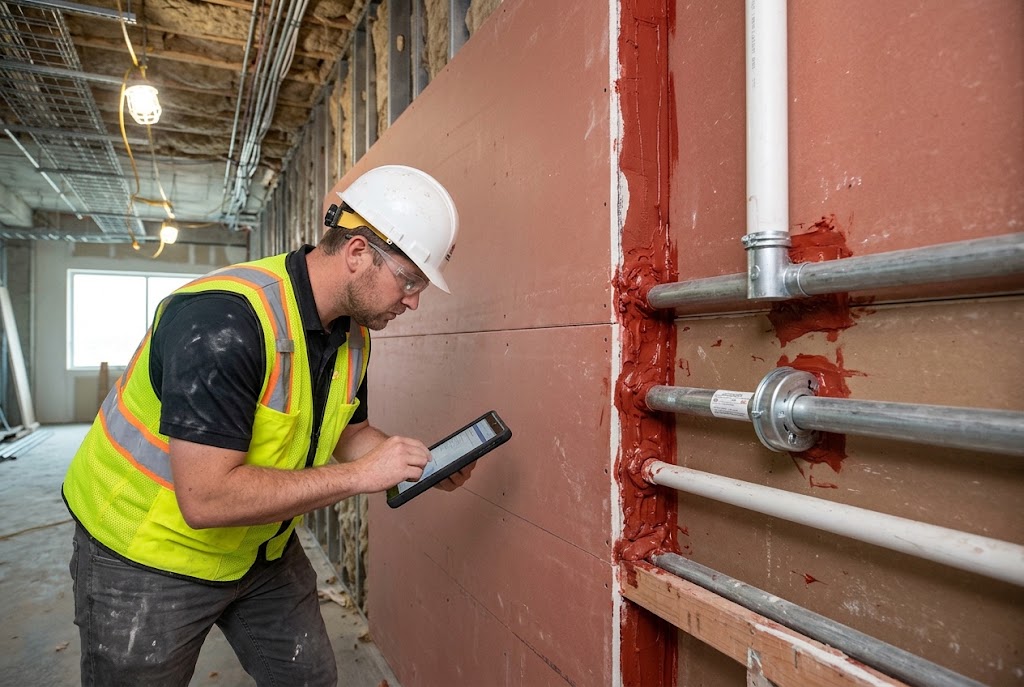
These checks should be completed before installation rather than after the penetration has been sealed.
Photographs, product identification and installation records can also help contractors demonstrate what was installed and support future maintenance.
4. Fire Collars vs Firestop Sealants: Understanding the Difference
Fire collars and firestop sealants are different types of passive fire protection products.
Their suitability depends on the tested or assessed penetration system.
Fire Collars
Fire collars commonly incorporate intumescent material designed to expand under fire exposure.
Depending on their design and supporting evidence, they may be used to protect penetrations involving certain combustible pipes or conduits.
However, the suitability of a particular collar must be verified for the actual electrical conduit application.
Contractors should check:
- Whether the product is approved or supported by evidence for the specified conduit material.
- The permitted conduit diameter.
- The applicable wall or floor construction.
- Required fixings and installation position.
- Any restrictions relating to cables inside the conduit.
- The fire resistance performance supported by the test or assessment evidence.
Firestop Sealants and Penetration Sealing Systems
Firestop sealants may form part of a tested penetration sealing system.
Depending on the application, a system may also incorporate fire-rated boards, mineral wool, backing materials or other components.
A sealant should not be assumed to provide a required FRL simply because it is described as fire-rated.
Its performance depends on the complete system configuration and supporting evidence.
Which Solution Is Better?
Neither option is universally better.
A fire collar may be appropriate for one tested configuration, while a sealant-based or combined system may be suitable for another.
Contractors should select the solution supported by evidence for the actual wall, service and required fire resistance performance.
5. Common Installation Mistakes to Avoid
Incorrectly protected penetrations can compromise the intended fire resistance of a building element.
Common mistakes include:
Using a Collar Designed for a Different Service
A collar tested for a plastic plumbing pipe may not be suitable for an electrical conduit.
Always verify the product’s intended application.
Ignoring Cable Fill
The number, size and type of cables inside a conduit may be relevant to the fire test configuration.
Where the supporting evidence specifies cable fill or arrangement, the installed configuration must remain within those conditions.
Using the Wrong Wall Construction
A product tested in a particular plasterboard wall may not automatically be suitable for concrete, masonry or another wall assembly.
Wall construction and thickness must match the applicable evidence.
Exceeding the Permitted Opening Size
The opening around the conduit may be limited by the tested system.
Oversized gaps, incorrect backing materials or inadequate sealant depth can affect performance.
Substituting Products Without Checking Evidence
Replacing a specified fire collar, sealant or other system component with a different product may invalidate the evidence relied upon for the original configuration.
Any substitution should be assessed against the applicable requirements and supporting documentation.
6. Why Firestopping Documentation Matters
Firestopping documentation is important during installation, inspection, maintenance and future building modifications.
For each penetration, useful records may include:
- Penetration location and identification.
- Wall construction and required FRL.
- Conduit dimensions and service details.
- Firestopping product manufacturer and model.
- Applicable test or assessment reference.
- Installation photographs.
- Installation date and relevant contractor details.
- Inspection findings and any corrective actions.
These records help building owners, maintenance teams and fire protection contractors understand the original installation.
They are particularly useful when additional cables are installed, conduits are modified or firestopping materials are disturbed during building work.
Any modification should be checked against the applicable firestopping system evidence.
7. Selecting Passive Fire Protection Products in Australia
Contractors should avoid choosing firestopping products based only on price, appearance or general product descriptions.
Before purchasing, confirm that the selected product has appropriate documentation for the intended application.
Useful purchasing checks include:
- Identify the service penetration and required fire resistance performance.
- Confirm the wall or floor construction.
- Determine whether the proposed product is suitable for the conduit and cable arrangement.
- Review relevant test reports, assessment reports and installation instructions.
- Check product dimensions, fixing requirements and system limitations.
- Confirm compatibility with the approved project documentation.
- Obtain clarification from the responsible designer or suitably qualified specialist where the evidence does not cover the proposed installation.
Passive Fire Protection Products from Fire Factory Australia
Fire Factory Australia supplies passive fire protection products for Australian contractors, installers and fire protection businesses.
Our passive fire range includes products such as fire collars, fire door seals and selected fire penetration sealing materials.
Contractors can explore our Passive Fire Protection Products or contact our team for available product information and technical documentation.
Product selection and installation compliance must be assessed against the applicable project requirements and supporting system evidence.
Frequently Asked Questions
Does Every Electrical Conduit Through a Fire-Rated Wall Need a Fire Collar?
No. The required firestopping solution depends on the wall construction, conduit material and dimensions, cable arrangement, required fire resistance performance and supporting evidence.
A fire collar may be suitable for some applications, while other tested penetration sealing systems may be appropriate for different configurations.
Can a Plumbing Fire Collar Be Used for an Electrical Conduit?
Not automatically.
A fire collar tested for a plumbing pipe should only be used for an electrical conduit if the relevant test or assessment evidence supports that specific application.
Can Firestop Sealant Replace a Fire Collar?
Only where a suitable tested or assessed system supports the proposed sealant installation.
Firestop sealants and collars are not automatically interchangeable.
What Australian Standards Apply to Electrical Conduit Penetrations?
Relevant references may include the National Construction Code, AS 1530.4 and AS 4072.1.
The applicable requirements depend on the project, building element, installation details and relevant editions of the standards.
Does a Fire Collar Automatically Make a Wall Penetration Compliant?
No.
The complete installation must be consistent with the applicable NCC requirements, project documentation and relevant evidence of suitability.
A product’s individual certification does not automatically establish compliance for every installation.
What Happens if Additional Cables Are Installed Later?
Adding cables may change the original penetration configuration.
The modified installation should be checked against the supporting firestopping evidence. Where necessary, the penetration should be reassessed and appropriately reinstated.
Conclusion
Electrical conduits passing through fire-rated walls require careful assessment to maintain the intended fire resistance of the building element.
The correct solution is not always a fire collar. It may involve a collar, sealant or another firestopping system, depending on the installation and supporting evidence.
Before installation, contractors should verify the conduit material, dimensions, cable arrangement, wall construction, opening size and applicable firestopping documentation.
Following this approach helps reduce installation errors, avoid unnecessary rework and support appropriate fire protection outcomes.
For passive fire protection product enquiries, visit Fire Factory Australia’s Passive Fire Solutions or contact our teamfor product information and availability.