Table of Contents
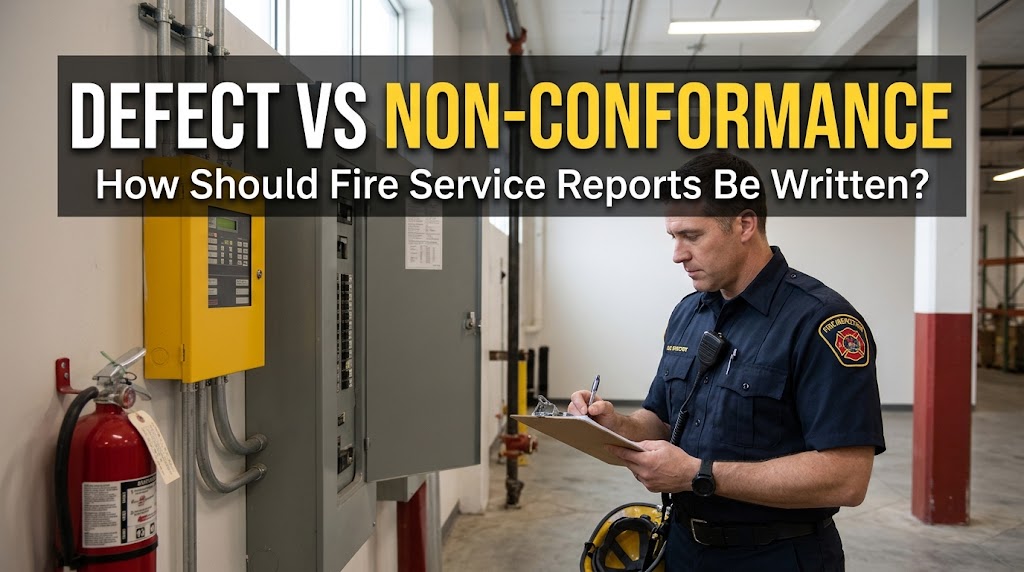
ToggleDefect vs Non-Conformance: How Should Fire Service Reports Be Written?
Quick Answer: Write reports by separating the physical condition from the compliance failure. A fire defect describes damaged, degraded, or missing equipment; a non-conformance describes failure to meet an AS 1851 requirement, manufacturer instruction, or site procedure. Use asset references, observed evidence, risk, and corrective actions so owners can act.
This guide clarifies fire defect vs non conformance language for AS 1851 reporting. Fire companies, electrical companies, retail operations, and fire protection teams all benefit from report language that is precise, evidence based, and easy for building owners to understand. The goal is to record what was found, why it matters, and what must be done next. Teams can also use FireFactory’s B2B fire protection product range to verify replacement components and product details when reports identify corrective actions.
Why the Distinction Matters in AS 1851 Reporting
Fire service reports often influence maintenance budgets, insurance responses, owner compliance reviews, and safety decisions. When a report uses vague terms, the reader may not know whether the issue is a physical fault, an overdue task, a missing part, or a procedural gap. Clear language helps the owner assign responsibility and prioritize corrective work.
The standard definitions should be checked before classification. Because a standards catalogue locator is not the full standard text, teams should obtain the relevant standard or an official technical guide before stating detailed requirements. This keeps report language aligned with current AS 1851 reporting expectations and avoids invented categories.
- Defects help identify what part of the asset is physically wrong.
- Non-conformances help identify which requirement, interval, procedure, or specification was not met.
- Corrective actions should be linked to the observed condition, not to a generic label.
- Risk language should describe the likely consequence, such as delayed operation, reduced coverage, or impaired system performance.
Fire Defect vs Non-Conformance: Practical Report Language
In many facilities, one asset can produce both a defect and a non-conformance. For example, a damaged control panel module is a defect. A failed inspection interval for that module is a non-conformance. Reporting both items separately gives the owner a clearer picture of repair needs and compliance status.
| Report Element | Fire Defect Example | Non-Conformance Example |
|---|---|---|
| Observed condition | Corroded pipe fitting, cracked enclosure, missing detector, failed battery, blocked vent. | Recorded maintenance interval missed, missing test record, procedure not followed, documentation not current. |
| Report focus | Physical state, installation condition, component function, damage, wear, or missing hardware. | Failure to meet an applicable requirement, manufacturer instruction, site procedure, or documented specification. |
| Corrective action | Repair, replace, clean, adjust, or retest the affected component or system. | Update records, complete overdue testing, retrain staff, revise procedure, or submit evidence of compliance. |
| Owner value | Identifies the asset and physical work required. | Identifies the compliance gap and the evidence needed to close it. |
Report writers should not force every finding into one category. If a finding involves both a physical condition and a missed requirement, describe both. Use the standard wording where it applies, and use plain language when explaining the practical effect.
Writing Clear Fire Service Report Entries
A useful report entry should allow another technician, owner, or auditor to understand the finding without extra explanation. Each entry should use specific asset references, objective observations, and a corrective action that is realistic to complete.
- Identify the asset with a location, asset number, system zone, or equipment tag. Avoid vague references such as “fire panel” or “alarm zone” when a more precise reference is available.
- Describe the observed condition using measurable or visible facts. Include component type, manufacturer, model, serial number, and installation condition where known.
- State the applicable requirement source. This may be the current standard, manufacturer instruction, site procedure, or approved design document. Verify exact clauses, intervals, and product claims before drafting.
- Classify the finding as a defect, a non-conformance, or both, based on the standard definitions and the evidence collected on site.
- Record the risk in practical terms, such as reduced detection coverage, delayed alarm operation, impaired suppression response, or incomplete compliance evidence.
- Specify the corrective action, responsible party, recommended time frame, and verification method. Where replacement is needed, include exact model evidence and compatibility checks.
Good reports separate fact from interpretation. The observed condition should be factual. The compliance interpretation should reference the applicable requirement. The corrective action should close the specific gap.
Evidence, Failure Points, and Commercial Facility Considerations
Common failure points differ by system, but reports become stronger when they include the evidence that supports the finding. For detection systems, evidence may include test results, fault codes, sensor condition, wiring condition, and location details. For suppression systems, evidence may include pressure readings, component condition, valve status, nozzle condition, and maintenance records. For alarm and communication equipment, evidence may include battery status, circuit health, software or firmware condition, and panel fault logs.
Commercial facilities add procurement, tenancy, and operational complexity. A retail centre, warehouse, or mixed use building may have multiple owners, tenants, contractors, and system interfaces. Reports should make it clear which asset is affected, which party owns the corrective action, and whether the issue affects common property, tenancy, or the building management system. Where a defect requires replacement parts, the report should include enough detail to support purchasing decisions, such as exact model references, material compatibility, and any required testing after installation.
Teams should verify current official sources before publishing report language that references specific clauses, intervals, or product performance. For standard identification, the Standards Australia search page provides a reliable starting point for locating the relevant standard.
When replacement components are needed, B2B suppliers can support the corrective action process by providing exact model references and product documentation. FireFactory’s B2B fire protection supply focus is relevant where teams need to match report findings to available replacement items and verify product details before purchase.
Frequently Asked Questions
What is the difference between a fire defect and a non-conformance?
A fire defect describes a physical or functional problem with an asset, such as damage, degradation, missing parts, or impaired operation. A non-conformance describes a failure to meet an applicable requirement, interval, procedure, or specification. In practice, one asset may have both findings.
Should fire service reports use the terms defect and non-conformance?
Yes, when the terms are defined by the applicable standard or clearly explained in the report. Reports should avoid invented categories and should link each term to observed evidence and a corrective action. This gives owners and auditors a clearer compliance picture.
How does AS 1851 reporting support compliance?
AS 1851 reporting supports compliance by recording system condition, test results, identified failures, and required corrective actions. Strong reports connect findings to asset references, applicable requirements, and verification steps. This helps owners demonstrate that fire protection systems are maintained and reviewed.
What details should a fire service report include?
A report should include asset identification, observed condition, evidence, applicable requirement source, classification, risk description, corrective action, and verification method. Where replacement is required, it should include exact model, manufacturer, and compatibility details. These details reduce ambiguity and support procurement.
When should a report include product model numbers?
Model numbers should be included when the finding requires replacement, repair, or component matching. They help procurement teams purchase the correct item and help technicians verify compatibility before installation. Reports should use exact model evidence rather than generic component descriptions.
Conclusion
Effective fire service reporting depends on clear separation between physical faults and compliance gaps. A fire defect identifies what is physically wrong with an asset. A non-conformance identifies which requirement, interval, procedure, or specification was not met. When reports use asset references, observed evidence, applicable sources, risk, and corrective actions, they become practical tools for safety and compliance.
FireFactory supplies B2B fire protection products and exact model references that support report based replacement decisions. If your team needs compatible components, installation materials, or product information for fire system maintenance, contact FireFactory to source verified items for your project.