Table of Contents
TogglePassive Fire Logbook
A Complete Guide to AS 1851—2012 Passive Fire Service Records
Passive fire protection is an important part of a building’s fire safety strategy. Fire-resistant walls, floors, ceilings, doorsets, service penetrations, structural fire protection, shutters and glazing are designed to help contain fire and maintain the required fire separation within a building.
Regular inspection and clear service records help identify damage, unauthorised modifications, unprotected penetrations, deterioration and other conditions that may affect the performance of passive fire elements.
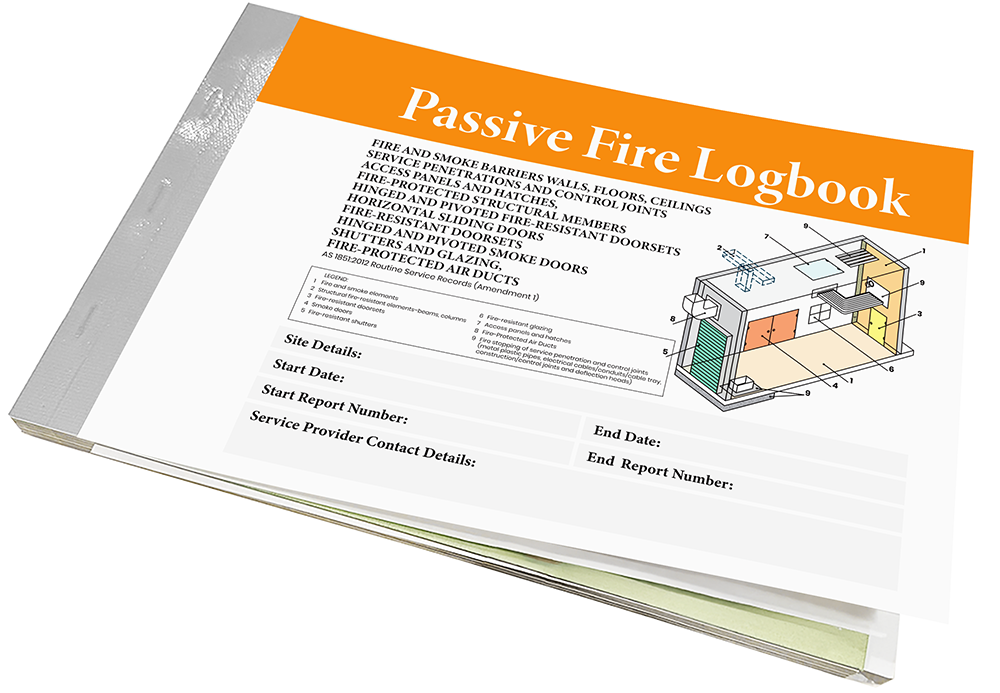
The Passive Fire Logbook provides structured routine service records for passive fire protection systems based on the relevant requirements of AS 1851—2012 (Incorporating Amendment No. 1), Section 12.
It brings Three-Monthly, Six-Monthly and Yearly passive fire service records together in one practical document, with dedicated areas for recording asset numbers, inspection results, defects, comments, corrective actions and completed repairs.
Why Is Passive Fire Maintenance Important?
Passive fire protection is built into the structure and fabric of a building.
Unlike active fire protection equipment that responds to a fire event, passive fire elements are designed to maintain compartmentation and fire resistance through features such as fire-rated walls, floors, doors, protected structural members and fire stopping.
Over time, these elements can be affected by building alterations, new service penetrations, damage, deterioration or changes to doors and other openings.
AS 1851—2012 requires accessible passive fire elements to be inspected using relevant compartmentation drawings, structural drawings or appropriately marked general drawings and associated schedules.
These inspections help identify barriers or penetrations that have been added, removed or modified, as well as areas that may require repair.
Clear and accurate passive fire inspection records are therefore an important part of ongoing passive fire maintenance.
What Does the Passive Fire Logbook Cover?
The Passive Fire Logbook is specifically designed for the passive fire elements covered by the product.
The logbook includes service records for:
- Fire & Smoke Barriers – Walls, Floors and Ceilings
- Service Penetrations and Control Joints
- Access Panels and Hatches
- Fire-Protected Structural Members
- Hinged and Pivoted Fire-Resistant Doorsets
- Horizontal Sliding Fire-Resistant Doorsets
- Hinged and Pivoted Smoke Doors
- Fire Shutters
- Fire-Rated Glazing
- Fire-Protected Air Ducts
These are the systems for which routine service records are provided within the logbook.
The inclusion of smoke doors and smoke-rated barriers does not make this a mechanical smoke control or smoke exhaust logbook. This product is specifically designed for passive fire service records under Section 12 of AS 1851—2012.
Passive Fire Routine Service Frequencies
The logbook provides service schedules at Three-Monthly, Six-Monthly and Yearly intervals according to the applicable Section 12 requirements.
| Passive Fire Element | Three-Monthly | Six-Monthly | Yearly |
|---|---|---|---|
| Fire & Smoke Barriers – Walls, Service Penetrations & Control Joints | — | — | ✓ |
| Fire & Smoke Barriers – Floors, Service Penetrations & Control Joints | — | — | ✓ |
| Fire & Smoke Barriers – Ceilings, Service Penetrations & Control Joints | — | — | ✓ |
| Fire & Smoke Rated Access Panels & Hatches | — | — | ✓ |
| Fire-Protected Structural Members | — | — | ✓ |
| Hinged & Pivoted Fire-Resistant Doorsets | — | ✓* | — |
| Horizontal Sliding Fire-Resistant Doorsets | ✓ | ✓ | — |
| Hinged & Pivoted Smoke Doors | — | ✓ | — |
| Fire Shutters | — | — | ✓ |
| Fire-Rated Glazing | — | — | ✓ |
| Fire-Protected Air Ducts | — | — | ✓ |
* Hinged and pivoted fire-resistant doorsets serving as entry doors to private residential apartments may be extended to a yearly service schedule where permitted by AS 1851—2012.
AS 1851 summarises the routine service frequencies for Section 12 as Three-Monthly for sliding fire doors, Six-Monthly for fire doors and smoke doors, and Yearly for the other applicable systems.
Yearly Passive Fire Service Records
A major part of the Passive Fire Logbook is dedicated to yearly inspections of passive fire elements.
Fire-Rated Walls, Floors and Ceilings
The logbook provides separate inspection requirements for walls, floors and ceilings, including their associated service penetrations and control joints.
The records allow technicians to document checks against drawings and penetration schedules and identify:
- elements that have been added, removed or modified
- new or modified service penetrations
- drawings or schedules that do not match installed penetrations
- unprotected penetrations
- damaged penetration protection
- incorrectly installed penetration and control joint work
- damage that may cause loss of fire resistance
For walls, the logbook also includes inspection of accessible walls to determine whether they continue to the next horizontal fire barrier or underside of the roof.
For ceilings, the inspection also considers light fittings, access panels and ceiling hatches.
Service Penetrations and Control Joints
Service penetrations are an important part of passive fire inspection because building services frequently pass through fire-rated walls, floors and ceilings.
The Passive Fire Logbook covers fire stopping associated with services such as:
- metal pipes
- plastic pipes
- electrical cables
- conduits
- cable trays
- construction joints
- control joints
- deflection heads
The service records allow technicians to document whether penetrations have been added, removed or modified and identify protection that is unprotected, damaged or incorrectly installed.
This provides a structured method for recording ongoing fire penetration inspections and fire stopping service records across buildings containing multiple passive fire assets.
The National Construction Code (NCC) also contains requirements relating to openings, construction joints and service penetrations through fire-resisting building elements.
NCC – Fire Protection of Openings and Penetrations
Fire & Smoke Rated Access Panels and Hatches
The Passive Fire Logbook includes a dedicated yearly service schedule for fire and smoke rated access panels and hatches.
Inspection items include:
- changes against drawings
- visible delamination or damage
- perimeter seals
- frame anchoring
- frame distortion
- screw fixings
- hinges and latches
- visible through-gaps
- added laminates or hardware that may interfere with operation
These checks are incorporated directly into the yearly passive fire service record.
Fire-Protected Structural Members
Structural fire protection is also covered by the Passive Fire Logbook.
The yearly service record provides checks for structural steel members and their fire protection systems or coatings.
This includes checking for additions, removals or modifications, mechanical damage, deterioration or loss of adhesion, damage to intumescent coatings, missing fire-protective boards and loss of adhesion of boards or cladding.
The logbook references protection such as:
- vermiculite
- cement
- mineral fibre
- plaster
- intumescent coatings
- fire-protective boards
- cladding
Six-Monthly Fire-Resistant Doorset Records
The Passive Fire Logbook contains a detailed Six-Monthly Service Schedule for Hinged and Pivoted Fire-Resistant Doorsets.
Fire doors form an important part of a building’s fire-resisting construction.
The inspection record covers important fire door components and operating conditions, including:
- modifications since the previous service
- door and frame tags
- statutory signage
- clearances
- locksets and latches
- closers and pivots
- hinges and selectors
- self-closing and self-latching operation
- door seals
- door leaves and frames
- vision panels
- fire-rated air transfer grilles
- travel limiting devices
- thresholds
- kickplates
- meeting stiles
- doors held open by a detection-controlled system
The logbook also provides dedicated fields for recording Asset Number, Results, Comments, Corrective Action and Completed Repairs for inspected doorsets.
National Construction Code – Part C4 Protection of Openings
Three-Monthly and Six-Monthly Horizontal Sliding Fire Doors
Horizontal sliding fire-resistant doors have their own combined service record within the Passive Fire Logbook.
Three-Monthly Service
The Three-Monthly section includes an operational test to verify correct automatic closing and confirm that the door closes from the fully open position and an intermediary position.
Six-Monthly Service
The more detailed Six-Monthly section includes checks for:
- location, tags and signage
- clearances and overlaps
- opening and closing forces
- restraint brackets
- flame guards
- suspension and operating hardware
- fusible links
- pulley cables and pulleys
- automatic closing
- warning signs and sounders
- guides, stops and restraints
- handles and grips
- door leaf condition
- door frames
- multiple-leaf doors
- wicket or personnel access doors
- power-assisted sliding doors
The schedule also records the requirement to replace applicable fusible links every 25 years from the date of manufacture.
Six-Monthly Smoke Door Records
Although this is a Passive Fire Logbook, Section 12 also includes passive smoke doors.
The product therefore contains a dedicated service record for Hinged and Pivoted Smoke Doors.
The Six-Monthly record covers:
- location
- door type and signage
- self-closing operation
- perimeter and bottom clearances
- smoke seals
- meeting stile seals
- doors held open
- essential hardware
- opening and closing forces
- closers and pivots
- hinges
- door condition
- frames
- glazing panels
- kickplates
- sequence selectors
- meeting stiles
The logbook also includes checks to confirm that smoke seals are suitable, undamaged, correctly fitted and do not interfere with correct door operation.
Yearly Fire Shutter Records
The Passive Fire Logbook includes a dedicated Yearly Service Schedule for fire shutters.
The service record covers:
- shutter location
- tags and signage
- bracket fixings
- barrel assembly
- guide tracks
- curtain overlap
- clearances
- free movement
- threshold
- fusible links
- automatic operation
- curtain descent
- rebound
- shutter slats
- bottom rail
- brake release mechanism
- illuminated warning signs
- sounders
- release delays
The logbook also provides for simulated automatic operation testing and checks of the shutter’s movement and condition.
Yearly Fire-Rated Glazing Records
Fire-rated glazing has its own yearly inspection section.
The service record includes checks for:
- additions, removals or modifications
- perimeter crazing or cracking
- impact cracking
- frame distortion
- frame anchoring
- visible defects or corrosion
- through-gaps
- fire stopping around the frame
- glazing seal deterioration
These records help document the ongoing condition of fire-rated glazing as part of the building’s passive fire protection.
Yearly Fire-Protected Air Duct Records
The Passive Fire Logbook also provides a Yearly Service Record for Fire-Protected Air Ducts.
The inspection covers modifications against drawings and schedules, condition of fire-resistant duct protection, supports, mechanical damage, deterioration of protective materials, loss of adhesion and missing fire-protective boards or cladding.
An important distinction applies here:
Damper operation is referred to Section 13 of AS 1851—2012.
The Passive Fire Logbook records the passive fire protection of the duct itself. It is not intended to act as a mechanical fire damper or mechanical smoke control service logbook.
Recording Results, Defects and Corrective Actions
The Passive Fire Logbook is designed not only to show which inspection was performed, but also to create a clear service record for individual passive fire assets.
Service pages provide fields for:
Asset Number | Results | Comments | Corrective Action | Completed Repairs
They also include site and service information such as:
Site Name | Site Address | Site ID | Work Order Number | System Location | Service Provider Details | Date | Report Number | Technician Name | Licence Number | Signatures
This allows identified passive fire defects and completed repairs to be linked to individual assets and service visits.
Passive Fire Results Tables
The Passive Fire Logbook also includes dedicated Results Tables for recording large numbers of passive fire assets.
These numbered tables make it easier to reference individual passive fire items and record their inspection status without creating an unnecessarily large service schedule for every asset.
This is particularly useful for buildings containing large numbers of:
- fire doors
- smoke doors
- service penetrations
- fire stopping systems
- access panels
- other passive fire elements
The Results Tables are provided as dedicated pages within the logbook.
Why Are Drawings and Penetration Schedules Important?
Passive fire inspections rely heavily on accurate building documentation.
AS 1851—2012 states that inspection, testing, routine servicing and survey of accessible passive fire elements should be conducted using existing compartmentation drawings, structural drawings or appropriately marked general drawings and associated schedules showing the location and fire requirements of the items.
The Standard notes that an inspection cannot be properly conducted without adequate documentation.
This is particularly important when inspecting service penetrations because the technician needs to identify whether penetrations have been added, removed or modified and whether the documentation accurately represents the installed condition.
AS 1851—2012 Requirements in NSW
An important regulatory change took effect in NSW on 13 February 2026.
NSW Government guidance states that building owners must apply the required procedures for maintaining applicable essential fire safety measures in accordance with AS 1851—2012 or the relevant Performance Solution.
From that date, new and existing Class 1b and Class 2 to Class 9 buildings in NSW must have applicable essential fire safety measures inspected and tested in accordance with AS 1851—2012, unless the maintenance activity is addressed by an applicable Performance Solution.
NSW Government – Responsibilities of Building Owners under AS 1851—2012
National Construction Code – Building Classifications
This is particularly relevant to passive fire maintenance because AS 1851 contains specific routine service requirements for passive fire elements under Section 12.
NSW Government guidance also states that building owners must keep the required AS 1851 records for at least seven years and make them available for inspection.
Current NSW Government guidance also states that AS 1851—2012 does not require a passive fire register. This should not be confused with the requirement to maintain applicable service records.
Why Use a Hardcopy Passive Fire Logbook?
AS 1851 recognises logbooks as a form of routine service record for Section 12.
The Standard requires service records, including applicable pass/fail criteria, to be captured at the time of routine service.
Current NSW Government guidance states that a hardcopy logbook must be left on site at the completion of testing.
Electronic recording may also be offered by a contractor, but it does not currently replace the physical logbook.
A structured physical AS 1851 Passive Fire Logbook therefore provides an accessible and organised service history at the building.
Who Can Use the Passive Fire Logbook?
The Passive Fire Logbook is suitable for use as part of routine passive fire service record keeping by:
- passive fire technicians
- fire protection contractors
- fire door service providers
- facility managers
- building managers
- strata representatives
- owners corporation representatives
- other professionals responsible for passive fire protection records
The actual inspection, testing and servicing must be performed by persons with the appropriate competency and, where required, licences or qualifications for the work being undertaken.
About the AS 1851 Passive Fire Logbook
The Passive Fire Logbook is a structured service record for passive fire protection systems in Australia, designed to support routine service and record keeping in accordance with the relevant requirements of AS 1851—2012 (Incorporating Amendment No. 1), Section 12.
It brings together Three-Monthly, Six-Monthly and Yearly passive fire inspection records for the passive fire elements covered by the product, including:
fire-rated walls, floors and ceilings, fire stopping, service penetrations, control joints, access panels and hatches, fire-protected structural members, fire-resistant doorsets, horizontal sliding fire doors, smoke doors, fire shutters, fire-rated glazing and fire-protected air ducts.
For fire penetration inspections, the logbook provides structured records to help identify added, removed or modified penetrations and unprotected, damaged or incorrectly installed fire stopping and control joint work.
For fire door inspections, dedicated service schedules cover hinged and pivoted fire-resistant doorsets and horizontal sliding fire-resistant doorsets, including door tags, signage, clearances, hardware, door closers, hinges, seals, frames, door leaves, self-closing and self-latching functions and other applicable components.
The Passive Fire Logbook also provides dedicated records for passive structural fire protection, fire shutters, fire-rated glazing and fire-protected ductwork, together with fields for recording:
Pass / Fail / N/A | Asset Number | Results | Comments | Corrective Action | Completed Repairs
For Australian passive fire contractors and building service providers looking for an AS 1851 Passive Fire Logbook, the product provides one organised location for recording applicable Section 12 routine service activities.
Designed to support routine service and record keeping in accordance with the relevant requirements of AS 1851—2012, Section 12.
Frequently Asked Questions
What is a Passive Fire Logbook?
A Passive Fire Logbook is used to record routine inspection, testing and service results for passive fire protection elements within a building. This logbook provides structured records based on the applicable requirements of AS 1851—2012 Section 12.
Is this logbook for mechanical smoke control systems?
No. This is a Passive Fire Logbook. It includes passive elements such as smoke doors and fire and smoke barriers where they form part of Section 12, but it is not designed for mechanical smoke exhaust or smoke control systems.
What passive fire systems are included?
The logbook includes records for walls, floors, ceilings, service penetrations, control joints, access panels and hatches, fire-protected structural members, fire-resistant doorsets, horizontal sliding fire doors, smoke doors, fire shutters, fire-rated glazing and fire-protected air ducts.
Does the logbook include fire door inspection records?
Yes. Dedicated records are provided for Hinged and Pivoted Fire-Resistant Doorsets and Horizontal Sliding Fire-Resistant Doorsets, including their applicable service frequencies.
How often are fire doors serviced under AS 1851—2012?
Fire doors are generally serviced Six-Monthly, while horizontal sliding fire doors also have a Three-Monthly service requirement.
Hinged and pivoted fire-resistant doorsets serving as private residential apartment entry doors may be extended to a yearly service schedule where permitted by AS 1851—2012.
Does the logbook cover fire penetration inspections?
Yes. It provides records for service penetrations and control joints through fire-rated walls, floors and ceilings, including checks for added, removed, modified, damaged, unprotected or incorrectly installed penetrations.
What types of service penetrations are covered?
Examples identified in the logbook include metal pipes, plastic pipes, electrical cables, conduits and cable trays, together with construction joints, control joints and deflection heads.
Does the logbook include passive structural fire protection?
Yes. It includes yearly inspection records for fire-protected structural members and protection such as sprayed materials, intumescent coatings, fire-protective boards and cladding.
Are fire shutters and fire-rated glazing included?
Yes. Both have dedicated Yearly Service sections within the Passive Fire Logbook.
Are fire-protected air ducts included?
Yes. The passive fire protection of air ducts is included. However, fire damper operation is referred to Section 13and is therefore outside the main servicing scope of this Passive Fire Logbook.
Is AS 1851—2012 mandatory in NSW?
For applicable maintenance activities, NSW requirements changed from 13 February 2026. Applicable essential fire safety measures in new and existing Class 1b and Class 2–9 buildings in NSW must be inspected and tested in accordance with AS 1851—2012 unless an applicable Performance Solution addresses the maintenance activity.
How long must AS 1851 service records be kept in NSW?
Current NSW Government guidance states that building owners must keep the prescribed AS 1851 records for at least seven years and make them available for inspection.
Does AS 1851—2012 require a passive fire register?
According to current NSW Government guidance, there is no requirement to have a passive fire register under AS 1851—2012. This is separate from the requirement to maintain applicable service records and documentation.
Does using this logbook automatically mean a building complies with AS 1851—2012?
No. The Passive Fire Logbook provides a structured way to record applicable routine service activities.
Compliance also depends on the actual condition of the building’s fire safety measures, applicable approved design and documentation, correct servicing, competent personnel and relevant regulatory requirements.
Do you ship Passive Fire Logbooks across Australia?
Yes. Our Passive Fire Logbooks can be shipped across Australia, including New South Wales, Victoria, Queensland, Western Australia, South Australia, Tasmania, the Australian Capital Territory and the Northern Territory.
Customers in Sydney, Melbourne, Brisbane, Perth, Adelaide, Hobart, Canberra, Darwin and regional areas can order Passive Fire Logbooks for delivery.
Is the Passive Fire Logbook only for NSW?
No. The Passive Fire Logbook is designed around the relevant requirements of Section 12 of AS 1851—2012.
AS 1851 is an Australian Standard, but the way its requirements are adopted or applied can vary between Australian states, territories, building types and regulatory frameworks.
The logbook can be ordered and used by fire protection and building service providers throughout Australia.
Conclusion
The Passive Fire Logbook provides a clear and organised way to document routine service activities for a wide range of passive fire protection elements.
With dedicated Three-Monthly, Six-Monthly and Yearly service records, it supports documentation for fire doors, sliding fire doors, smoke doors, fire-rated walls, floors and ceilings, service penetrations, fire stopping, control joints, structural fire protection, fire shutters, fire-rated glazing and fire-protected air ducts.
For fire protection contractors, passive fire technicians and building managers in Australia, the Passive Fire Logbookprovides a practical AS 1851 Passive Fire service record for maintaining clear, consistent and traceable passive fire maintenance records.
Designed to support routine service and record keeping in accordance with the relevant requirements of AS 1851—2012, Section 12.
Explore Our Complete Fire Safety Logbook Range
Looking for logbooks for other fire protection systems?
Fire Factory Australia provides a comprehensive range of AS 1851—2012 Fire Safety Logbooks for routine inspection, testing, servicing and maintenance records across a wide range of fire protection systems.
Our range includes logbooks for fire detection and alarm systems, emergency warning systems, sprinkler systems, fire pumps, hydrants, hose reels, water storage tanks, special hazard systems, passive fire protection, mechanical fire and smoke control systems, emergency and exit lighting, and other fire protection equipment.