Table of Contents
Toggle-
Fire Extinguisher, Hose Reel, Fire Hose & Fire Blanket Logbook
A Complete Guide to AS 1851 Fire Equipment Routine Service Records
Fire extinguishers, fire hose reels, delivery lay flat fire hoses and fire blankets are some of the most common fire protection equipment found in Australian buildings.
Regular servicing and clear records are important for maintaining this equipment and documenting its condition, inspection and service history.
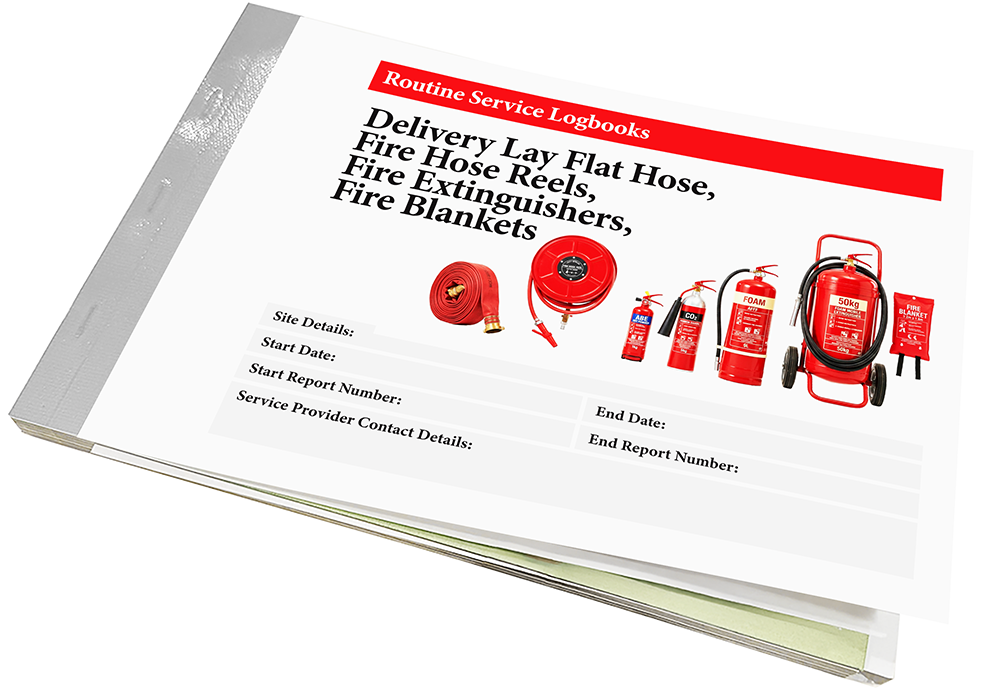
The BRSL Routine Service Logbook provides one organised location for recording routine service activities for:
- Delivery Lay Flat Fire Hoses
- Fire Hose Reels
- Portable Fire Extinguishers
- Wheeled Fire Extinguishers
- Fire Blankets
Developed around the relevant requirements of AS 1851—2012 (Incorporating Amendment No. 1), Sections 8, 9, 10 and 11, this two-year fire equipment service logbook combines an equipment register with structured routine service records for these four categories of fire protection equipment.
For the equipment covered by this product, AS 1851 uses service tags or labels supported by hardcopy summary records. The BRSL provides a practical hardcopy format for maintaining these supporting equipment and service records together.
What Fire Equipment Does the BRSL Cover?
The BRSL Fire Equipment Routine Service Logbook brings four categories of fire protection equipment together in one document.
Fire Equipment AS 1851—2012 Section Main Service Intervals Delivery Lay Flat Fire Hose Section 8 Yearly Fire Hose Reels Section 9 Six-Monthly · Yearly Portable Fire Extinguishers Section 10 Six-Monthly · Yearly · Five-Yearly* Wheeled Fire Extinguishers Section 10 Six-Monthly · Yearly · Five-Yearly* Fire Blankets Section 11 Six-Monthly * Additional requirements can apply to particular extinguisher types and circumstances. For example, AS 1851 identifies a Three-Yearly discharge requirement for certain stored-pressure extinguishers and also includes requirements following use.
The BRSL therefore provides a combined Fire Extinguisher Logbook, Fire Hose Reel Logbook, Fire Blanket Service Record and Delivery Lay Flat Fire Hose Service Record within one practical document.
Delivery Lay Flat Fire Hose Service Records
Section 8 of AS 1851—2012 covers routine servicing of delivery lay flat fire hose.
The Standard specifies Yearly servicing, as well as servicing after use and where defects are suspected.
The BRSL includes a dedicated Yearly Routine Service Schedule for Delivery Lay Flat Fire Hose based on the applicable Section 8 requirements.
The service schedule includes checks for:
- visible cuts, abrasion and burns
- contamination
- hose condition and cleanliness
- hose couplings
- threads and lugs
- gaskets
- correct storage
- service tag condition and accessibility
- hydrostatic pressure testing
- cleaning after contamination
- drying before storage where required
The service schedule also provides the applicable hydrostatic test pressures for Class L, Class M and Class H hose, together with the required pressure-test procedure.
AS 1851 also requires hose that cannot be repaired, or that fails the required hydrostatic pressure test, to be condemned and removed from service.
Changes to hose length following permitted repairs must also be recorded.
The BRSL therefore provides a structured record for fire hose inspection, fire hose pressure testing, hose condition and routine service history.
Fire Hose Reel Service Records
The BRSL includes dedicated Six-Monthly and Yearly Fire Hose Reel Service Records.
Six-Monthly Fire Hose Reel Service
The Six-Monthly schedule covers operational and condition checks including:
- accessibility and obstructions
- location signage
- operating instructions
- damage and corrosion
- hose reel cabinet condition
- nozzle and nozzle interlock
- swing arm operation
- hose run-off
- free unwinding of the hose
- leakage from the hose
- leakage from the nozzle, stop valve and fittings
- water flow through the reel
- service tag or label
These checks allow technicians to document the condition and operation of each fire hose reel during routine servicing.
Yearly Fire Hose Reel Service
The Yearly service includes the applicable Six-Monthly activities together with additional checks relating to the installation and performance of the hose reel.
These include:
- mounting and anchor points
- hose guide
- fittings and connections
- bearings
- hose condition
- water flow rate from the most disadvantaged hose reel
The schedule also checks whether the hose reel remains appropriate for the fire hazard and whether building alterations have affected access, hose deployment or the ability of the hose to reach the intended hazard.
The BRSL therefore provides dedicated Fire Hose Reel Routine Service Records for both Six-Monthly and Yearly activities within the same document.
Fire Extinguisher Service Records
A major part of the BRSL is dedicated to portable and wheeled fire extinguisher servicing under Section 10 of AS 1851—2012.
The logbook covers a range of extinguisher types, including:
Water · Wet Chemical · Foam · Powder · Carbon Dioxide (CO₂) · Vaporizing Liquid
It also distinguishes between portable and wheeled extinguishers and between applicable stored-pressure and gas-container extinguisher types where different service activities apply.
Six-Monthly Fire Extinguisher Service
The Six-Monthly Fire Extinguisher Routine Service Schedule includes checks relating to the extinguisher’s location, condition and operation.
Depending on the extinguisher type, the schedule includes items such as:
- accessibility and assigned location
- anti-tamper device
- operating instructions
- service tag or label
- external damage
- corrosion
- outlet hose and nozzle condition
- pressure indicator
- extinguisher contents or charge
- location signage
- support bracket
- discharge nozzle
- control valve
- wheeled extinguisher carriage
- powder condition
- compressed gas container
- actuating device
- internal components
- tyres, wheels and mobility
Where fitted, the pressure indicator is checked for legibility and correct operating range.
Applicable extinguishers are also weighed where required to determine whether they remain correctly charged.
For wheeled extinguishers, additional checks include the carriage assembly, tyres, wheels and mobility.
These dedicated records make the BRSL particularly useful as an AS 1851 Fire Extinguisher Logbook for sites containing different extinguisher types and sizes.
Yearly Fire Extinguisher Service
The Yearly Fire Extinguisher Service Schedule incorporates the applicable Six-Monthly activities and adds further service requirements for relevant extinguisher types.
These can include inspection of:
- operating head or cap
- discharge performance
- actuating device
- internal discharge components
- internal cylinder condition
- recharging
- seals and leak detection
- suitability for the fire hazard
- extinguisher type, class, size and rating
- changes to the building that may affect access
AS 1851 requires Yearly routine service of portable and wheeled extinguishers in accordance with the applicable Section 10 requirements.
Fire extinguisher servicing therefore involves more than simply checking the service tag.
The applicable activities depend on the type, construction and condition of the extinguisher.
Five-Yearly Fire Extinguisher Service
The BRSL also provides a dedicated Five-Yearly Fire Extinguisher Routine Service Schedule.
Depending on extinguisher type, Five-Yearly service can include more extensive activities such as:
- extinguisher function and discharge checks
- actuating-device inspection
- internal component inspection
- cylinder internal examination
- hydrostatic pressure testing
- extinguishing-agent replacement
- recharging
- replacement of seals and gaskets
- leak testing
- hose assembly pressure testing
For applicable extinguisher bodies, AS 1851 includes hydrostatic testing requirements, while certain cylinders must be tested in accordance with AS 2030.5 at a certified gas cylinder test station.
For wheeled extinguishers, Five-Yearly requirements can also include hydrostatic pressure testing of the hose assembly.
The dedicated Five-Yearly section provides a clear record of these longer-term fire extinguisher testing and maintenance activities.
Fire Blanket Service Records
Section 11 of AS 1851—2012 covers fire blankets and specifies routine servicing at intervals not exceeding six months, as well as when defects are suspected.
The BRSL includes a dedicated Six-Monthly Fire Blanket Service Schedule.
The inspection includes checks that the fire blanket is:
- conspicuous
- in its assigned location
- readily accessible
- correctly installed
- provided with visible and correct signage
The container is also checked for:
- secure support
- cleanliness
- damage
- legible instructions
- service record tag or label
The blanket itself is removed from the container to check for damage or contamination, damaged hand-holding devices and correct folding before being repacked in accordance with the manufacturer’s recommendations.
An important requirement is that a fire blanket must be discarded after it has been used on a fire.
AS 1851 Service Tags, Labels and Summary Records
For the equipment categories covered by the BRSL, AS 1851 uses service tags or labels together with supporting hardcopy summary records.
These equipment categories include:
- Delivery Lay Flat Fire Hose
- Fire Hose Reels
- Portable Fire Extinguishers
- Wheeled Fire Extinguishers
- Fire Blankets
The service tag or label records the level of service performed and the month and year of service.
AS 1851 uses service-level markings including:
1 = Six-Monthly
2 = Yearly
3 = Three-Yearly, where applicable
4 = Five-Yearly
5 = Recharged after use, where applicableThe supporting hardcopy summary record includes an equipment register, the service performed and details of missing or defective items.
The BRSL is therefore more than a simple inspection checklist.
It provides an organised site record that can be used alongside individual equipment service tags and labels.
Equipment Register for Up to 100 Fire Equipment Items
The BRSL includes a dedicated Equipment Register for up to 100 items.
Each asset can be recorded using fields including:
Equipment Type | Level | ID / Asset No. | Location | Class | Size / Length | Make / Model | Install Date | Comments
The register is designed for all equipment categories covered by the logbook, including:
- delivery lay flat fire hose
- fire hose reels
- portable extinguishers
- wheeled extinguishers
- fire blankets
For extinguishers, this allows different equipment types and classifications to be clearly identified within the same site register.
This is particularly useful for commercial buildings and larger sites containing multiple fire extinguishers, hose reels and fire blankets across different floors and locations.
Recording Fire Equipment Defects and Service Results
Clear records are an important part of AS 1851 routine servicing.
Where tags or labels are used, the supporting summary record documents the equipment, service performed and missing or defective items.
Service activities and applicable pass/fail criteria are also recorded at the time of routine service.
This allows service providers to maintain traceable records of:
Equipment Identification | Service Performed | Inspection Results | Defects | Corrective Actions | Completed Work
After defect rectification, the applicable system or component should also be tested for correct function.
AS 1851—2012 Requirements in NSW
From 13 February 2026, requirements changed in NSW for the maintenance of applicable essential fire safety measures in new and existing Class 1b and Class 2 to Class 9 buildings.
Applicable essential fire safety measures must be inspected and tested in accordance with AS 1851—2012 unless the maintenance activity is addressed by an applicable Performance Solution.
NSW Government guidance also states that building owners must keep the required AS 1851 records for at least seven years.
This is particularly relevant to commonly installed equipment such as fire extinguishers, fire hose reels and fire blankets.
NSW Government – Building Fire Safety Requirements under AS 1851—2012
Why Use a Hardcopy Fire Equipment Service Logbook?
For the equipment covered by the BRSL, AS 1851 provides for service tags or labels supported by hardcopy summary records.
The required service information needs to remain accessible and clearly linked to the equipment being maintained.
A structured hardcopy Fire Equipment Service Logbook provides a practical way to keep:
- equipment registers
- routine service records
- inspection results
- defects
- corrective actions
- service history
together at the building.
This creates an organised record that complements the service tags and labels attached to individual equipment.
Who Can Use the BRSL Routine Service Logbook?
The BRSL Routine Service Logbook is designed for organisations and professionals responsible for maintaining routine service records for the applicable fire equipment.
This can include:
- fire protection service providers
- fire equipment technicians
- facility managers
- building managers
- organisations responsible for fire equipment maintenance records
Actual inspection, testing and servicing should be performed by persons with the appropriate competency and, where applicable, licences or qualifications for the work being undertaken.
About the AS 1851 Fire Extinguisher, Hose Reel, Fire Hose & Fire Blanket Logbook
The BRSL Routine Service Logbook is a combined fire equipment service record designed for:
Delivery Lay Flat Fire Hoses · Fire Hose Reels · Portable Fire Extinguishers · Wheeled Fire Extinguishers · Fire Blankets
Developed around the relevant requirements of Sections 8, 9, 10 and 11 of AS 1851—2012 (Incorporating Amendment No. 1), the logbook provides structured records for applicable Six-Monthly, Yearly and Five-Yearly servicing, together with an equipment register for up to 100 fire equipment assets.
For fire extinguisher servicing, the logbook covers portable and wheeled extinguishers and applicable Water, Wet Chemical, Foam, Powder, Carbon Dioxide (CO₂) and Vaporizing Liquid extinguisher types.
Dedicated schedules support recording of condition checks, pressure indicators, contents, hoses and nozzles, corrosion, discharge testing, internal components, recharging, hydrostatic testing and other applicable service activities.
For fire hose reel maintenance, dedicated Six-Monthly and Yearly records cover accessibility, signage, cabinets, hose condition, nozzle operation, leakage, water flow, mounting, fittings and changes that may affect access or hose coverage.
For delivery lay flat fire hose, the Yearly service record covers hose condition, couplings, storage, service tags, cleaning, drying and hydrostatic pressure testing.
For fire blanket servicing, the Six-Monthly schedule provides structured checks for accessibility, location, signage, container condition, blanket condition, hand-holding devices, folding and repacking.
The dedicated 100-item Equipment Register provides fields for Equipment Type, Level, ID / Asset Number, Location, Class, Size / Length, Make / Model, Install Date and Comments.
For Australian fire protection contractors, technicians and building service providers looking for a combined Fire Extinguisher Logbook, Fire Hose Reel Logbook, Fire Blanket Service Record and Fire Hose Service Record, the BRSL brings these records together in one practical hardcopy document.
Designed to support routine service record keeping for Delivery Lay Flat Fire Hose, Fire Hose Reels, Portable and Wheeled Fire Extinguishers and Fire Blankets in accordance with the relevant requirements of AS 1851—2012, Sections 8–11.
Frequently Asked Questions
What is the BRSL Routine Service Logbook?
The BRSL Routine Service Logbook is a combined service record for Delivery Lay Flat Fire Hose, Fire Hose Reels, Portable and Wheeled Fire Extinguishers and Fire Blankets.
It provides structured routine service records based on the relevant requirements of Sections 8–11 of AS 1851—2012.
What sections of AS 1851 does the BRSL cover?
The BRSL covers equipment addressed by:
- Section 8 – Delivery Lay Flat Fire Hose
- Section 9 – Fire Hose Reels
- Section 10 – Portable and Wheeled Fire Extinguishers
- Section 11 – Fire Blankets
Is this a Fire Extinguisher Logbook?
Yes.
A major part of the BRSL provides structured service records for portable and wheeled fire extinguishers, including applicable Six-Monthly, Yearly and Five-Yearly service activities.
How often should fire extinguishers be serviced under AS 1851—2012?
Section 10 includes Six-Monthly, Yearly and Five-Yearly routine service requirements, with additional requirements applying to particular extinguisher types and circumstances.
For example, a Three-Yearly discharge requirement applies to certain extinguisher types.
Does the logbook cover both portable and wheeled fire extinguishers?
Yes.
The fire extinguisher schedules include applicable requirements for both portable and wheeled fire extinguishers.
What types of fire extinguishers are covered?
The product identifies:
Water · Wet Chemical · Foam · Powder · Carbon Dioxide (CO₂) · Vaporizing Liquid
Applicable service activities depend on extinguisher type and construction.
How often are fire hose reels serviced?
The BRSL provides dedicated Six-Monthly and Yearly Fire Hose Reel Service Records.
Does the logbook include fire hose reel flow testing?
Yes.
The Yearly Fire Hose Reel schedule includes measurement of water flow from the most disadvantaged hose reel, together with the applicable criteria shown in the service schedule.
How often is delivery lay flat fire hose serviced?
AS 1851 specifies Yearly servicing, as well as servicing after use and when defects are suspected.
Does delivery lay flat fire hose require pressure testing?
Yes.
The Yearly routine service schedule includes hydrostatic pressure testing, with applicable test requirements depending on the hose class.
How often are fire blankets serviced?
AS 1851 specifies routine servicing at intervals not exceeding six months, as well as when defects are suspected.
Can a fire blanket be reused after a fire?
No.
A fire blanket must be discarded after it has been used on a fire.
Does the BRSL include an equipment register?
Yes.
The BRSL includes an Equipment Register for up to 100 items, with fields for equipment type, level, asset number, location, class, size or length, make/model, installation date and comments.
Are service tags still required when using this logbook?
Yes.
The BRSL does not replace applicable AS 1851 service tag or label requirements.
For the equipment covered by the product, service tags or labels are used together with supporting hardcopy summary records.
Does using the BRSL automatically make a building AS 1851 compliant?
No.
The BRSL provides a structured method for maintaining applicable routine service records.
Compliance also depends on the equipment, correct service activities, competent servicing, building requirements and applicable legislation.
Can the BRSL be ordered across Australia?
Yes.
The BRSL Fire Equipment Routine Service Logbook can be supplied to customers throughout Australia, including New South Wales, Victoria, Queensland, Western Australia, South Australia, Tasmania, the Australian Capital Territory and the Northern Territory.
Customers in Sydney, Melbourne, Brisbane, Perth, Adelaide, Canberra, Hobart, Darwin and regional Australiacan order the same BRSL for delivery.
Is the BRSL only for NSW?
No.
The BRSL is designed around the relevant requirements of AS 1851—2012 Sections 8, 9, 10 and 11.
AS 1851 is an Australian Standard, although the way its requirements are adopted or applied can vary between Australian states, territories, building types and regulatory frameworks.
Conclusion
The BRSL Routine Service Logbook brings routine service records for four common fire protection equipment categories together in one organised document:
Delivery Lay Flat Fire Hose · Fire Hose Reels · Portable & Wheeled Fire Extinguishers · Fire Blankets
With a two-year coverage period, an Equipment Register for up to 100 items, and structured Six-Monthly, Yearly and Five-Yearly service records, it provides a practical solution for maintaining clear and traceable fire equipment service documentation.
For fire protection contractors, technicians and building service providers, the BRSL provides a combined Fire Extinguisher Logbook, Fire Hose Reel Logbook, Fire Hose Service Record and Fire Blanket Service Recordwithin one practical hardcopy format.
Designed to support routine service record keeping in accordance with the relevant requirements of AS 1851—2012, Sections 8, 9, 10 and 11.
Explore Our Complete Fire Safety Logbook Range
Looking for logbooks for other fire protection systems?
Fire Factory Australia provides a comprehensive range of AS 1851—2012 Fire Safety Logbooks for routine inspection, testing, servicing and maintenance records across a wide range of fire protection systems.
Our range includes logbooks for fire detection and alarm systems, emergency warning systems, sprinkler systems, fire pumps, hydrants, hose reels, water storage tanks, special hazard systems, passive fire protection, mechanical fire and smoke control systems, emergency and exit lighting, and other fire protection equipment.