Table of Contents
ToggleFire Alarm & Fire-Rated Cables in Australia: Materials, Construction and Australian Standards
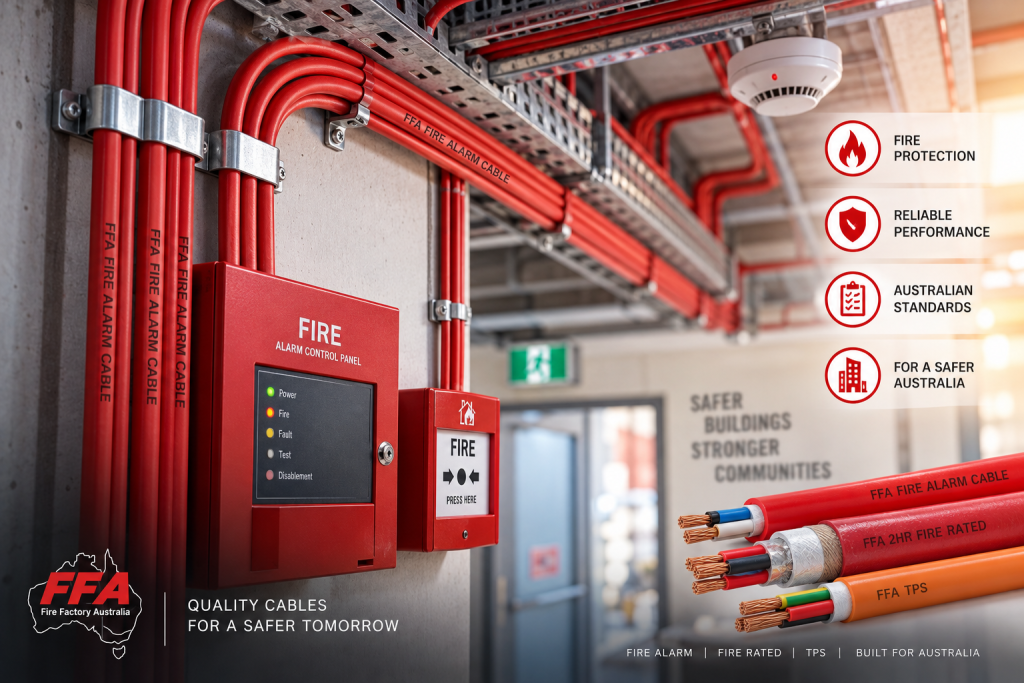
Fire alarm and fire-rated cables are a critical part of a building’s fire safety infrastructure. They carry power, signals and communications between fire detection equipment, alarm systems, emergency warning systems and other essential fire safety components.
The quality of these cables matters. A fire cable is more than copper conductors inside a red outer sheath. Its conductor construction, insulation, fire barrier, mechanical protection, temperature performance, smoke behaviour and identification can all affect how the cable performs in its intended application.
Fire Factory Australia (FFA) is an Australian manufacturer and wholesaler of fire protection equipment, serving the Australian fire industry since 2004. Our fire cable range is designed to support professional fire protection, electrical and building applications, with products manufactured and selected around relevant Australian and Australian/New Zealand Standards.
Our cable range includes Fire Alarm TPS Cable, Twisted TPS Fire Alarm Cable, 2-Hour Fire-Rated Cable, 3-Core and 4-Core Fire-Rated Cable, Twin & Earth TPS Cable, Orange Circular Cable and related fire cable accessories.
Explore Fire Factory Australia Fire Cables
Why Cable Quality Matters in Fire Protection Systems
In a normal electrical installation, a cable primarily needs to safely carry power or signals under its specified operating conditions.
Fire protection applications can introduce additional requirements.
Depending on the system and circuit, the wiring may need appropriate mechanical protection, clear fire-service identification, reliable conductor performance or the ability to maintain circuit integrity under specified fire conditions.
This distinction is important.
A standard fire alarm cable and a fire-rated circuit-integrity cable are not necessarily the same product.
For example, Fire Factory Australia offers TPS fire alarm cables for alarm and signalling applications as well as specially constructed 2-hour fire-rated cables for applications requiring a higher level of fire-survival performance.
AS/NZS 3013 provides a classification system for wiring-system elements based on their ability to maintain circuit integrity under specified fire conditions and against specified levels of mechanical damage.
This is why selecting cable only by its colour, size or number of conductors is not enough.
Understanding the Australian Standards Behind FFA Fire Cables
Several Australian and Australian/New Zealand Standards address different parts of cable construction and performance.
They should not be treated as interchangeable. Each standard addresses a different aspect of the cable or its use.
AS/NZS 3013 — Fire & Mechanical Performance
AS/NZS 3013 – Electrical installations: Classification of the fire and mechanical performance of wiring system elements is one of the key standards relevant to fire-rated wiring systems.
The standard establishes a classification system based on a wiring system’s ability to:
maintain circuit integrity under fire conditions for a specified period, and
maintain circuit integrity against mechanical damage of a specified severity.
It also provides type-test methods used to classify wiring-system elements for fire and mechanical performance.
This distinction is important when discussing a 2-hour fire-rated cable.
Fire resistance is not simply about whether the outer jacket burns. For critical circuits, the important question can be whether the wiring system continues to perform its electrical function for the required period under the specified test conditions.
Fire Factory Australia’s 2-hour fire-rated cable range uses a multi-layer construction designed for these demanding applications, including products incorporating:
Stranded bare copper conductors → Mica fire barrier → Flame-retardant low-smoke zero-halogen insulation → Filler → Fire-resistant LSZH tape → Flame-retardant low-smoke zero-halogen outer jacket.
This layered construction is fundamentally different from ordinary TPS cable.
Why Mica Tape Is Used
Mica is widely used as a fire-resistant barrier in fire-survival cable construction because of its ability to withstand very high temperatures while providing electrical insulation.
In FFA’s 2-hour fire-rated cable construction, a double layer of mica tape is used as the flame/fire barrier around the conductor.
The purpose is not simply to make the outside of the cable harder to burn. The protective layers help preserve electrical separation and support circuit integrity when the cable is exposed to severe fire conditions.
AS/NZS 1125 — The Conductors Inside the Cable
At the centre of every cable is its conductor.
FFA fire cable specifications use stranded bare copper conductors across relevant products.
AS/NZS 1125 specifies requirements for conductors used in insulated electric cables and flexible cords. Its requirements cover areas including copper conductors, conductor construction, stranded conductor classes and maximum DC resistance.
This matters because conductor size alone does not tell the full story.
The construction of the conductor and its electrical resistance affect voltage drop, current carrying performance and the reliability of the transmission path.
For example, FFA’s fire-rated cable range includes multiple conductor sizes to suit different applications, including:
0.75 mm², 1.0 mm², 1.5 mm², 2.5 mm², 4.0 mm² and 6.0 mm² in selected configurations.
FFA also offers multi-core fire-rated options, including 3-core and 4-core + earth constructions.
Selecting the correct conductor size should always be based on the system design, voltage drop, circuit requirements, equipment manufacturer requirements and applicable standards.
AS/NZS 3808 — Cable Insulation and Sheathing Materials
A cable’s insulation and outer sheath are not simply protective plastic coverings.
Their material properties are an important part of cable safety and long-term performance.
AS/NZS 3808 – Insulating and sheathing materials for electric cables provides specifications and tests for compounds used as insulating and sheathing materials in electric cables and flexible cords. The standard addresses materials including PVC, elastomeric materials, polyolefin materials and reduced-fire-hazard cable materials.
The current edition is AS/NZS 3808:2025, which superseded the earlier 2000 edition.
This is particularly relevant because different FFA cables use different materials according to their intended application.
V-90 PVC — Fire Alarm TPS Cable
FFA’s standard fire alarm TPS products use V-90 PVC insulation with a V-90 red PVC jacket in the relevant cable construction.
PVC provides practical electrical insulation and physical protection for general fire alarm wiring applications.
These products are different from FFA’s 2-hour fire-rated LSZH cables and should be selected according to the requirements of the specific circuit.
LSZH — Low Smoke Zero Halogen
FFA’s 2-hour fire-rated cable range uses flame-retardant, low-smoke, zero-halogen materials in the insulation and outer jacket of relevant products.
LSZH means Low Smoke Zero Halogen.
These materials are designed to limit smoke and halogen-containing gas emissions compared with conventional halogenated materials when exposed to fire under defined test conditions.
This characteristic is particularly valuable in buildings where people may need to evacuate through enclosed spaces.
However, it is important to understand that LSZH and fire-rated are not synonyms.
LSZH describes material/fire-emission characteristics.
Fire-rated circuit integrity describes the ability of a cable or wiring system to continue performing its electrical function under specified fire conditions.
A high-quality fire-survival cable may combine both characteristics.
Fire Performance Is More Than “Fire Resistant”
Several different properties can be involved when evaluating a cable’s behaviour in fire.
These include flame spread, smoke density, halogen gas emissions, acidity of gases and circuit integrity.
They measure different things.
For example, smoke-density testing evaluates smoke generated by cables burning under defined conditions. The current AS/NZS IEC 61034 series provides test procedures for measuring smoke density and superseded the earlier AS/NZS 1660.5.2 method.
FFA’s 2-core 2-hour fire-rated cable documentation references fire-performance testing including:
Vertical Flame Spread — AS/NZS 1660.5.1 / IEC 60332-3-24
Smoke Density — AS/NZS 1660.5.2 / IEC 61034
Halogen Gas — AS/NZS 1660.5.3 / IEC 60754-1
Acidity of Gases — AS/NZS 1660.5.4 / IEC 60754-2
Vertical Flame Propagation — AS/NZS 1660.5.6 / IEC 60332-1
These properties help provide a more complete picture of cable behaviour under fire conditions than simply describing a product as “fire resistant.”
AS/CA S008 — Australian Cabling Product Requirements
For applicable customer cabling products in Australia, AS/CA S008 is another important part of the regulatory framework.
AS/CA S008 covers requirements for customer cabling products and connecting hardware on the customer side of the telecommunications network boundary.
The Australian Communications and Media Authority (ACMA) states that cabling work subject to the Australian telecommunications cabling framework must use products that comply with the applicable technical standard, which adopts AS/CA S008.
The regulatory framework is relevant to communications cabling used in areas including telecommunications, security and alarm applications where the cabling falls within its scope.
ACMA also has compliance and labelling requirements for applicable cabling products supplied in Australia. The Regulatory Compliance Mark (RCM), or other permitted labelling methods under the rules, provides a means of demonstrating applicable regulatory compliance.
This is why ACMA compliance should not be treated simply as another marketing logo. Where applicable, it forms part of Australia’s regulatory system for customer cabling products.
AS 1670.1 — Fire Detection and Alarm System Wiring
Cable construction is only one side of the equation.
The cable must also be appropriate for the fire detection and alarm system in which it is installed.
AS 1670.1 covers the design, installation and commissioning of fire detection and alarm systems. Its requirements include system configuration, installation and wiring systems.
Identification is particularly important in fire systems because installers and service technicians need to distinguish fire-system transmission paths from other building services.
The 2018 edition, incorporating its 2021 amendment, includes requirements for identification of specialist cables. For cables not available with the specified markings, the amendment provides for indelible red identification markers at defined intervals and identification such as ELV Fire or LV Fire at termination points.
Correct cable identification therefore helps more than appearance. It supports installation, inspection, servicing and future identification of fire-system wiring.
Standard Fire Alarm Cable vs 2-Hour Fire-Rated Cable
This is one of the most important distinctions for installers, specifiers and contractors.
| Feature | Standard Fire Alarm TPS | 2-Hour Fire-Rated Cable |
|---|---|---|
| Main purpose | Fire alarm signals/power | Critical fire-system circuits requiring specified fire survival |
| Conductor | Stranded copper | Stranded copper |
| Typical insulation | PVC / V-90 | Flame-retardant LSZH |
| Fire barrier | Generally no dedicated mica barrier | Double-layer mica barrier in relevant FFA products |
| Outer jacket | PVC | Flame-retardant LSZH |
| Circuit-integrity design | Not equivalent to fire-rated cable | Designed for specified fire-survival applications |
| AS/NZS 3013 relevance | Mechanical classification may apply | Fire & mechanical performance is a key consideration |
| Typical applications | Fire alarm / signalling circuits | Critical fire alarm and EWIS circuits where specified |
The correct cable should always be determined by the approved design, system requirements, relevant standards and project specification.
A red cable is not automatically a 2-hour fire-rated cable.
Similarly, a cable described as flame-retardant or LSZH is not automatically a circuit-integrity cable.
FFA Fire Cable Range
Fire Factory Australia’s cable portfolio provides different constructions for different electrical and fire protection requirements.
Flat TPS Fire Alarm Cable provides a practical solution for general fire alarm wiring and signalling applications.
Twisted TPS Fire Alarm Cable uses twisted conductors and is available for applications where signal integrity and reduced susceptibility to electrical interference are important considerations.
2-Core 2-Hour Fire-Rated Cable combines stranded copper conductors with mica fire barriers and LSZH materials for demanding fire-survival applications.
3-Core 2-Hour Fire-Rated Cable provides an additional conductor configuration for fire-system applications requiring three conductors.
4-Core + Earth 2-Hour Fire-Rated Cable provides multiple conductors plus earth for applications requiring a larger fire-rated cable configuration.
Twin & Earth TPS Cable is available in 1.5 mm² and 2.5 mm² configurations for general electrical wiring applications.
Orange Circular Cable is available for power mains, submains and subcircuits in residential, commercial and industrial applications.
This range allows contractors to source both general electrical cable and specialised fire-system cable from the same fire protection supplier.
Why Choose Fire Factory Australia for Fire Cables?
Fire Factory Australia has supplied the Australian fire protection industry since 2004 and operates as an Australian manufacturer and wholesaler of fire protection equipment. Its product portfolio covers fire detection, fire-rated cables, extinguishers, emergency lighting, wet fire products, passive fire products and other fire safety equipment.
For contractors, installers, wholesalers and fire protection companies, cable selection is about more than price per metre.
It is about having clear technical specifications, appropriate construction, relevant compliance documentation, reliable supply and a range capable of supporting different fire-system applications.
Fire Factory Australia’s fire cable range has been developed around these requirements, from standard TPS fire alarm cable through to multi-core 2-hour fire-rated LSZH cable.
For projects requiring supporting documentation, Fire Factory Australia also maintains a dedicated Fire-Rated Cables certification section within its online certificates library.
View Fire-Rated Cable Certificates
Choosing the Right Fire Cable
Before selecting a cable, consider the circuit’s actual function.
Check whether the cable carries detection signals, communications, power or emergency warning circuits; whether circuit integrity during fire is required; the required number and size of conductors; voltage and voltage-drop requirements; mechanical protection; installation environment; fire and smoke performance; and any requirements specified by the fire engineer, consultant, equipment manufacturer or approved project documentation.
Most importantly, do not substitute a standard fire alarm cable for a specified fire-rated cable simply because both have a red outer sheath.
The cable construction and tested performance are what matter.
Fire Cables Built for Australian Fire Protection
From everyday fire alarm wiring to demanding 2-hour fire-rated transmission paths, the cable is an essential link between fire detection equipment, control systems and emergency warning equipment.
Fire Factory Australia’s range combines copper conductor technology, purpose-selected insulation and sheathing materials, fire-resistant construction and relevant Australian Standards requirements to provide cable solutions for Australia’s fire protection industry.
With more than two decades in the Australian fire protection market, FFA continues to expand its cable and fire safety product range for contractors, installers, wholesalers and commercial projects across Australia.