Table of Contents
ToggleWater Storage Tanks Logbook
A Complete Guide to AS 1851—2012 Fire Water Storage Tank Service Records
Water storage tanks are an important part of many fire protection water supply systems, providing stored water for systems such as fire sprinklers and fire hydrants where required by the approved fire protection design.
Maintaining the water level, tank condition, associated components and structural integrity is therefore an important part of maintaining a reliable fire protection water supply.
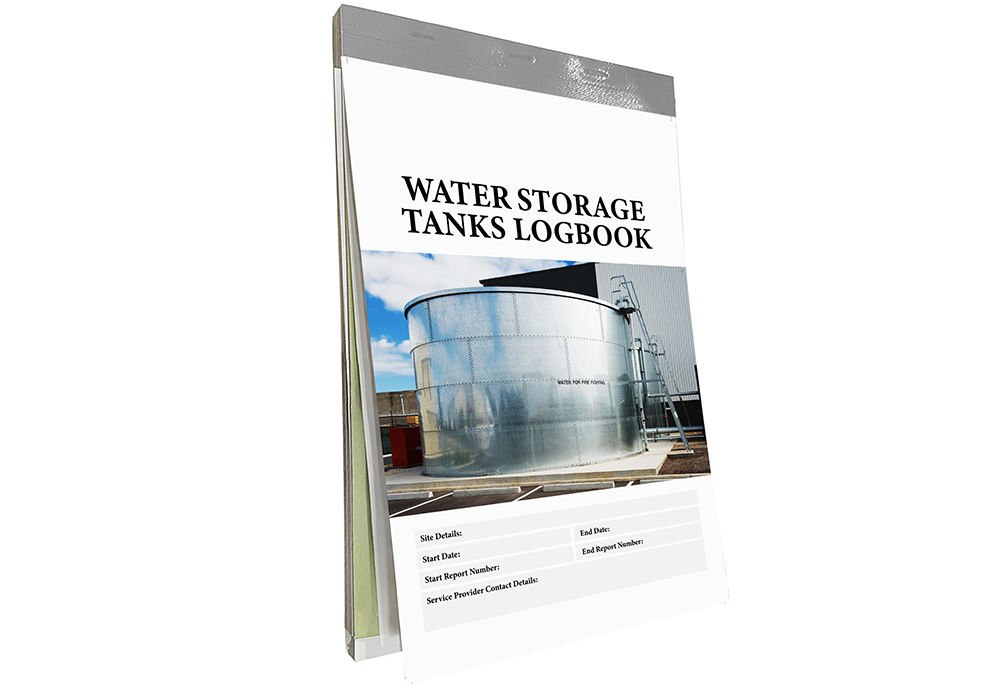
The Water Storage Tanks Logbook provides structured routine service records for fire protection water storage tanks based on the relevant requirements of AS 1851—2012 (Incorporating Amendment No. 1), Section 5 – Water Storage Tanks for Fire Protection Systems.
The logbook brings together applicable Monthly, Six-Monthly, Yearly, Six-Yearly and Ten-Yearly service records, with dedicated areas for recording inspection results, defects, comments, corrective actions and completed repairs.
Why Is Fire Water Tank Maintenance Important?
A fire water storage tank forms part of the water supply infrastructure supporting a building’s fire protection systems.
Its ability to store and make the required water available can be affected by issues such as:
- corrosion
- leakage
- physical damage
- foundation movement
- deterioration of tank liners
- contamination
- defective water-level equipment
- deterioration of associated components
AS 1851—2012 identifies a range of water storage tank components requiring attention during applicable routine servicing, including suction inlets, vortex inhibitors, tie rods in rectangular tanks, fittings, roof supports and tank liners where installed.
Routine inspection and clear fire water tank service records help document tank condition and identify deterioration that may affect the fire protection water supply.
What Does the Water Storage Tanks Logbook Cover?
The Water Storage Tanks Logbook is specifically designed around routine service activities applicable to water storage tanks for fire protection systems under Section 5 of AS 1851—2012.
The logbook provides structured records for applicable checks relating to:
- water level and water level indicators
- water supply pressure tanks, where fitted
- float valves
- tank joints, flanges and fittings
- bolts, anchors and tank fixings
- external and accessible internal corrosion
- tank foundations and evidence of subsidence
- access hatches and ladder systems
- roof structure and penetrations
- vermin proofing
- foreign objects and algae
- vents and rotary spinners
- signs, gaskets and sealants
- vortex inhibitors
- tank liners
- rectangular panel tanks
- pressure tanks
- draining, cleaning and refilling activities
- sludge depth measurements
- defects and corrective actions
These areas correspond with the service records provided within the Water Storage Tanks Logbook.
The Yearly service pages, for example, include checks for leakage, bolts and anchors, physical damage, foundation cracking, corrosion, access, roof structure, vermin protection, algae, vents, signs, gaskets, vortex inhibitors and other relevant tank conditions.
Types of Fire Protection Water Storage Tanks Covered
The Water Storage Tanks Logbook supports routine service record keeping for different water storage tank configurations used as part of fire protection systems, including:
- Fire Protection Water Storage Tanks
- Atmospheric Tanks
- Pressure Tanks
- Tanks with Liners
- Rectangular Panel Tanks
The applicable inspection, testing and maintenance activities depend on the tank type, construction, installed components and system configuration.
The logbook provides structured records for applicable routine service activities under Section 5 of AS 1851—2012.
Water Storage Tank Routine Service Frequencies
AS 1851—2012 Section 5 establishes different routine service frequencies for water storage tanks.
The Water Storage Tanks Logbook organises the applicable records as follows:
| Service Interval | Main Application in the Logbook |
|---|---|
| Monthly | Water level, water level indicator and applicable pressure tank checks |
| Six-Monthly | Float valve and water level indicator operation |
| Yearly | Detailed tank condition, structural, corrosion, access, liner and associated component inspection |
| Six-Yearly | Pressure tank inspection, where applicable |
| Ten-Yearly | Applicable draining, cleaning and refilling of tanks |
Not every service activity applies to every tank.
The applicable requirements depend on the tank type, installed components, tank liner configuration and other relevant system conditions.
Monthly Fire Water Storage Tank Service Records
The logbook contains a dedicated Monthly Routine Service Schedule based on the applicable Section 5 requirements.
The Monthly service record includes confirmation that the tank is full and that the water level indicator operates correctly and provides the appropriate reading.
Where a water supply pressure tank is fitted, the record also provides for applicable checks of:
- gauge glass water level
- tank pressure
- compressor cut-in pressure
- compressor cut-out pressure
- low tank pressure alarm
- air compressor or gas cylinder supply
Dedicated spaces are provided for recording applicable pressure values, including tank pressure, compressor operating pressures and low tank pressure alarm information.
Six-Monthly Water Storage Tank Service Records
The Six-Monthly Service Record includes functional verification of key water-level control equipment.
The logbook provides records for checking the operation of the float valve by exercising the valve.
It also provides for verification of applicable water level indicators by exercising the indicator or its mechanism.
These records help document whether components responsible for maintaining or indicating the tank’s available water supply continue to operate as required.
Yearly Fire Water Tank Inspection Records
The Yearly Routine Service Schedule is the most detailed part of the Water Storage Tanks Logbook and is divided across two service record pages.
General Tank Condition
The Yearly record includes checks relating to:
- leakage from joints, flanges and fittings
- loose bolts, anchors and fittings
- physical impact damage
- earth subsidence and foundation cracking
- external corrosion
- accessible internal corrosion
- access hatch condition
- ladder security and corrosion
- roof stability and security
- sealing around roof penetrations
- vermin proofing
- foreign objects inside the tank
- algae accumulation
- vents and rotary spinners
- tank access
- signage
- gaskets and sealants
- vortex inhibitor condition
- lubrication of applicable water level indicator components
- compatibility of applicable fittings with local fire authority hard suction fittings
These items are incorporated directly into the Yearly service records of the Water Storage Tanks Logbook.
Fire Water Tank Liner Inspection Records
Tank liners require additional attention because their condition can affect the integrity of the stored water supply.
The Water Storage Tanks Logbook contains dedicated records for tank liners above and below the waterline.
Applicable inspection items include signs of:
- liner discolouration
- shrinkage or increased tension
- brittleness
- surface deterioration or chalking
- cuts and tears
- loss of flexibility
- elongation
- bulging beneath the base girder
- leakage
For tanks with liners, the logbook also provides records relating to liner attachment components, tank base condition and possible undermining or hollow areas.
This provides a structured history of fire water tank liner inspections as the tank ages.
Rectangular Panel Tank Inspection Records
The Yearly schedule contains specific records for rectangular panel tanks.
The internal stay support system can include stay bars, bolts and brackets.
The logbook provides areas to record checks for:
- corrosion at connection points
- bolt tightness
- elongation of bolt holes
- distortion of panels
- distortion of connection points
These records allow structural observations to be documented alongside other Yearly fire water tank inspection results.
Pressure Tank Inspection Records
Where a pressure tank forms part of the fire protection water supply, additional servicing requirements apply.
The Water Storage Tanks Logbook includes pressure tank records covering applicable operational information during routine servicing and a dedicated Six-Yearly Pressure Tank Inspection.
The Six-Yearly record requires a water supply tank pressure inspection by a qualified pressure vessel inspector.
The logbook also contains Yearly pressure tank records addressing external structural integrity, corrosion and operation of the low-water-level alarm.
This is why Six-Yearly appears as a service interval within the logbook in addition to the other Section 5 routine service frequencies.
Draining, Cleaning and Refilling Fire Water Tanks
Periodic tank cleaning forms part of the longer-term service requirements.
The Water Storage Tanks Logbook provides records for applicable draining, cleaning and refilling activities, including:
- removal of sludge and debris
- cleaning of internal surfaces
- refilling the tank as soon as practicable
For lined tanks, additional precautions are recorded to help avoid damaging or puncturing the liner during cleaning.
The logbook also provides a field for recording sludge depth.
This information can assist in documenting tank condition and determining the next applicable drain and cleaning period.
The longer-term service section separately provides records for applicable tank cleaning and refilling activities and the Six-Yearly pressure tank inspection.
What Happens if a Fire Water Tank Is Taken Out of Service?
A fire water storage tank can form an important part of the available fire protection water supply.
Taking the tank out of service therefore requires appropriate precautions.
AS 1851—2012 Section 5 specifies arrangements where a tank is planned to be out of service for more than 24 hours.
These include advising the owner and Fire Brigade and addressing temporary water supply arrangements.
The Standard also identifies possible measures such as a standby water tanker or temporary water storage where practicable.
This demonstrates why maintenance of a fire water storage tank needs to be coordinated with the wider fire protection system rather than treated only as an isolated building maintenance activity.
Recording Fire Water Tank Defects and Corrective Actions
The Water Storage Tanks Logbook provides dedicated fields for documenting:
Item No. | Defect Type | Results | Comments | Corrective Action | Completed Repairs
Service pages also provide fields for:
Site Name | Site Address / Location | Site ID | Work Order No. | Service Provider | Date | Technician Name | Licence No. | Signature | Client Name | Client Signature
This structure allows identified tank defects, observations and corrective actions to be associated with the relevant service visit.
The logbook also contains a dedicated Notes section for recording additional information associated with the service activity.
How Do Water Storage Tanks Relate to Sprinkler and Hydrant Systems?
A fire water storage tank should not be confused with the sprinkler, hydrant or pumpset itself.
AS 1851 addresses these systems under different sections:
- Section 2 – Automatic Fire Sprinkler Systems
- Section 3 – Fire Pumpsets
- Section 4 – Fire Hydrant Systems
- Section 5 – Water Storage Tanks for Fire Protection Systems
Where water storage tanks form part of sprinkler or hydrant systems, the applicable Section 5 tank servicing requirements need to be considered separately from servicing of the associated systems.
The Water Storage Tanks Logbook therefore focuses specifically on the tank and applicable tank components.
Separate routine service records may still be required for associated sprinkler systems, fire hydrant systems and fire pumpsets.
The National Construction Code also contains requirements relating to fire-fighting water services supplying equipment such as hydrants and sprinkler systems.
AS 1851—2012 Requirements in NSW
An important regulatory change took effect in NSW on 13 February 2026.
From that date, applicable essential fire safety measures in new and existing Class 1b and Class 2 to Class 9 buildings in NSW must be inspected and tested in accordance with AS 1851—2012, unless the maintenance activity is addressed by an applicable Performance Solution.
Where a fire protection water storage tank is an applicable essential fire safety measure or forms part of one, the relevant Section 5 routine service requirements need to be considered as part of the maintenance program.
NSW Government – AS 1851—2012 Building Fire Safety Requirements
Why Use a Hardcopy Water Storage Tanks Logbook?
AS 1851 requires appropriate records of applicable inspection, testing and preventive maintenance activities.
Current NSW Government guidance also addresses the requirement for physical service records to be maintained on site.
A structured physical AS 1851 Water Storage Tanks Logbook provides one practical location for maintaining routine service records relating specifically to the building’s fire protection water storage tank.
It helps keep inspection results, tank condition information, measurements, defects and corrective actions together in an organised service history.
Who Can Use the Water Storage Tanks Logbook?
The Water Storage Tanks Logbook is suitable for routine fire water tank service record keeping by:
- fire protection service providers
- suitably competent service technicians
- building and facility managers
- strata and owners corporation representatives
- property maintenance providers
- persons responsible for maintaining fire protection system records
The actual inspection, testing and servicing must be undertaken by persons with the appropriate competency and any licences or qualifications required for the work and jurisdiction.
About the AS 1851 Water Storage Tanks Logbook
The Water Storage Tanks Logbook is a structured fire water tank service logbook designed for:
Fire Protection Water Storage Tanks · Atmospheric Tanks · Pressure Tanks · Tanks with Liners · Rectangular Panel Tanks
It supports routine service and record keeping in accordance with the relevant requirements of AS 1851—2012 (Incorporating Amendment No. 1), Section 5 – Water Storage Tanks for Fire Protection Systems.
The logbook brings together applicable Monthly, Six-Monthly, Yearly, Six-Yearly and Ten-Yearly service recordsfor fire protection water storage tanks.
It supports records relating to:
water levels, water level indicators, pressure tanks, float valves, tank structure, corrosion, foundations, access systems, roof components, vermin proofing, algae, vents, signage, gaskets, vortex inhibitors, tank liners, rectangular panel tanks, sludge measurements, draining, cleaning and refilling.
For fire protection contractors, technicians and building managers looking for an AS 1851 Water Storage Tank Logbook, Fire Water Tank Logbook or Fire Tank Maintenance Logbook, it provides one organised location for recording applicable Section 5 routine service activities.
Designed to support routine service and record keeping in accordance with the relevant requirements of AS 1851—2012, Section 5.
Frequently Asked Questions
What is a Water Storage Tanks Logbook?
A Water Storage Tanks Logbook is used to record applicable routine inspection, testing and service activities for water storage tanks forming part of fire protection systems.
This logbook provides structured service records based on the relevant requirements of AS 1851—2012 Section 5.
Which section of AS 1851 covers fire water storage tanks?
Section 5 of AS 1851—2012 covers Water Storage Tanks for Fire Protection Systems.
It addresses applicable routine servicing including inspection, testing, preventive maintenance and survey.
How often should fire water storage tanks be serviced under AS 1851—2012?
Section 5 includes applicable Monthly, Six-Monthly, Yearly and Ten-Yearly activities, together with other frequencies where applicable.
Certain components have additional requirements, including a Six-Yearly pressure tank inspection.
Does the logbook include Monthly water level checks?
Yes.
The Monthly Service Record includes checking that the tank is full and verifying correct operation and reading of the water level indicator.
Additional checks are provided where a water supply pressure tank is fitted.
Does the Water Storage Tanks Logbook include tank liner inspections?
Yes.
The logbook contains dedicated records for applicable tank liner inspections, including areas above and below the waterline.
Checks include liner condition, discolouration, deterioration, cuts, tears, loss of flexibility, elongation and other relevant conditions.
Does the logbook include pressure tanks?
Yes.
Where applicable, the logbook includes pressure tank service records and a dedicated Six-Yearly Pressure Tank Inspection.
The inspection is to be conducted by a qualified pressure vessel inspector.
Does the logbook include drain and clean records?
Yes.
The logbook provides records for applicable draining, cleaning, sludge removal and refilling activities.
Separate provisions are included for tanks with liners to reduce the risk of liner damage during cleaning.
Does the logbook cover sprinkler and fire hydrant servicing?
No.
This logbook is specifically for Water Storage Tanks for Fire Protection Systems under Section 5.
Associated sprinkler systems, pumpsets and fire hydrant systems have their own routine service requirements under other sections of AS 1851—2012.
Is AS 1851—2012 mandatory in NSW?
For applicable maintenance activities, NSW requirements changed from 13 February 2026.
Applicable essential fire safety measures in new and existing Class 1b and Class 2–9 buildings in NSW must be inspected and tested in accordance with AS 1851—2012 unless an applicable Performance Solution addresses the maintenance activity.
Does using this logbook automatically mean the fire water tank complies with AS 1851—2012?
No.
The Water Storage Tanks Logbook provides a structured way to record applicable routine service activities.
Compliance also depends on factors including the actual condition and performance of the system, approved design, correct servicing, competent personnel and applicable regulatory requirements.
Can Water Storage Tanks Logbooks be ordered across Australia?
Yes.
Our Water Storage Tanks Logbooks can be supplied to customers throughout Australia, including New South Wales, Victoria, Queensland, Western Australia, South Australia, Tasmania, the Australian Capital Territory and the Northern Territory.
Customers in Sydney, Melbourne, Brisbane, Perth, Adelaide, Hobart, Canberra, Darwin and regional Australiacan order the same Water Storage Tanks Logbook for delivery.
Is the Water Storage Tanks Logbook only for NSW?
No.
The Water Storage Tanks Logbook is designed around the relevant routine service requirements of Section 5 of AS 1851—2012.
AS 1851 is an Australian Standard, although the way its requirements are adopted or applied can vary between Australian states, territories, building types and regulatory frameworks.
Conclusion
The Water Storage Tanks Logbook provides a clear and organised way to document routine service activities for water storage tanks forming part of fire protection systems.
With applicable Monthly, Six-Monthly, Yearly, Six-Yearly and Ten-Yearly service records, it supports documentation relating to water levels, pressure tanks, float valves, corrosion, tank structure, foundations, access, tank liners, rectangular panel tanks, draining and cleaning, sludge measurement and other applicable fire water tank service activities.
For fire protection contractors, technicians and building managers throughout Australia, the Water Storage Tanks Logbook provides a practical AS 1851 Section 5 Fire Water Tank Service Record for maintaining clear and traceable inspection and maintenance documentation.
Designed to support routine service and record keeping in accordance with the relevant requirements of AS 1851—2012, Section 5.
Explore Our Complete Fire Safety Logbook Range
Looking for logbooks for other fire protection systems?
Fire Factory Australia provides a comprehensive range of AS 1851—2012 Fire Safety Logbooks for routine inspection, testing, servicing and maintenance records across a wide range of fire protection systems.
Our range includes logbooks for fire detection and alarm systems, emergency warning systems, sprinkler systems, fire pumps, hydrants, hose reels, water storage tanks, special hazard systems, passive fire protection, mechanical fire and smoke control systems, emergency and exit lighting, and other fire protection equipment.
View Our Complete Range of Fire Safety Logbooks