Table of Contents
ToggleVictorian Rooming Houses: What Should Electricians Check About Smoke Alarms?
Quick Answer: Electricians should verify that Victoria rooming house smoke alarms are hardwired where required, match the building-specific detection design, have current product evidence, and that service responsibilities, maintenance arrangements, and installation records are documented before commissioning or replacement works for rooming house occupants.
Why Rooming House Occupancy Changes the Smoke Alarm Check
Rooming house buildings can have multiple occupied units and varied layouts, which makes a generic smoke alarm job less reliable. For electrical contractors, the starting point is a compliance check for Victoria rooming house smoke alarms under Consumer Affairs guidance. That guidance states that rooming houses must have hardwired smoke alarms, so electricians should confirm the alarm type before quoting, purchasing, or energising equipment. The Consumer Affairs smoke alarm and fire safety guidance gives property stakeholders a reference point for the obligations that shape the installation. For commercial fire protection product sourcing, electricians can also check FireFactory.
The practical value for an electrical company is that a correct check reduces rework. It prevents a contractor from fitting a unit that satisfies a normal residential job but misses the rooming house requirement. It also gives the owner or property manager a clear record of what was verified, what was installed, and who is responsible for ongoing service.
Victoria Rooming House Smoke Alarms and Hardwired Rooming House Alarms
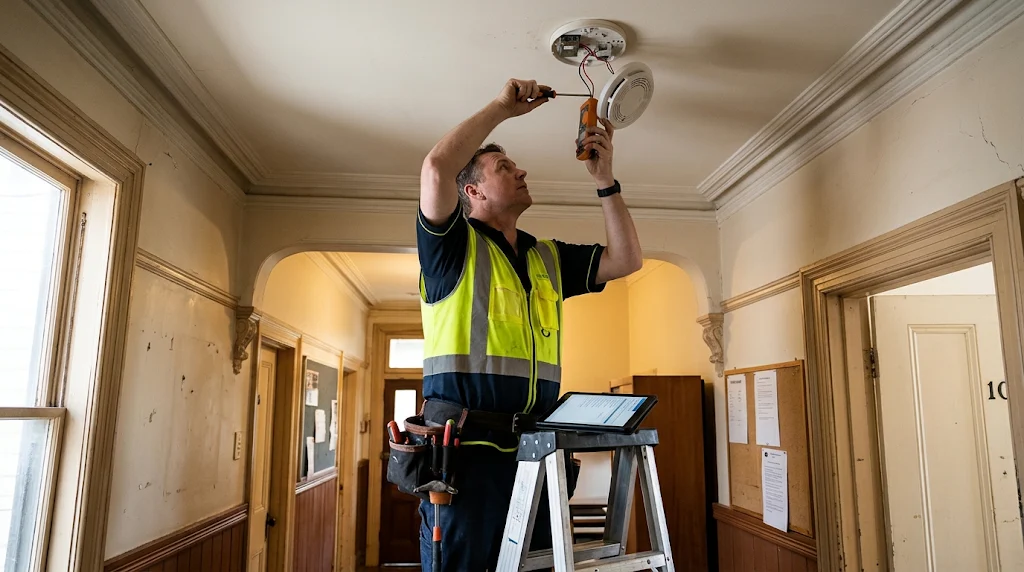
Electricians should treat the hardwired requirement as a design and installation control. The first step is to confirm that the alarm position is part of the building-specific detection design. This includes checking the alarm location, the intended coverage for occupied units, and any existing alarm arrangement in the building. Where the building has a documented design, the installed alarm should match that design. Where no design is available, the electrician should note the limitation and confirm the applicable requirement before finalising the job.
For hardwired rooming house alarms, the electrical work should be checked against the building supply and the alarm connection. The check should include the alarm type, the wiring condition, and the evidence that the installed unit is the specified model. Because rooming house buildings can contain varied wiring conditions and limited access to alarm positions, electricians should document the actual condition found, not only the work completed.
Practical checklist
- Confirm the rooming house obligation for hardwired smoke alarms before selecting equipment.
- Verify the building-specific detection design, including alarm positions and coverage for occupied units.
- Check the installed alarm model against the product evidence and the design note.
- Record the wiring method, connection condition, and any access limitations.
- Confirm who is responsible for service, replacement, and maintenance after installation.
Product Evidence, Installation Records, and Service Responsibilities
Product evidence is a major failure point in commercial fire protection projects. A rooming house job can fail if the installed unit is the wrong model, the documentation does not match the exact model, or the service owner cannot prove the alarm was installed and maintained correctly. Electricians and fire protection contractors should keep the exact model number, product data sheet or compliance document, installation location, and the name of the responsible service provider.
Service responsibilities should be agreed before the work starts. In a rooming house, the owner, property manager, and electrical contractor may all have different duties. The contractor should not assume that a future service arrangement is in place unless it is documented. A clear service record helps the owner demonstrate that the smoke alarm system remains in service and helps the next contractor understand what was installed.
| Check | Why it matters | Record to keep |
|---|---|---|
| Hardwired alarm requirement | Rooming houses require the specified alarm form under Consumer Affairs guidance. | Installation note or compliance check record |
| Building-specific detection design | Alarm placement and coverage must match the building layout. | Design drawing, layout note, or site survey |
| Exact model evidence | The installed unit must be traceable to the selected product documentation. | Product data sheet or manufacturer evidence |
| Service responsibility | Ongoing testing and maintenance needs a named owner. | Service agreement or owner instruction |
Purchasing Considerations for Electrical and Fire Protection Contractors
When purchasing Victoria rooming house smoke alarms, contractors should order the exact model required by the building-specific detection design. Generic stock lists are less useful because rooming house work may involve hardwired alarms, specific mounting positions, and documentation that must match the installed unit. Before placing a B2B order, the contractor should confirm the model number, the product evidence, and whether the product is suitable for the building condition described by the design.
Fire protection companies should also consider installation access, spare stock, and service continuity. If the building has multiple rooms, corridors, or limited access, the contractor should plan for replacement access and keep a record of any alarm that is not accessible for routine service. For B2B procurement, a supplier that can support commercial fire protection product selection, exact model documentation, and repeatable orders can reduce the risk of a mismatch between the purchased alarm and the installed requirement.
Contractors and retailers can use FireFactory for commercial fire protection products when sourcing hardwired rooming house alarms for B2B projects. The supplier approach should remain practical: confirm the exact model, keep the product evidence with the job file, and ensure the service owner understands the maintenance responsibility.
Frequently Asked Questions
- Do rooming houses in Victoria require hardwired smoke alarms?
- Consumer Affairs guidance states that rooming houses must have hardwired smoke alarms. Electricians should confirm the current guidance and the building-specific detection design before installation or replacement.
- What should an electrician check before fitting a smoke alarm in a rooming house?
- The electrician should check the hardwired requirement, the alarm position, the building layout, and the exact model evidence. The work should also record the wiring condition, product documentation, and service responsibility.
- Can a standard residential smoke alarm be used in a Victorian rooming house?
- Only if the standard residential alarm is the specified hardwired rooming house alarm and it matches the building-specific detection design. A generic residential unit without the required evidence should not be assumed compliant.
- Who is responsible for maintaining rooming house smoke alarms?
- The responsible party should be documented before installation. This may be the owner, property manager, or contracted service provider, and the record should identify who performs testing, maintenance, and replacement.
- What records should an electrical contractor keep for rooming house smoke alarm work?
- The contractor should keep the installation location, exact alarm model, product evidence, wiring notes, and service responsibility details. These records support future maintenance and help confirm that the installed system matches the required design.
- How should contractors source hardwired rooming house alarms for B2B projects?
- Contractors should source the exact model required by the detection design and keep product evidence with the job file. A B2B fire protection supplier can help with commercial ordering and documentation when the product selection is confirmed.
Conclusion
Electricians checking Victoria rooming house smoke alarms should focus on the hardwired requirement, the building-specific detection design, product evidence, and service responsibilities. The safest approach is to verify the current guidance, document the installed model, and make the maintenance owner clear before commissioning the work. This reduces rework, supports ongoing service, and gives the property owner a clear record.
For electrical contractors, fire protection companies, retailers, and B2B buyers, FireFactory supports commercial fire protection product sourcing for rooming house projects. Visit FireFactory to discuss hardwired rooming house alarms, exact model documentation, and commercial project requirements.