
Table of Contents
ToggleQueensland Electrical Safety Regulation 2026: Key Changes for Contractors and Businesses
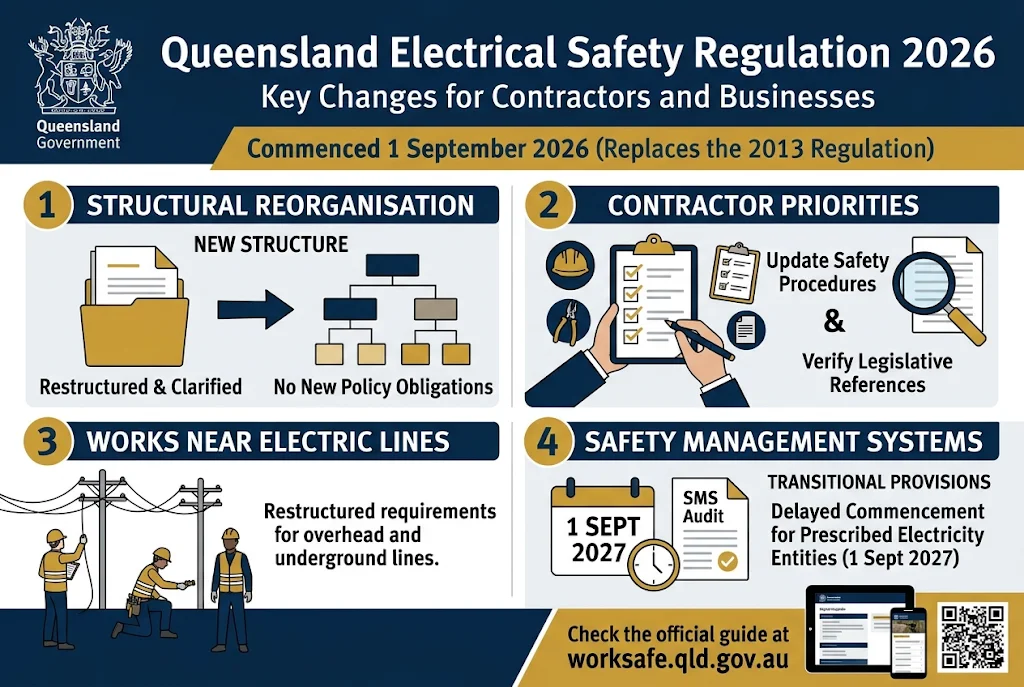
Queensland’s Electrical Safety Regulation 2026 commenced on 1 September 2026, replacing the Electrical Safety Regulation 2013. The updated regulation reorganises and clarifies existing electrical safety requirements without introducing new policy or changing the underlying regulatory obligations.
For electrical contractors, fire protection companies, building owners and facility managers operating in Queensland, the main priority is to understand the updated structure, check legislative references and ensure existing safety procedures remain accurate.
One important exception concerns safety management system provisions for prescribed electricity entities. These provisions have a delayed commencement date of 1 September 2027.
The Queensland Government has published an official guide to the Electrical Safety Regulation 2026, including a summary of changes, frequently asked questions and a comparison of the old and new sections.
What Is the Queensland Electrical Safety Regulation 2026?
The Electrical Safety Regulation 2026 is subordinate legislation made under Queensland’s Electrical Safety Act 2002.
It provides detailed requirements supporting electrical safety duties under the Act, including requirements relating to electrical work, equipment, licensing and risk management.
Queensland regulations are generally subject to a periodic review and remake process. The Electrical Safety Regulation 2013 was due to expire on 31 August 2026.
Following a review and public consultation, the Queensland Government remade the regulation to improve its structure, clarity and usability.
The new regulation commenced on 1 September 2026.
Importantly, WorkSafe Queensland confirms that the remake does not introduce new policy or regulatory obligations.
Businesses already complying with the previous regulation are therefore unlikely to need major changes to their existing work practices solely because of the remake.
What Changed Under the Electrical Safety Regulation 2026?
Although the underlying obligations remain largely unchanged, the regulation includes several structural and drafting improvements.
| Area | Key change | What it means for businesses |
|---|---|---|
| Regulation structure | Sections have been reorganised and renumbered | Review references in procedures and compliance documents |
| Legislative references | Connections to the Electrical Safety Act 2002 are clearer | Easier identification of relevant duties |
| Electrical line safety | Overhead and underground electric line provisions have been reorganised | Check updated section references |
| Electrical licensing | Related definitions and requirements have been consolidated | Review licensing documentation where necessary |
| High-voltage live-line work | Requirements are presented in separate sections | Check the revised structure when referencing these provisions |
| Safety management systems | Requirements have been reorganised, with delayed commencement for specified provisions | Prescribed electricity entities should review the transitional arrangements |
| Audit requirements | Certain reporting and audit provisions have been clarified | Relevant electricity entities should review the updated wording |
These changes are intended to make the regulation easier to navigate and apply.
The full legislation is available through Queensland Legislation – Electrical Safety Regulation 2026.
1. Updated Structure and Section Numbers
One of the most noticeable changes is the reorganisation of the regulation.
Sections have been grouped into revised parts, and section numbers have changed throughout the document.
For businesses using internal safety procedures, inspection checklists, training materials or compliance reports, this creates a practical documentation task.
Documents that refer to the Electrical Safety Regulation 2013 or its previous section numbers should be reviewed.
However, documents that describe practical safety requirements without referencing specific sections may not require changes.
WorkSafe Queensland has published a comparison guide to help businesses identify where provisions from the 2013 regulation appear in the 2026 regulation.
Recommended action: Review existing documents and update outdated references where necessary. Do not assume that every form or procedure needs to be rewritten.
2. Electrical Work Near Overhead and Underground Lines
The new regulation reorganises requirements relating to work near overhead and underground electric lines.
The provisions are separated to better reflect the different risks associated with each type of electrical infrastructure.
This may be relevant to contractors working on commercial buildings, industrial facilities and construction projects.
For example, fire protection and electrical contractors may work near electrical infrastructure when installing or maintaining equipment.
Businesses should review the provisions applicable to their activities and ensure that existing risk controls remain appropriate.
The revised regulation includes:
- Section 10: Exclusion zones for overhead electric lines.
- Section 11: Unsafe distances for underground electric lines.
- Sections 13–15: Requirements relating to work near electric lines.
These changes improve the presentation of the requirements rather than establishing a new general set of electrical line safety duties.
3. Electrical Licensing Requirements
The Electrical Safety Regulation 2026 consolidates several licensing-related definitions and provisions.
This includes clearer organisation of requirements concerning qualified business persons (QBPs) and qualified technical persons (QTPs).
For electrical contractors, the important point is that existing electrical licences remain valid.
According to WorkSafe Queensland:
- Electrical licences issued under the previous regulation continue to operate.
- Licence holders do not need to apply for a replacement licence because of the new regulation.
- Existing licence conditions and obligations continue to apply.
Businesses should still ensure that their licences remain current and that relevant work is performed by appropriately licensed personnel.
4. Safety Management System Changes Deferred Until September 2027
A specific part of the new regulation has a later commencement date.
Part 10, Division 2, relating to safety management systems, commences on 1 September 2027.
This delayed commencement applies to the relevant requirements for prescribed electricity entities.
It does not mean that every electrical contractor or fire protection business must introduce a new safety management system in September 2027.
The updated safety management system provisions are contained in sections 237–240.
Section 339 provides the transitional arrangement.
During the transition period from 1 September 2026 to 1 September 2027, former section 234 of the Electrical Safety Regulation 2013 continues to apply.
WorkSafe Queensland confirms that the underlying safety management system requirements have not changed.
The purpose of the delay is to give affected electricity entities time to become familiar with the revised structure.
For further details, refer to the official WorkSafe Queensland guidance.
5. What Should Electrical Contractors Do Now?
The commencement of the new regulation provides an opportunity for businesses to review their electrical safety documentation.
WorkSafe Queensland recommends becoming familiar with the new structure and updating references where necessary.
A practical review may include the following steps.
Review Existing Procedures
Check whether workplace procedures, safe work instructions and internal compliance documents reference the expired 2013 regulation.
Where necessary, update the references to the corresponding provisions of the 2026 regulation.
Check Inspection and Testing Documentation
Review inspection and testing templates used for electrical work.
Confirm that legislative references remain accurate and that records continue to support applicable electrical safety obligations.
The regulation remake does not automatically require additional inspection or testing activities.
Review Contractor Training Materials
Check whether training materials and internal guidance use outdated section numbers.
WorkSafe Queensland confirms that retraining is not required solely because the regulation has been remade.
However, workers should be made aware of the updated legislative structure where it is relevant to their duties.
Confirm Licensing Information
Businesses should continue to maintain appropriate electrical licences and authorisations.
Existing licences remain valid, subject to their normal conditions and requirements.
Use Official Comparison Resources
Before changing internal compliance documents, consult the comparison guide published by WorkSafe Queensland.
This can help prevent incorrect references or unnecessary changes to established procedures.
How Does the Regulation Affect Fire Protection Contractors?
Fire protection systems often depend on electrical infrastructure.
Examples include:
- Fire detection and alarm systems.
- Fire pump electrical supplies and controls.
- Smoke control and mechanical fire safety systems.
- Electrically operated fire and smoke control equipment.
- Emergency warning and communication systems.
Electrical work associated with these systems may be subject to Queensland electrical safety requirements.
For fire protection contractors working in Queensland, the new regulation is relevant where their activities involve electrical installation, testing, maintenance or other regulated electrical work.
However, the Electrical Safety Regulation 2026 does not automatically change routine fire protection maintenance frequencies or introduce new AS 1851 servicing requirements.
Businesses should distinguish between:
Electrical safety obligations: Requirements applying to electrical work, electrical equipment and associated risks.
Fire protection maintenance obligations: Requirements applying to the inspection, testing and maintenance of fire safety systems under relevant legislation, standards and site-specific obligations.
Where electrical and fire protection activities overlap, contractors should ensure that the appropriate requirements are identified and followed.
Why Accurate Maintenance Records Still Matter
Although the regulation does not introduce new documentation obligations through its remake, accurate records remain important for managing building safety.
For applicable fire protection systems, routine service records can help document:
- Equipment identification and location.
- Inspection and testing dates.
- Service results.
- Identified defects.
- Corrective actions and repairs.
- Outstanding maintenance issues.
Businesses should maintain records appropriate to the systems being serviced and the requirements that apply to those systems.
Fire Factory Australia’s Fire Safety Logbooks provide structured documentation for routine servicing of relevant fire protection equipment in accordance with applicable AS 1851 requirements.
These logbooks support fire protection maintenance documentation. They are not a replacement for electrical safety procedures or records required under Queensland electrical safety legislation.
Does the Regulation Apply Across Australia?
No.
The Electrical Safety Regulation 2026 is Queensland legislation.
It applies within Queensland according to its legal scope and should not be presented as a nationwide electrical safety regulation.
Electrical contractors and fire protection businesses operating across multiple Australian states and territories must identify the legislation applicable to each location.
For example, businesses operating in New South Wales should not assume that Queensland’s regulation replaces NSW electrical safety requirements.
This distinction is particularly important for companies managing projects or service contracts across multiple jurisdictions.
Frequently Asked Questions
When did Queensland’s Electrical Safety Regulation 2026 commence?
The regulation commenced on 1 September 2026, replacing the Electrical Safety Regulation 2013.
Does the new regulation introduce additional electrical safety obligations?
According to WorkSafe Queensland, the remake does not introduce new policy or regulatory obligations. It primarily reorganises and clarifies existing requirements.
Do electrical contractors need to update their procedures?
Contractors should review procedures and documents that reference the 2013 regulation or its section numbers.
Documents that remain accurate and do not contain outdated references may not require changes.
Do electrical workers need new licences?
No. Existing electrical licences continue to be valid under the new regulation, subject to their normal conditions and requirements.
Is retraining required?
No. WorkSafe Queensland states that retraining is not required solely because of the new regulation. However, workers should understand the updated structure and references relevant to their work.
What happens on 1 September 2027?
Part 10, Division 2 of the new regulation, concerning safety management systems for prescribed electricity entities, commences.
The previous section 234 requirements continue to apply during the transitional period.
Does the regulation change AS 1851 fire protection maintenance requirements?
The regulation remake does not itself introduce new AS 1851 inspection or servicing intervals.
Fire protection contractors should continue to follow the applicable fire safety legislation, standards and maintenance obligations.
Where can businesses find the official regulation?
The full regulation is published on the Queensland Government’s legislation website.
WorkSafe Queensland also provides explanatory guidance and a comparison of the 2013 and 2026 provisions.
Conclusion
The Queensland Electrical Safety Regulation 2026 is an important legislative update for electrical contractors, facility managers and businesses operating in Queensland.
While the regulation does not introduce new underlying electrical safety obligations, its revised structure and section numbers mean that businesses should review existing compliance documentation.
The key actions are to understand the updated provisions, correct outdated references and continue following established electrical safety requirements.
For prescribed electricity entities, the safety management system provisions commencing on 1 September 2027 should also be considered.
For fire protection contractors, the change reinforces the importance of distinguishing electrical safety responsibilities from routine fire protection maintenance obligations.
Fire Factory Australia supports Australian fire protection professionals with AS 1851 Fire Safety Logbooks, fire protection products and related accessories.
For product enquiries, contact Fire Factory Australia.
Official Government Sources
- WorkSafe Queensland – Electrical Safety Regulation 2026
Official overview, changes, transitional arrangements, FAQs and comparison guidance. - Queensland Legislation – Electrical Safety Regulation 2026
Full legislative text, including commencement, updated requirements and transitional provisions. - WorkSafe Queensland – Electrical Safety Laws
General information about Queensland’s electrical safety legislative framework.
Information reviewed: 16 November 2026. This article provides general information and does not replace legal advice or professional electrical safety guidance.
