Table of Contents
ToggleNSW Impulse Fan Carpark Guideline 2026: Sprinkler Performance and Fire Safety Requirements
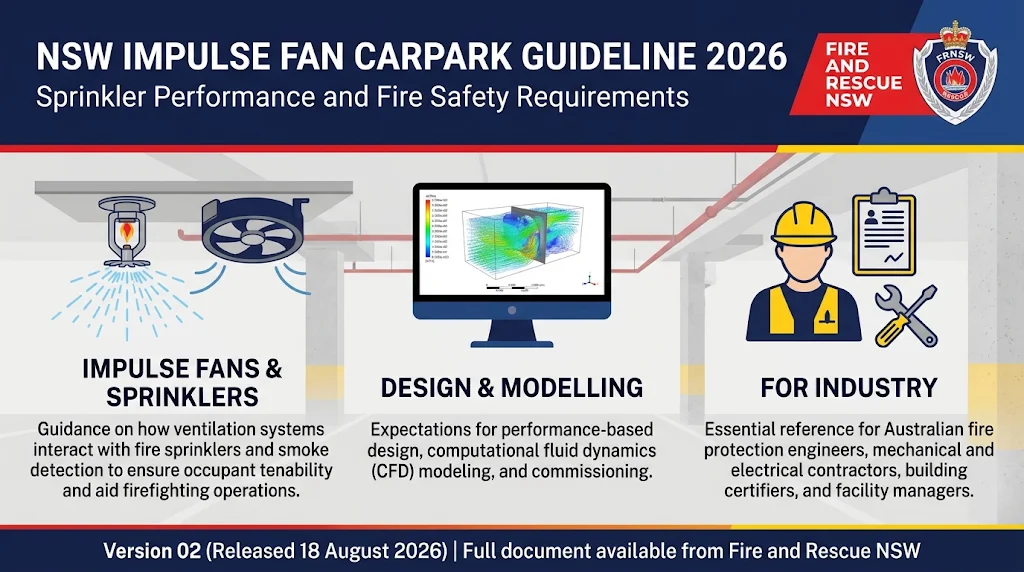
Fire and Rescue NSW (FRNSW) released Version 02 of its Impulse Fans in Carparks guideline on 18 August 2026, updating the guidance first issued in October 2014. The revised document provides important design and assessment guidance for impulse fan ventilation systems in sprinkler-protected carparks.
The guideline addresses how impulse fans interact with fire sprinklers, smoke detection, occupant tenability and firefighter operations. It also outlines expectations for performance-based design, computational fluid dynamics (CFD) modelling and commissioning.
For Australian fire protection engineers, mechanical contractors, electrical contractors, building certifiers and facility managers, the update provides a useful reference when planning or assessing carpark ventilation systems.
The full document is available from Fire and Rescue NSW – Impulse Fans in Carparks, Version 02 (PDF).
What Has Changed in the 2026 Impulse Fan Guideline?
The updated guideline replaces the previous version dated 9 October 2014.
It brings together FRNSW’s interpretation of relevant National Construction Code (NCC) provisions and Australian Standards, together with detailed recommendations for assessing impulse fan systems.
The document references:
- NCC 2022: Building Code of Australia, Volume One.
- AS 1668.1:2015: Fire and smoke control in buildings.
- AS 1668.2:2012: Mechanical ventilation in buildings.
- AS 1670.1:2018: Fire detection and alarm system design, installation and commissioning.
- AS 2118.1:2017: Automatic fire sprinkler systems.
- AFAC 2025: Guideline – Fire Safety for Carparks.
The 2026 document also addresses the relationship between the standards referenced by NCC 2022 and newer editions of certain Australian Standards.
Importantly, the publication of Version 02 does not automatically require every existing carpark to replace or upgrade its ventilation system.
The guideline is primarily intended for fire engineers and certifying authorities preparing or assessing proposed performance solutions involving impulse fans.
Why Impulse Fans Matter for Sprinklered Carparks
Impulse fans, also known as jet fans, are used to move air through enclosed carparks.
Unlike conventional ducted ventilation systems, impulse fans generate directed airflow that helps move contaminated air towards exhaust points.
Their primary purpose is to support mechanical ventilation and air quality, including the removal of vehicle exhaust contaminants.
However, their operation can also influence conditions during a fire.
Directed airflow may affect:
- The movement of smoke and hot gases.
- Heat reaching sprinkler heads.
- Sprinkler activation times.
- The performance of smoke and heat detectors.
- Conditions along evacuation routes.
- Firefighter access and intervention.
For this reason, FRNSW expects proposed impulse fan designs to demonstrate that the system will not adversely affect sprinkler performance or occupant tenability.
When Is a Performance Solution Required?
Under the standards referenced in the guideline, limited use of a single impulse fan to serve a poorly ventilated area, or dead spot, may be accommodated by the Deemed-to-Satisfy provisions.
However, FRNSW states that impulse fan installations beyond this limited arrangement generally require a Performance Solution.
The Performance Solution must address relevant NCC requirements, including:
- E1P4: Fire suppression systems.
- E2P2: Smoke hazard management.
- F6P4: Ventilation.
The assessment must demonstrate that impulse fan operation does not adversely affect the effectiveness of the sprinkler system or tenable conditions within the carpark.
Designers should establish the assessment approach through a Performance-Based Design Brief (PBDB), developed in consultation with relevant stakeholders.
The final Performance Solution Report (PSR) should document the agreed design assumptions, modelling, analysis and supporting evidence.
1. Impulse Fan Location and Sprinkler Performance
One of the most important considerations is the location of impulse fans relative to sprinkler heads.
FRNSW recommends locating impulse fans between sprinkler rows, generally within driveways and accessways, rather than above parking spaces or areas containing stationary fire loads.
The fan discharge should not directly affect sprinkler heads.
This is important because directed airflow can influence the movement of hot gases towards sprinklers.
If airflow changes the heating conditions around a sprinkler, it may affect activation time.
Comparing Sprinkler Activation Times
Section 8.2 of the guideline calls for analysis demonstrating a negligible difference in sprinkler activation times between two conditions:
- Impulse fans operating at full design speed.
- Impulse fans switched off.
The assessment should consider, at minimum, fire scenarios located:
- Directly within the fan’s airflow.
- Outside the immediate airflow.
These comparisons help determine whether the proposed ventilation system could adversely affect sprinkler operation.
The analysis must be specific to the carpark layout, fan arrangement and relevant fire scenarios.
2. Automatic Shutdown During a Fire
The guideline addresses automatic shutdown of impulse fans when fire conditions are detected.
Under the referenced Australian Standards, impulse fans are required to shut down when specified events occur, including:
- Initiation of fire mode.
- Activation of the carpark sprinkler system.
- Activation of the impulse fan smoke detection system.
The purpose is to prevent continued fan operation from adversely affecting sprinkler performance or conditions within the carpark.
Designers must consider the time required for the detection system to identify a fire and stop the fans.
This includes the delay between detection, the shutdown signal and the reduction in fan speed.
A system that eventually stops may still influence fire conditions before shutdown is complete.
For this reason, the shutdown sequence and its timing should be included in the engineering assessment.
3. Class A Aspirating Smoke Detection
The guideline identifies Class A Aspirating Smoke Detection (ASD) as an important part of the impulse fan shutdown strategy.
ASD systems draw air through sampling points to detect smoke.
FRNSW references AS 1670.1:2018 requirements for Class A ASD in the immediate area influenced by impulse fans.
The design must consider:
- Sampling point locations.
- Sampling pipe configuration.
- System transport time.
- Airflow created by the impulse fans.
- The required response time for fan shutdown.
Where an ASD system is used solely to shut down impulse fans, it does not necessarily need to provide smoke detection coverage throughout the entire carpark or initiate a general fire alarm.
However, other fire detection requirements may still apply.
The specific arrangement must be assessed against the relevant standards and approved fire safety design.
4. Firefighter Override and Manual Fan Control
Although impulse fans are designed to shut down automatically under specified fire conditions, firefighters may need to restart or control them during an incident.
For example, controlled ventilation may assist with smoke removal during or after firefighting operations.
The guideline therefore addresses manual override arrangements.
Where a Fire Fan Control Panel (FFCP) is provided, manual controls should be available at that panel.
Where the relevant fire detection control and indicating equipment is not provided, the referenced standards identify alternative control locations at the designated building entry point.
The controls should provide the following operating positions:
ON – AUTO – OFF
The AUTO position is located between ON and OFF.
For multiple fire compartments, separate controls are required for the relevant fan groups.
Clear Labelling and Block Plans
FRNSW also recommends clear identification of the fans controlled by each switch.
For multilevel carparks, labels should identify the relevant level or zone.
Block plans showing fan locations should be provided adjacent to the FFCP, with consistent naming between the plans and control switches.
These arrangements help firefighters identify and operate the appropriate equipment during an emergency.
5. CFD Modelling and Fire Engineering Assessment
Computational Fluid Dynamics (CFD) modelling is a central part of the design analysis described in the guideline.
CFD modelling allows engineers to simulate airflow, smoke movement and other relevant conditions within the carpark.
FRNSW expects the analysis to reflect the actual carpark geometry and proposed impulse fan arrangement.
The assessment should consider:
- Multiple fire locations, including potentially severe scenarios.
- Fan position relative to exits and exhaust points.
- Fan discharge velocity and direction.
- Structural beams, columns and other airflow obstructions.
- The number and arrangement of impulse fans.
- Fan shutdown timing and speed reduction.
- Sprinkler activation and occupant tenability.
The guideline also requests a grid sensitivity analysis to support the reliability of the airflow modelling.
Relevant modelling results should be compared with manufacturer test data where specified.
The Performance Solution Report should explain the modelling approach, assumptions and results.
Assessing Occupant Tenability
The guideline requires consideration of conditions during evacuation.
The analysis should demonstrate either that suitable conditions are maintained for occupants to evacuate with an appropriate safety margin, or that conditions are at least equivalent to those expected under the relevant Deemed-to-Satisfy ventilation arrangement.
This assessment must consider the period before the impulse fans shut down.
The objective is to demonstrate that fan operation does not create unacceptable conditions for people evacuating the carpark.
6. Commissioning and Testing Requirements
The guideline addresses commissioning before the building is occupied.
Section 8.6 states that the shutdown operation of the impulse fan system is to be tested during commissioning.
Where Class A ASD is used, testing must follow the relevant requirements of AS 1670.1.
The results must also be documented as part of the required baseline data.
For contractors, commissioning should verify that the installed equipment and control arrangements operate consistently with the approved design.
Relevant records may include:
- Detection system test results.
- Impulse fan shutdown operation.
- Control interface testing.
- Recorded shutdown response.
- Fan identification and control arrangements.
- Any identified defects and corrective actions.
The commissioning process should be based on the approved design and applicable standards.
7. What About Carparks Without Sprinklers?
The guideline primarily addresses impulse fans in sprinkler-protected carparks.
However, Section 9 also discusses proposals involving impulse fans in carparks without sprinkler protection.
FRNSW advises that these designs should be discussed during the PBDB process.
The assessment should consider matters such as occupant tenability and the means of shutting down the fans.
The extent of the analysis should be agreed during the design consultation process.
This means the guideline should not be interpreted as automatically approving impulse fan installations in non-sprinklered carparks.
Each proposed design requires appropriate assessment.
What Should Fire Protection and Mechanical Contractors Check?
For contractors involved in carpark fire safety systems, the updated guideline provides a useful reference for understanding how mechanical ventilation interacts with other fire protection measures.
When working on a relevant installation, contractors should consider whether the approved design and available documentation identify:
- The impulse fan arrangement and operating sequence.
- The sprinkler system layout.
- The relevant fire detection interfaces.
- Automatic shutdown functions.
- Firefighter manual controls.
- Commissioning and baseline test records.
- The approved Performance Solution, where applicable.
Any proposed changes to fan locations, controls, sprinkler layouts or detection arrangements should be reviewed against the approved design by appropriately qualified professionals.
A routine maintenance visit is not a substitute for a fire engineering assessment.
Maintaining Fire Protection Service Records
After commissioning, building owners and service providers should maintain appropriate records for fire safety systems covered by applicable routine servicing requirements.
Accurate documentation can help identify defects, track corrective actions and support ongoing maintenance.
For applicable systems, relevant records may include:
- Sprinkler system inspection and testing results.
- Fire detection and alarm system service records.
- Mechanical fire and smoke control system testing.
- Defects and corrective actions.
- Equipment identification and service history.
Fire Factory Australia supplies AS 1851 routine service logbooks to help fire protection contractors maintain structured maintenance records.
Relevant products include:
For applicable mechanical systems operating in fire and smoke control modes, these logbooks support the recording of routine inspection, testing and maintenance activities.
The range includes logbooks for relevant sprinkler systems and fire detection and alarm systems.
These products support routine service documentation. They are not substitutes for a Performance Solution Report, CFD analysis, commissioning certification or other project-specific engineering records.
Frequently Asked Questions
When was the NSW Impulse Fan Carpark Guideline updated?
Fire and Rescue NSW released Version 02 on 18 August 2026, replacing Version 01 dated 9 October 2014.
Does the guideline apply to all existing carparks?
No. The guideline is intended primarily for proposed Performance Solutions involving impulse fans in sprinkler-protected carparks. Its publication does not automatically require all existing carparks to be upgraded.
Do impulse fan systems require a Performance Solution?
FRNSW states that impulse fan installations generally require a Performance Solution, except for the limited Deemed-to-Satisfy arrangement involving a single impulse fan serving a dead spot.
Can impulse fans affect sprinkler activation?
Yes. Directed airflow can influence heat movement and sprinkler activation. The guideline calls for analysis demonstrating a negligible difference in sprinkler activation times between fans operating at full design speed and fans switched off.
Should impulse fans stop automatically during a fire?
Yes, under the applicable arrangements described in the guideline. Automatic shutdown is required on specified fire detection and sprinkler activation events.
Why is Class A ASD important?
Class A aspirating smoke detection can provide early detection to initiate impulse fan shutdown. Its sampling arrangement and response time must account for airflow generated by the fans.
Can firefighters manually restart impulse fans?
Yes. The guideline addresses manual override arrangements so firefighters can operate the fans when needed during an incident.
Is CFD modelling required?
The guideline calls for CFD modelling as part of the analysis for the relevant Performance Solution. The modelling must address the proposed carpark layout, fan operation, sprinkler performance and occupant tenability.
Does the guideline introduce new AS 1851 maintenance intervals?
No. The guideline focuses on design, analysis, controls and commissioning. It does not itself establish new AS 1851 routine servicing frequencies for all impulse fan systems.
Conclusion
The NSW Impulse Fan Carpark Guideline 2026 provides important guidance for the design and assessment of impulse fan ventilation systems in sprinkler-protected carparks.
The updated document highlights the need to demonstrate that impulse fan operation does not adversely affect sprinkler activation, occupant tenability or firefighting operations.
For fire protection engineers, mechanical contractors, electrical contractors and certifiers, the main considerations include appropriate fan placement, automatic shutdown, Class A smoke detection, firefighter override, CFD modelling and commissioning.
Using the current FRNSW guideline and maintaining accurate design and service documentation can support safer and better-coordinated carpark fire protection systems.
Fire Factory Australia supports fire protection professionals with AS 1851 routine service logbooks and fire safety products.
Explore our Fire Safety Logbooks or contact Fire Factory Australia for product enquiries.
Official Government Source
Fire and Rescue NSW – Impulse Fans in Carparks, Version 02
- Published: 18 August 2026
- Document ID: D16/35391
- Issuing authority: Fire and Rescue NSW, Fire Safety Branch
- Read the official guideline (PDF)
Relevant sections:
- Section 6 – Interpretation of Requirements
- Section 7 – Design Objectives, Considerations and Recommendations
- Section 8.2 – Impact on Sprinkler Performance
- Section 8.3 – Impact on Tenable Conditions
- Section 8.4 – CFD Modelling Considerations
- Section 8.5 – Fire Brigade Intervention
- Section 8.6 – Commissioning
- Section 9 – Impulse Fans in Non-Sprinkler Protected Carparks
Information reviewed: 16 November 2026. This article provides general industry information and does not replace the official guideline, approved fire engineering documentation or professional advice.