Table of Contents
ToggleMechanical Services – Fire & Smoke Control Features Logbook
A Complete Guide AS 1851 Mechanical Services Logbook – Fire & Smoke Control Features
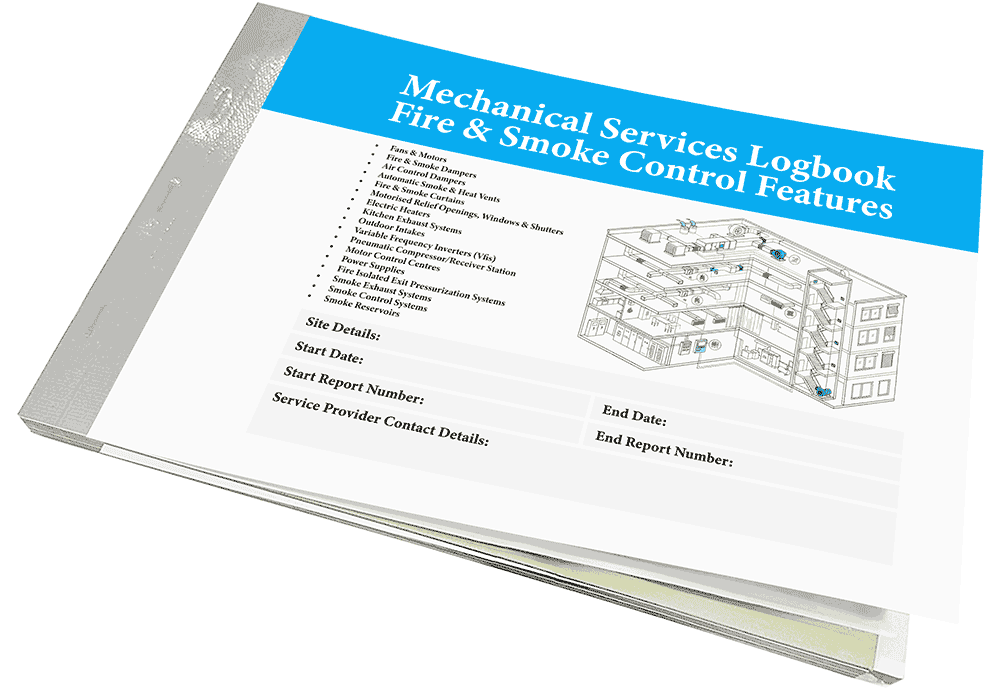
A Mechanical Services – Fire & Smoke Control Features Logbook is used to record routine inspection, testing, service and survey activities for mechanical fire and smoke control systems. The logbook is designed to support record keeping in accordance with the relevant requirements of Section 13 of AS 1851—2012, including smoke control, smoke exhaust, exit pressurisation, fire and smoke dampers and other mechanical services with a required fire-mode function.
Fire and smoke control systems are an important part of a building’s fire safety strategy.
Unlike normal air-conditioning or ventilation systems, these systems may need to:
- start during a fire
- stop during a fire
- change from normal mode to fire mode
- control smoke movement
- maintain safer evacuation paths
- support fire-isolated exit pressurisation
- operate smoke exhaust systems
- interact with fire alarm and control systems
The Mechanical Services – Fire & Smoke Control Features Logbook has been developed to provide a practical and organised way to inspect, test and record these systems in accordance with the relevant requirements of Section 13 of AS 1851—2012, incorporating Amendment No. 1.
AS 1851 sets out requirements for the routine servicing of fire protection systems and equipment. Routine service includes inspection, testing, preventive maintenance and survey. Its objective is to help fire protection systems and equipment continue to meet the requirements of their approved design.
Section 13 specifically covers the fire and smoke control features of mechanical services, also described in the Standard as smoke hazard management systems. It applies to mechanical services that have a required function during a fire, including systems that need to operate, change mode or shut down under fire conditions.
Which Buildings Are Affected?
In NSW, an important regulatory change took effect from 13 February 2026.
From this date, AS 1851—2012 became mandatory for applicable essential fire safety measures in new and existing Class 1b and Class 2 to Class 9 buildings, unless a relevant Performance Solution specifies another standard.
These building classes include:
| Building Class | Typical Examples |
|---|---|
| Class 1b | Small boarding houses, guest houses, hostels and certain short-term accommodation |
| Class 2 | Apartment buildings and residential unit buildings |
| Class 3 | Hotels, motels, hostels, dormitories and similar residential accommodation |
| Class 4 | A single dwelling located within a Class 5, 6, 7, 8 or 9 building |
| Class 5 | Offices and commercial buildings |
| Class 6 | Shops, restaurants, cafés and other businesses providing goods or services to the public |
| Class 7 | Car parks, warehouses and storage buildings |
| Class 8 | Factories, laboratories and process buildings |
| Class 9a | Hospitals and other healthcare buildings |
| Class 9b | Schools, universities, childcare centres, assembly buildings and sporting facilities |
| Class 9c | Residential care buildings |
A building can also contain more than one classification where different parts of the building have different uses.
Sources:
NSW Government – AS 1851-2012 Building Fire Safety Requirements
National Construction Code (NCC) – Building Classifications
NSW Government – Responsibilities of building owners under AS 1851-2012
The NSW requirement applies broadly to applicable essential fire safety measures in these building classes.
However, this particular logbook is specifically designed for the fire and smoke control features of mechanical services covered by Section 13 of AS 1851—2012.
Section 13 applies when the mechanical system has a required function during a fire.
Which Mechanical Systems Does Section 13 Apply To?
The application depends on what the mechanical system is required to do under the building’s approved fire safety design.
| Mechanical System | Required Operation During a Fire | Section 13 |
|---|---|---|
| Fire-Isolated Exit Pressurisation System | Starts and operates to pressurise the protected exit | ✅ Applies |
| Smoke Control System | Operates to control smoke movement or pressure between areas | ✅ Applies |
| Smoke Exhaust System | Starts and removes smoke from the required area | ✅ Applies |
| Air-Handling System with a Fire-Mode Function | Continues operating or changes operation according to the fire-mode design | ✅ Applies |
| Mechanical System Required to Shut Down | Stops when the required fire condition occurs | ✅ Relevant shutdown requirements apply |
| Ordinary HVAC with No Fire-Mode Function | Has no required fire response | ❌ Section 13 does not apply to that system |
What Does Section 13 Cover and the Logbook Record?
Section 13 of AS 1851—2012 sets out routine service requirements for fire and smoke control features of mechanical services. The Mechanical Services Logbook is designed to provide structured records for these applicable inspection, testing, service and survey activities, based on each system’s required function under the building’s approved design.
Routine Service Schedule
| System / Equipment | Includes / Description | Monthly | 3-Monthly | 6-Monthly | Yearly |
|---|---|---|---|---|---|
| Fans and Motors | Supply, exhaust, return, pressurization, smoke exhaust and smoke spill fans | — | ✅ | — | ✅ |
| Fire Dampers and Smoke Dampers | Fire dampers, intumescent fire dampers and smoke dampers | — | — | — | ✅ |
| Air Control Dampers — Recycle, Relief, Smoke Spill & Outdoor Air | Dampers controlling recycle, relief, smoke spill and outdoor air | — | —* | ✅ | ✅ |
| Air Control Dampers — Supply, Return & Exhaust Air | Dampers controlling supply, return and exhaust air | — | —* | ✅ | ✅ |
| Automatic Smoke and Heat Vents | Automatic vents used to release smoke and heat | — | — | ✅ | ✅ |
| Fire and Smoke Curtains | Automatic fire and smoke curtain systems | ** | — | ✅ | ✅ |
| Motorized Relief Openings, Windows and Shutters | Motorized openings used for air and smoke relief | — | — | ✅ | ✅ |
| Electric Heaters — Duct or Unit Mounted | Electric heaters installed in ducts or air-handling units | — | — | — | ✅ |
| Kitchen Exhaust Systems | Kitchen exhaust and associated components | ✅ | — | — | ✅ |
| Outdoor Air Intakes | Outdoor air intake openings and associated areas | ✅ | — | — | ✅ |
| Variable Frequency Inverters (VFIs) | VFIs controlling mechanical services equipment | — | ✅ | ✅ | ✅ |
| Pneumatic Compressor / Receiver Station | Compressor, receiver and associated pneumatic equipment | — | ✅ | — | ✅ |
| Motor Control Centres | Motor control equipment associated with mechanical services | — | — | — | ✅ |
| Power Supplies — Main Switchboards (Low Voltage) | Main switchboards supplying mechanical fire and smoke control systems | — | — | — | ✅ |
* The two air-control-damper groups are normally six-monthly and yearly. For certain dampers dedicated to fire-mode duty and exposed to corrosive exterior air, the frequency is increased to three-monthly.
** Fire and smoke curtains are normally six-monthly and yearly. Where a curtain deploys below 2.5 m from floor level, the area underneath should also be checked at least monthly for obstructions.
*** The Fire Fan Control Panel (FFCP), Fire Indicator Panel (FIP) and associated fire detection and alarm equipment are serviced under Section 6 — Fire Detection and Alarm Systems and are not covered as equipment service items in this logbook. Mechanical system functionality and performance testing associated with exit pressurization is covered below.
Test and Records
| System / Test | Includes / Description | Monthly | 3-Monthly | 6-Monthly | Yearly |
|---|---|---|---|---|---|
| Fire-Isolated Exit Pressurization Systems | Tests system operation in fire mode and annual performance | — | ✅ | — | ✅ |
| System Changeover Under Fire Condition | Tests changeover from normal operation to fire mode | — | ✅ | — | ✅ |
| Smoke Exhaust Systems | Tests smoke exhaust system operation and performance | — | ✅ | — | ✅ |
| System Shutdown | Confirms required mechanical systems shut down in fire mode | — | — | — | ✅ |
| Smoke Dampers | Tests required smoke damper operation | — | — | — | ✅ |
Survey and Records
| System / Survey | Includes / Description | Monthly | 3-Monthly | 6-Monthly | Yearly |
|---|---|---|---|---|---|
| Active Fire and Smoke Control Systems | Checks for obstructions, alterations or changes that may affect system performance | — | — | — | ✅ |
| Motorized Relief Openings — Windows and Shutters | Checks for building changes that may affect relief openings | — | — | — | ✅ |
| Smoke Reservoirs | Checks for changes that may compromise smoke reservoir integrity | — | — | — | ✅ |
The Mechanical Services Logbook Specifications
Size 210mm x 295mm
Duration: 1 Year
| Section / Page | Non-NCR Sheets | NCR Sets | NCR Sheets (3-copy) | Capacity |
|---|---|---|---|---|
| Site & Equipment List – Pages 1–6 | 6 × 100gsm White | – | – | 100x Equipment |
| Monthly & Three-Monthly Routine Service Schedule | 1 × Guide Page 250gsm | 12 | 36 | 4x Cut-in and Cut-out Pressures Record |
| Six-Monthly Routine Service Schedule | 1 × Guide Page 250gsm | 2 | 6 | 12x System Pressure Record |
| Yearly Routine Service Schedule – Page 1 | 1 × Guide Page 250gsm | 1 | 3 | – |
| Yearly Routine Service Schedule – Page 2 | 1 × Guide Page 250gsm | 1 | 3 | 20x Curtains Service Record |
| Yearly Routine Service Schedule – Page 3 | 1 × Guide Page 250gsm | 1 | 3 | – |
| Yearly Routine Service Schedule – Page 4 | 1 × Guide Page 250gsm | 1 | 3 | – |
| Smoke Control System — Performance Yearly Test Record | 1 × Guide Page 250gsm | 2 | 6 | 40x rows |
| Smoke Control System — Functionality Yearly Test Record | 1 × Guide Page 250gsm | 3 | 9 | 60x rows |
| Smoke Exhaust System — Performance Yearly Test Record | 1 × Guide Page 250gsm | 1 | 3 | 20x rows |
| Fire-Isolated Exit Pressurization Systems — Performance Yearly Test Record | 1 × Guide Page 250gsm | 3 | 9 | 60x rows |
| Fire-Isolated Exit Pressurization Systems — Functionality Yearly Test Record | 1 × Guide Page 250gsm | 1 | 3 | 20x rows |
| Fire Damper — 20% Yearly Routine Service Record | 1 × Guide Page 250gsm | 3 | 9 | 60x rows |
| Electric Heaters — 50% Yearly Routine Service Record | 1 × Guide Page 250gsm | 1 | 3 | 20x rows |
| Notes | 1 × Guide Page 250gsm | 12 | 36 | 12x Pages for Notes records |
| Writing Shield | 150gsm | – | – | – |
| TOTAL | 21 sheets | 44 sets | 132 sheets | 153 Total Physical Sheets |
AS 1851 Mechanical Services Logbook for Fire & Smoke Control Systems
The Mechanical Services – Fire & Smoke Control Features Logbook is a comprehensive AS 1851—2012 mechanical services logbook designed to support routine service, inspection, testing and record keeping for the fire and smoke control features of mechanical services, also known as smoke hazard management systems.
Developed around the relevant requirements of Section 13 of AS 1851—2012, incorporating Amendment No. 1, this one-year logbook provides structured monthly, three-monthly, six-monthly and yearly routine service records for mechanical systems and equipment that are required to operate, change mode or shut down under fire conditions.
The logbook supports routine service and record keeping for fans and motors, supply fans, return fans, exhaust fans, pressurization fans, smoke exhaust fans, smoke spill fans, fire dampers, intumescent fire dampers, smoke dampers, air control dampers, automatic smoke and heat vents, fire curtains, smoke curtains, motorized relief openings, windows and shutters, electric duct and unit-mounted heaters, kitchen exhaust systems, outdoor air intakes, Variable Frequency Inverters (VFIs), pneumatic compressor and receiver stations, Motor Control Centres (MCCs), low-voltage main switchboards and associated mechanical fire and smoke control equipment.
It also provides dedicated records for important fire mode functionality and performance testing, including fire-isolated exit pressurization systems, smoke control systems, smoke exhaust systems, system changeover under fire conditions, mechanical system shutdown and smoke damper operation. These records help document whether fans start or stop, dampers open or close and systems change correctly between normal and fire mode, as well as performance measurements such as airflow rates, airflow velocity, differential pressure, doorway velocity, door opening force and system restoration time where applicable.
For yearly service activities, the logbook also supports fire and smoke control system surveys, including checks of active fire and smoke control systems, motorized relief openings, smoke reservoirs, mechanical services alterations, building alterations and physical obstructions that may affect the functionality or performance of the approved fire safety design.
Dedicated Equipment / Plant Register pages allow up to 100 mechanical services assets to be identified by equipment ID, type, location, system or zone and relevant design or function information. Service pages include Pass / Fail / N/A results, measurements, defects, comments, corrective actions and completed repairs, helping technicians and service providers maintain clear and consistent fire safety maintenance records.
With dedicated Smoke Control System Performance and Functionality Test Records, Smoke Exhaust System Performance Test Records, Fire-Isolated Exit Pressurization Performance and Functionality Test Records, Fire Damper Routine Service Records and Electric Heater Routine Service Records, the logbook brings the key Section 13 mechanical fire safety records together in one practical document.
The AS 1851 Mechanical Services Logbook is suitable for recording routine service activities for mechanical systems with a required fire mode function, including dual-duty mechanical services systems and dedicated fire mode systems, where applicable to the building’s approved design.
Designed to support routine service and record keeping in accordance with the relevant requirements of Section 13 of AS 1851—2012 – Fire and Smoke Control Features of Mechanical Services.
FAQs
What is an AS 1851 Mechanical Services Logbook?
An AS 1851 Mechanical Services Logbook is used to record routine inspection, testing, service and survey activities for fire and smoke control features of mechanical services. This logbook is designed to support record keeping in accordance with the relevant requirements of Section 13 of AS 1851—2012.
What does Section 13 of AS 1851—2012 cover?
Section 13 covers the fire and smoke control features of mechanical services, also referred to as smoke hazard management systems. It applies to mechanical systems that are required to operate, change mode or shut down under fire conditions.
What systems and equipment can be recorded in this logbook?
The logbook provides records for systems and equipment including fans and motors, fire dampers, smoke dampers, air control dampers, smoke and heat vents, fire and smoke curtains, motorized relief openings, electric heaters, kitchen exhaust systems, outdoor air intakes, Variable Frequency Inverters (VFIs), pneumatic compressor and receiver stations, Motor Control Centres (MCCs) and associated power supplies.
Does the logbook include smoke control and smoke exhaust system testing?
Yes. The logbook includes dedicated records for smoke control system functionality and performance testing and smoke exhaust system performance testing. It also provides records for system changeover under fire conditions and mechanical system shutdown.
Does the logbook include fire-isolated exit pressurisation systems?
Yes. Dedicated yearly performance and functionality test records are provided for fire-isolated exit pressurisation systems. These records can document measurements and operational checks associated with the system’s fire-mode performance.
Does the logbook include fire damper and smoke damper records?
Yes. The logbook includes routine service requirements for fire dampers, intumescent fire dampers and smoke dampers, together with dedicated yearly Fire Damper Routine Service Record pages.
How often are mechanical fire and smoke control systems serviced under AS 1851?
The required frequency depends on the system or equipment. Section 13 includes applicable monthly, three-monthly, six-monthly and yearly routine service activities. The logbook provides structured sections for recording these different service intervals.
What information can technicians record in the logbook?
The logbook provides an Equipment / Plant Register for up to 100 assets and service records for Pass / Fail / N/A results, measurements, defects, comments, corrective actions and completed repairs.
Does this logbook cover normal HVAC systems?
Not necessarily. Section 13 applies where a mechanical system has a required fire-mode function. An ordinary HVAC system with no required response during a fire is not covered by Section 13 simply because it is part of the building’s mechanical services.
Is the Fire Indicator Panel (FIP) covered by this Mechanical Services Logbook?
The FIP, Fire Fan Control Panel (FFCP) and associated fire detection and alarm equipment are serviced under Section 6 of AS 1851—2012 rather than as mechanical equipment service items in this logbook. However, relevant mechanical system functionality and performance testing involving fire-mode operation is recorded where applicable.
Does using this logbook automatically make a building AS 1851 compliant?
No. The logbook is designed to support routine service and record keeping in accordance with the relevant requirements of Section 13 of AS 1851—2012. Compliance also depends on factors such as the building’s approved design, applicable systems, correct servicing, technician competency, applicable legislation and proper completion of the required activities.
How long does the Mechanical Services Logbook cover?
The logbook is designed for one year of routine service records and includes monthly, three-monthly, six-monthly and yearly service sections.
Do you ship Mechanical Services fire logbooks across Australia?
Yes. Our Mechanical Services Fire Logbooks can be shipped across Australia, including New South Wales, Victoria, Queensland, Western Australia, South Australia, Tasmania, the Australian Capital Territory and the Northern Territory.
Whether you are looking for an AS 1851 Mechanical Services fire logbook in Sydney, Melbourne, Brisbane, Perth, Adelaide, Hobart, Canberra or Darwin, you can order our fire and smoke control logbooks for delivery to your location.
Can I order an AS 1851 Mechanical Services fire logbook outside Sydney?
Yes. Our AS 1851 Mechanical Services Logbooks are available to customers throughout Australia, not only Sydney or New South Wales.
We supply Mechanical Services fire safety logbooks to customers in Melbourne and regional Victoria, Brisbane and Queensland, Perth and Western Australia, Adelaide and South Australia, Hobart and Tasmania, Canberra and the ACT, and Darwin and the Northern Territory.
Conclusion
The Mechanical Services – Fire & Smoke Control Features Logbook brings the relevant routine service, functionality, performance and survey records into one structured document.
It is designed to support the practical recording of service activities associated with Section 13 of AS 1851—2012, while providing clear equipment identification, Pass / Fail / N/A checklists, dedicated measurement fields, defect records, corrective actions and additional notes.
For marketing and compliance wording, the safest statement is:
Designed to support routine service and record keeping in accordance with the relevant requirements of Section 13 of AS 1851—2012.
It is better not to state that the logbook by itself makes a building compliant, because compliance depends on the actual systems, approved design, servicing, competency, applicable legislation and correct completion of the required activities. The service record itself also makes clear that it does not automatically infer compliance with all applicable building and fire safety legislation.
Our Fire Safety Logbooks
Fire Factory Australia is a leading Australian manufacturer and supplier of professional fire safety logbooks, providing a comprehensive range of purpose-designed logbooks for fire protection professionals across Australia. With experience in the fire protection industry since 2004, we understand the importance of clear, practical and reliable service records. Our logbooks are designed to provide an organised and professional approach to recording routine inspection, testing, servicing and maintenance activities. Our range includes logbooks designed around the relevant requirements of AS 1851—2012 and other applicable Australian Standards, covering a wide range of fire protection systems and equipment.
Explore our complete range of Fire Safety Logbooks for fire protection routine service, testing, inspection and maintenance records.
- Fire Detection and Alarm Systems
- Emergency Warning & Intercom Systems
- Fire Detection & Alarm Systems and Emergency Warning & Intercom Systems
- Automatic Fire Sprinkler System Logbook – Wet Pipe Sprinkler and Jacking Pump
- Automatic Fire Sprinkler System Logbook – Dry-Pipe / Pre-Action, Deluge & Water Spray
- Special Hazard Fire Suppression Systems
- Fire Pumpset Logbook – Sprinkler & Hydrant Pumps (Diesel & Electric) & Jacking Pumps
- Diesel Fire Pumpset Logbook – Sprinkler & Hydrant Pumps & Jacking Pumps
- Electric Fire Pumpset Logbook – Sprinkler & Hydrant Pumps & Jacking Pumps
- Hose Reel & Jacking Pumps Logbook
- Fire Hydrant Systems & Jacking Pumps Logbook
- Water Storage Tanks Logbook
- Routine Service Logbook – Delivery Lay Flat Hose, Fire Hose Reels, Fire Extinguishers & Fire Blankets
- Passive Fire Logbook
- Mechanical Services Logbook – Fire/Smoke Control Features
- Emergency and Exit Lighting Maintenance Logbook
Designed for fire protection technicians, service companies, facility managers and building owners, Fire Factory Australia logbooks provide a practical and professional solution for maintaining clear and consistent fire safety service records.