Table of Contents
ToggleFRNSW Storz Connection Guidance in 2026: What Should Contractors Check?
Quick Answer: Contractors should verify that every Storz coupling, hose, appliance, and hydrant adapter matches FRNSW Version 11 guidance, NSW hydrant connection requirements, and the exact model evidence supplied. Checks should cover connection details, marking, conformity documents, service history, and replacement intervals before commissioning any new or upgraded fire system.
When fire companies, electrical companies, retail facility teams, or fire protection contractors plan a new or upgraded fire system, the connection between the hydrant and the hose line is a high risk point. In NSW, FRNSW Storz 2026 guidance matters because it defines the technical expectations for FRNSW compatible Storz hose connections and NSW hydrant connections. The supplied current official technical sheet is Version 11, dated 19 January 2026. Contractors should use it to review product conformity, connection details, service intervals, and model evidence before commissioning.
Confirm the Correct FRNSW Storz 2026 Reference
The official technical information sheet should be the first reference, not a supplier claim. The FRNSW Storz hose connection technical information sheet is available from the FRNSW Storz hose connection technical information sheet. Version 11, dated 19 January 2026, is the current source supplied for FRNSW compatible Storz hose connections.
Contractors should confirm the document version, date, and applicable clauses before selecting equipment. Where a specification, tender, or design note refers to FRNSW Storz 2026, the contractor should check whether the requirement covers couplings, adapters, hose lengths, appliances, or the full hydrant connection set. This prevents substitution errors on site and keeps the project aligned with the official NSW hydrant connection guidance.
Check Product Conformity and Exact Model Evidence
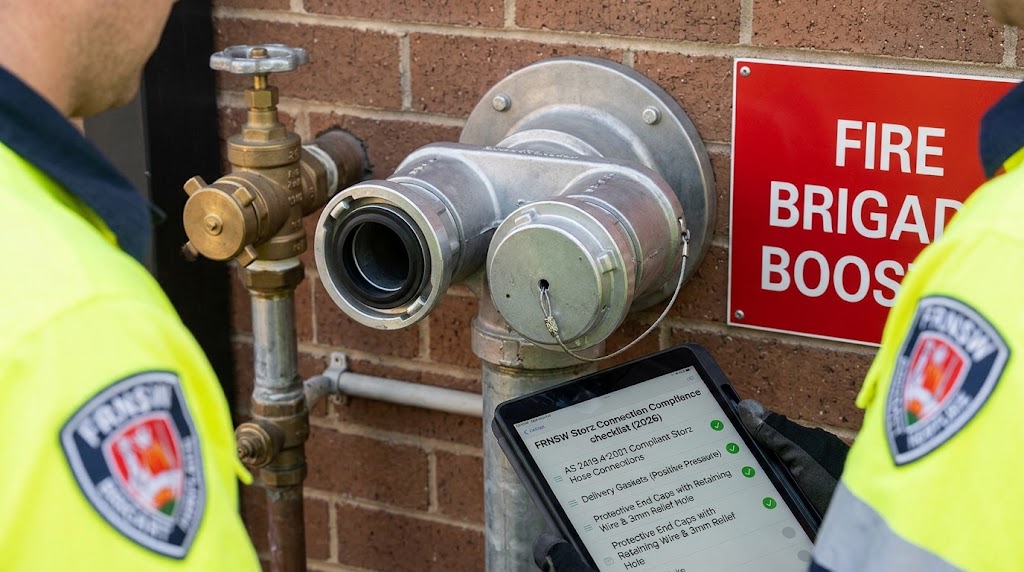
Product conformity is the core of a compliant supply. For NSW hydrant connections, the contractor should verify that each supplied item matches the exact model evidence required by the project. That evidence should identify the manufacturer, model, size, connection type, and any FRNSW compatible Storz hose connection marking or documentation.
The official technical sheet should be used to confirm the clauses that apply to the proposed equipment. Where an Australian standard or FRNSW clause applies, the contractor should quote the exact clause and confirm it applies to the installed model. Where a supplier claims conformity, the contractor should request the supporting certificate, test report, or conformity statement that matches the exact model, not a product family or generic product line. This is especially important for upgraded systems where older parts may look similar but no longer meet current connection requirements. If a claim cannot be traced to current official sources and exact model evidence, the contractor should not rely on it.
Inspect NSW Hydrant Connections and Plan Service Checks
Mechanical compatibility is a practical issue on site. Contractors should inspect the hydrant outlet, coupling faces, adapters, hose ends, and any appliances before final assembly. The check should confirm that the parts fit without force, that the connection closes fully, and that the marking or size evidence matches the installed hydrant. Where the equipment is part of a commercial facility, the inspection should also note access constraints, storage location, and any fixed hose or appliance arrangement.
Common failure points include mismatched adapters, worn coupling faces, damaged threads, incorrect hose end fittings, and parts that are visually similar but not listed for the intended connection. A small connection error can delay testing or create a noncompliant hydrant interface. Service history also affects connection reliability. Contractors should review maintenance records for couplings, hoses, adapters, and appliances before putting NSW hydrant connections back into service.
The official FRNSW technical information sheet should be used to confirm the exact intervals and conditions that apply. Where an interval is stated, the contractor should record the check date, responsible person, and equipment model. For older equipment, the contractor should also check for corrosion, deformation, damaged seals, and missing parts. If the equipment cannot be traced to a current model or service record, replacement is usually the safer path.
Buying and Supply Considerations for Commercial Projects
Commercial projects need documentation as much as hardware. Before purchasing FRNSW Storz 2026 related components, the project team should prepare a short checklist. The checklist should list the hydrant location, required connection details, adapter type, hose or appliance specification, and the exact model evidence required by the owner or designer.
| Check item | Why it matters | Evidence to keep |
|---|---|---|
| Document version | Ensures Version 11 dated 19 January 2026 is used | FRNSW sheet reference |
| Product model | Confirms exact model evidence | Certificate or conformity documents |
| Connection fit | Prevents mechanical failure on NSW hydrant connections | Site inspection notes |
| Service history | Supports replacement intervals | Maintenance records |
| Purchase documentation | Supports audit and warranty | Invoice, specification, and delivery notes |
FireFactory B2B fire protection supplies can be useful when a contractor needs a documented supply option, technical confirmation, or a consistent source for Storz related components. The supplier should provide current documentation and should not rely on visual similarity alone.
Frequently Asked Questions
What is the current FRNSW Storz guidance in 2026?
The supplied current official technical sheet is Version 11, dated 19 January 2026. Contractors should use it to check FRNSW compatible Storz hose connections and NSW hydrant connection requirements.
Should contractors rely on supplier claims for Storz coupling conformity?
No. Supplier claims should be backed by exact model evidence, conformity documentation, and the current FRNSW technical information sheet. This protects the project from substitution or incorrect model installation.
What should a fire company inspect before commissioning NSW hydrant connections?
The fire company should inspect couplings, adapters, hose ends, hydrant outlets, and any appliances for correct fit, marking, and service history. The inspection notes should record model details and the FRNSW reference used.
Does upgraded fire protection equipment need special documentation?
Yes. Upgraded systems should include current product conformity records, installation notes, and evidence that the equipment matches the applicable FRNSW Storz 2026 guidance. This helps auditors and facility managers verify compliance later.
Can similar looking Storz parts be substituted on site?
Contractors should not substitute similar looking parts without verified model evidence and confirmation against the current FRNSW sheet. NSW hydrant connections require traceable parts that fit the specified connection details.
Conclusion
Contractors should treat FRNSW Storz 2026 as a project control point, not a supply footnote. The correct document version, exact model evidence, mechanical fit, and service history all protect NSW hydrant connections and the wider fire system. FireFactory can assist with B2B sourcing, documentation checks, and supply of FRNSW compatible Storz hose connection components where required. Contact FireFactory for current product documentation and project support.