Table of Contents
ToggleEmergency Lighting in Australia: Installation, Testing and Maintenance Requirements
Emergency lighting systems are an essential part of building safety, helping occupants find safe evacuation routes when normal lighting fails. In commercial, industrial and public buildings, properly designed emergency lighting and exit signs help people navigate corridors, stairways and exits during power failures and other emergencies.
For electrical contractors, fire protection professionals, facility managers and building owners, selecting the right emergency lighting involves more than choosing a suitable light fitting. Installation requirements, system performance, accessibility, testing and ongoing maintenance must also be considered.
In Australia, the National Construction Code (NCC) and the AS/NZS 2293 series provide important requirements for emergency lighting and exit signs.
Understanding these requirements helps building professionals make informed decisions about emergency lighting design, installation and maintenance.
What Is Emergency Lighting and Why Is It Important?
Emergency lighting provides illumination when the normal lighting supply fails, helping occupants move safely through designated evacuation routes.
During a power outage, corridors, stairways and other circulation areas may become difficult to navigate. Emergency lighting helps reduce the risk of injury and supports safe evacuation.
Emergency lighting and illuminated exit signs perform different but complementary functions:
- Emergency lighting: Provides illumination along designated evacuation routes and other required areas.
- Exit signs: Identify exits and help occupants understand the direction of travel.
- Combined emergency and exit luminaires: Provide exit identification and emergency illumination where the fitting is designed and approved for both functions.
The required lighting arrangement depends on the building classification, layout and applicable NCC provisions.
For official workplace guidance, see SafeWork NSW – Lighting.
Types of Emergency Lighting Systems
Emergency lighting systems are available in different configurations to suit building requirements, installation conditions and maintenance arrangements.
1. Self-Contained Emergency Lighting
Self-contained emergency luminaires typically include the light source, control electronics, battery and charging equipment within a single fitting.
These systems are commonly used in commercial buildings, retail premises, offices and other facilities.
Potential advantages include:
- Individual battery backup.
- Flexible installation arrangements.
- No requirement for a central battery system.
- Straightforward replacement of individual fittings, where compatible.
- Suitability for smaller or distributed installations.
However, each fitting requires appropriate inspection, testing and maintenance.
2. Centrally Supplied Emergency Lighting
Centrally supplied systems use a central emergency power source to supply connected emergency luminaires.
These arrangements may be suitable for larger or more complex buildings, depending on the project design.
Potential advantages include centralised battery management and coordinated system operation.
However, central systems require careful consideration of electrical distribution, circuit integrity, monitoring and maintenance requirements.
3. Monitored Emergency Lighting Systems
Some emergency lighting installations include central monitoring or automated testing capabilities.
Depending on the system, these features may help maintenance teams:
- Identify faulty luminaires.
- Monitor battery or equipment status.
- Schedule and record tests.
- Review system performance.
- Maintain digital inspection records.
Automated testing can improve maintenance efficiency, particularly in buildings containing many emergency lighting fittings.
However, monitoring systems do not remove the responsibility to perform required maintenance, investigate defects and verify compliance.
Recessed vs Surface-Mounted Emergency Lighting
Emergency luminaires are available in different mounting configurations.
The choice depends on ceiling construction, available installation space, access requirements and the intended appearance.
| Feature | Recessed emergency lighting | Surface-mounted emergency lighting |
|---|---|---|
| Installation | Fitted into a suitable ceiling opening | Fixed to a ceiling or other suitable surface |
| Appearance | More discreet | More visible |
| Ceiling space | Requires suitable cavity space | May suit limited cavity space |
| Typical applications | Offices, retail and finished ceilings | Warehouses, exposed ceilings and retrofits |
| Maintenance access | Depends on ceiling construction | Depends on fitting location and mounting height |
Neither mounting method is automatically better.
The selected fitting must be suitable for the environment and meet the relevant emergency lighting design and installation requirements.
Key Considerations When Selecting Emergency Lighting
Electrical contractors and building designers should assess several factors before specifying emergency lighting equipment.
Building Classification and Layout
The NCC establishes where emergency lighting and exit signs are required for relevant building classifications and spaces.
Designers should consider corridors, stairways, exits, changes in direction and other areas identified by the applicable provisions.
Emergency Lighting Performance
Emergency luminaires must provide suitable illumination for their intended locations.
The design should consider required illumination levels, fitting classification, spacing and the expected performance during emergency operation.
Battery Backup and Operating Duration
Emergency lighting must remain operational for the required duration following a loss of normal power.
Battery capacity, charging performance and the applicable operating duration are important selection considerations.
The required duration must be established from the relevant standards and project requirements rather than assumed for every installation.
Installation Environment
Emergency luminaires should be selected for the conditions in which they will operate.
Important factors may include:
- Temperature and humidity.
- Dust and moisture exposure.
- Mounting height.
- Ceiling construction.
- Mechanical protection.
- Accessibility for maintenance.
Maintenance and Testing Access
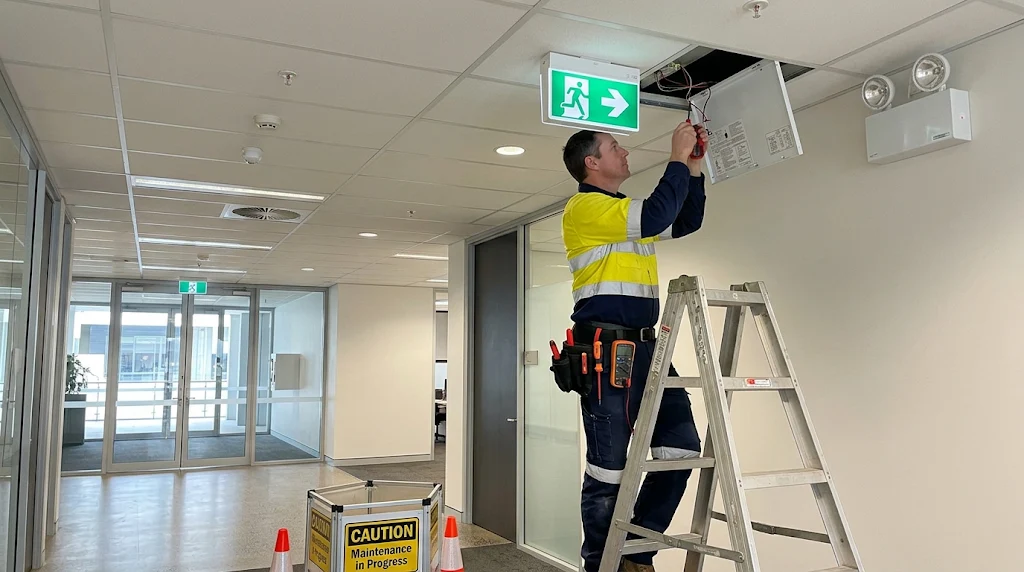
Emergency lighting should remain accessible for inspection, testing, repair and replacement.
Poor access can increase maintenance costs and make it difficult to complete required servicing activities.
Australian Standards for Emergency Lighting and Exit Signs
The AS/NZS 2293 series provides requirements for emergency lighting and exit signs in buildings.
Different parts of the series address different stages of the equipment lifecycle.
| Standard | Main purpose |
|---|---|
| AS/NZS 2293.1 | System design, installation and commissioning |
| AS/NZS 2293.2 | Routine service and maintenance |
| AS/NZS 2293.3 | Emergency luminaire and exit sign product requirements |
AS/NZS 2293.1 – Design and Installation
AS/NZS 2293.1 addresses the design, installation and commissioning of emergency lighting and exit sign systems.
It includes requirements relevant to system configuration, lighting performance, installation and commissioning.
AS/NZS 2293.2 – Routine Service and Maintenance
AS/NZS 2293.2 provides requirements for periodic inspection, testing and maintenance of emergency lighting and exit sign systems.
Its purpose is to help ensure that installed systems remain ready for operation.
AS/NZS 2293.3 – Product Requirements
AS/NZS 2293.3 addresses requirements for emergency luminaires and exit signs.
Selecting suitable equipment is important for ensuring that the products are appropriate for the intended installation.
The applicable editions, amendments and regulatory requirements should be confirmed for each project.
Emergency Lighting Inspection and Testing
Regular testing helps identify faults that may not be visible during normal operation.
For example, an emergency luminaire may appear to be functioning correctly while connected to mains power but fail to operate for the required duration during a power outage.
Routine maintenance should follow the applicable AS/NZS 2293.2 requirements and the building’s maintenance obligations.
Common Emergency Lighting Checks
Typical inspection and testing activities may include:
Visual Inspection
Check for damaged fittings, missing components, obstructed light paths and other visible defects.
Emergency Operation Testing
Verify that the emergency lighting operates correctly when normal power is interrupted using the appropriate test procedure.
Battery Performance Testing
Confirm that the emergency power supply supports operation for the required duration under the applicable test conditions.
Exit Sign Inspection
Check that illuminated exit signs are visible, correctly positioned and functioning as required.
Maintenance Documentation
Record inspection results, equipment failures, defects and corrective actions.
Defect Rectification
Investigate failed equipment and arrange appropriate repairs or replacement.
These activities are general examples. The complete servicing procedures and frequencies must be determined from the applicable standard and building requirements.
Common Emergency Lighting Problems
Emergency lighting systems can develop faults due to ageing components, environmental conditions, installation issues or insufficient maintenance.
Common problems include:
Battery Failure
Batteries can lose capacity over time, potentially preventing emergency luminaires from operating for the required duration.
Damaged or Faulty Fittings
Physical damage, faulty electronics or defective light sources can affect emergency lighting performance.
Incorrect Installation
Poor fitting placement, unsuitable mounting arrangements or incorrect wiring can reduce system effectiveness.
Obstructed Exit Signs
Storage, signage, decorations or building modifications may obstruct exit signs and emergency luminaires.
Incomplete Maintenance Records
Missing or inaccurate records can make it difficult to confirm servicing history, identify recurring failures and demonstrate maintenance activities.
Regular inspections and timely corrective action help reduce these risks.
Why Emergency Lighting Maintenance Records Matter
Accurate maintenance records are important for managing emergency lighting systems over time.
They provide a history of inspections, testing results, equipment failures and completed repairs.
A suitable maintenance record may include:
- Building or site identification.
- Emergency luminaire identification.
- Equipment location.
- Inspection and test date.
- Test results.
- Identified defects.
- Corrective actions.
- Repair or replacement details.
- Technician identification.
For facilities with multiple floors, buildings or emergency lighting circuits, consistent equipment identification can make maintenance more efficient.
Records may be maintained using an appropriate paper-based register or electronic maintenance system, provided the applicable documentation requirements are met.
Emergency Lighting and AS 1851: Understanding the Difference
Emergency lighting is an important building fire safety measure, but it is essential to distinguish its maintenance requirements from those of other fire protection systems.
Emergency lighting and exit signs are maintained under the applicable AS/NZS 2293 requirements, not AS 1851—2012.
AS 1851 addresses routine servicing of specified fire protection systems and equipment, such as fire detection systems, sprinklers, hydrants and fire pumps.
Emergency lighting has its own maintenance framework.
This distinction is particularly important for building owners and maintenance contractors in NSW.
The NSW Government explains that the AS 1851 maintenance requirements introduced on 13 February 2026 apply to essential fire safety measures covered by that standard.
Essential fire safety measures not covered by AS 1851, including emergency exit lighting, must still be maintained in accordance with the applicable Fire Safety Schedule or original design requirements.
For further information, see NSW Government – Responsibilities of Building Owners Under AS 1851—2012.
Emergency Lighting Compliance in NSW
Building owners in NSW are responsible for maintaining applicable essential fire safety measures.
Where emergency lighting and exit signs are identified as essential fire safety measures, the relevant maintenance and assessment obligations must be followed.
Building owners should review:
- The building’s Fire Safety Schedule.
- Applicable NCC requirements.
- Relevant AS/NZS 2293 provisions.
- Inspection and testing records.
- Outstanding defects and corrective actions.
- Annual Fire Safety Statement requirements, where applicable.
Routine maintenance and annual fire safety assessments are separate activities and may involve different competency and accreditation requirements.
Electrical installation and repair work must be performed by appropriately licensed personnel.
For official information, refer to NSW Government – Building Fire Safety Requirements.
Practical Emergency Lighting Maintenance Checklist
The following checklist can help facility managers and maintenance teams prepare for scheduled emergency lighting inspections.
| Maintenance item | What to review |
|---|---|
| Emergency luminaires | Condition, location and accessibility |
| Exit signs | Visibility, illumination and correct positioning |
| Battery backup | Required test results and operating duration |
| Electrical connections | Visible defects and applicable electrical safety requirements |
| System monitoring | Fault indications and testing records |
| Equipment register | Asset identification and location details |
| Maintenance history | Completed inspections and outstanding defects |
| Corrective actions | Repair, replacement and follow-up status |
This checklist is intended for maintenance planning and does not replace the detailed procedures in AS/NZS 2293.2.
Frequently Asked Questions
What is the purpose of emergency lighting?
Emergency lighting provides illumination when normal lighting fails, helping occupants navigate designated evacuation routes and exit the building safely.
What is the difference between emergency lighting and exit signs?
Emergency lighting illuminates evacuation routes, while exit signs identify exits and provide directional guidance