Table of Contents
ToggleNSW EV Charging Fire Safety Guidelines 2026: New FRNSW Recommendations for Carparks
Fire and Rescue NSW (FRNSW) updated its position on electric vehicles (EVs) and EV charging equipment on 18 August 2026. The revised guidance, Version 03, outlines important fire safety considerations for buildings incorporating EV parking and charging facilities.
The update is particularly relevant to fire protection engineers, building certifiers, electrical contractors, fire safety companies, developers and facility managers involved in commercial and residential building projects.
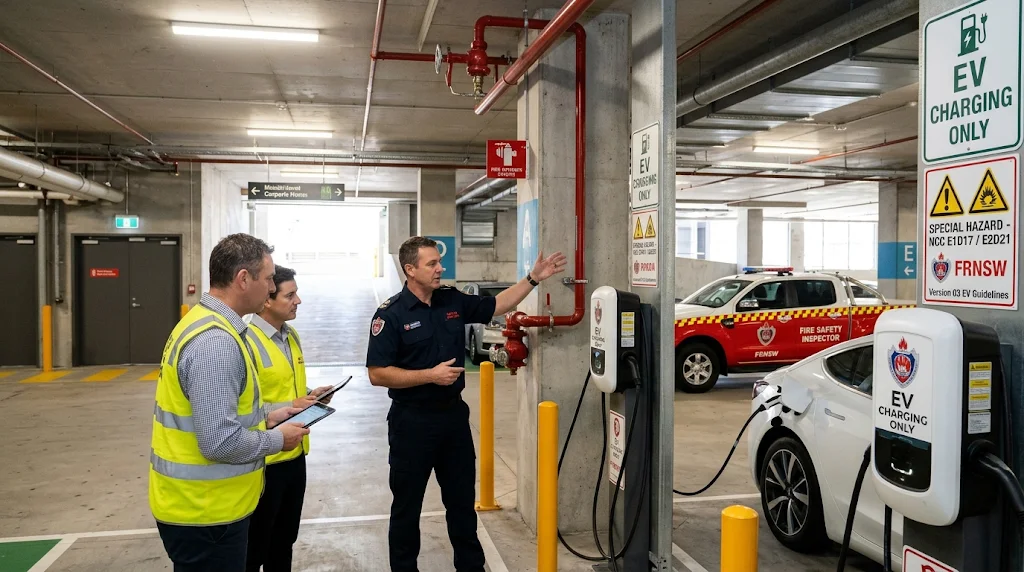
FRNSW recommends locating EV parking and charging facilities outdoors or in open-air areas where possible. For internal carparks, the guidance highlights automatic sprinkler protection, appropriate fire resistance levels and fire hydrant coverage.
The position also identifies EVs and EV charging equipment as special hazards under NCC 2022 clauses E1D17 and E2D21.
These recommendations do not represent a new nationwide law. They explain the position FRNSW takes when considering fire safety measures for relevant building projects in New South Wales.
Read the official FRNSW position statement – Electric Vehicles and EV Charging Equipment, Version 03 (PDF).
What Changed in the August 2026 FRNSW EV Fire Safety Guidance?
The updated position statement became effective on 18 August 2026 and supersedes the previous version dated 4 June 2024.
FRNSW endorses the Fire Safety for Carparks guideline published by the Australasian Fire and Emergency Service Authorities Council (AFAC).
The guidance is intended for practitioners designing and certifying Class 2–9 buildings that incorporate EV parking or charging equipment.
It focuses on identifying EV-related fire hazards and ensuring that building fire safety measures are appropriate for the risks involved.
Key FRNSW Recommendations
| Fire safety consideration | FRNSW position |
|---|---|
| EV parking location | Locate EV parking and charging outdoors or in open-air areas where possible |
| Internal carpark sprinklers | Provide automatic sprinkler protection with performance equivalent to AS 2118.1 or AS 2118.6 |
| Fire resistance levels | Do not apply relevant NCC Deemed-to-Satisfy FRL concessions to internal EV parking areas |
| Fire hydrants | Provide fire hydrant coverage |
| Special hazards | Assess EV parking and charging under NCC 2022 clauses E1D17 and E2D21 |
| Design and certification | Identify relevant hazards and demonstrate how the proposed fire safety measures address them |
These are FRNSW recommendations and assessment positions. Their application to a particular project must be considered alongside the applicable NCC requirements, approval process and building design.
Why EV Parking and Charging Are Considered Special Fire Hazards
Electric vehicles contain high-energy battery systems, commonly using lithium-ion technology.
Although EV battery fires are relatively uncommon, the consequences can be significant when a battery becomes involved in a fire.
FRNSW describes incidents involving EVs and associated infrastructure as currently low-frequency but potentially high-consequence events.
Potential hazards include:
- Rapidly developing fires.
- High-intensity, jet-like flames.
- Extended burning periods.
- Vapour cloud explosions.
- Thermal runaway within battery cells.
- Secondary ignition after initial extinguishment.
- Difficult and prolonged firefighting operations.
These hazards can create additional challenges for occupants, building structures and emergency responders.
Understanding Thermal Runaway
Thermal runaway occurs when a battery cell experiences an uncontrolled increase in temperature, potentially causing further reactions and heat generation.
In some circumstances, failure can spread between cells within a battery pack.
FRNSW identifies several possible initiating conditions, including mechanical damage, thermal abuse, rapid discharge and internal cell failure.
A battery involved in thermal runaway may continue to present hazards after the initial flames have been controlled.
This is one reason EV fire safety planning must consider more than the initial fire detection and suppression response.
1. NCC 2022 Special Hazard Requirements: E1D17 and E2D21
One of the most important elements of the updated FRNSW position is its reference to the National Construction Code.
FRNSW considers EVs and EV charging stations to be special hazards under:
- NCC 2022 Clause E1D17 – Fire-fighting services and equipment
- NCC 2022 Clause E2D21 – Smoke hazard management
These provisions address situations where the ordinary fire safety measures for a building may not adequately account for a particular hazard.
FRNSW expects building certifiers to consider whether additional fire safety measures are needed for the proposed EV parking or charging arrangements.
This does not mean every EV charging installation automatically requires the same additional equipment.
Instead, the design and certification process should consider the specific hazards and determine whether the proposed fire safety measures are appropriate.
Relevant considerations may include:
- Whether EV parking is internal or external.
- The location and arrangement of charging equipment.
- The building’s existing fire protection systems.
- Firefighter access and intervention.
- The potential consequences of a battery fire.
- The overall fire safety strategy.
The objective is to ensure that fire protection measures are appropriate for the identified risks.
2. External and Open-Air EV Parking Is Preferred
FRNSW recommends locating EV parking and charging facilities externally or in open-air areas wherever possible.
Open-air arrangements can provide different fire and smoke conditions compared with enclosed or underground carparks.
However, outdoor location alone does not eliminate EV fire risks.
Designers must still consider the location of charging equipment, nearby structures, vehicle access and the overall fire safety strategy.
Where external parking is not practical, FRNSW recommends additional attention to the fire protection arrangements within the building.
3. Sprinkler Protection for Internal EV Carparks
For EV parking or charging located inside a building, FRNSW recommends that the carpark be protected by an automatic fire sprinkler system.
The recommended system should provide performance equivalent to a system complying with either:
- AS 2118.1 – Automatic fire sprinkler systems: General systems
- AS 2118.6 – Automatic fire sprinkler systems: Combined sprinkler and hydrant systems in multistorey buildings
This is an important consideration for fire protection engineers and sprinkler contractors working on carpark projects.
Why Sprinkler Protection Matters
Automatic fire sprinklers can help control fire development and limit the spread of fire within the protected area.
However, sprinkler protection should not be assumed to immediately stop thermal runaway inside an EV battery pack.
The role of the sprinkler system must be considered as part of the building’s overall fire safety strategy.
For internal EV carparks, design teams should review:
- The proposed sprinkler system design and coverage.
- Water supply and system performance.
- The building layout and potential obstructions.
- The relationship between sprinkler protection and other fire safety measures.
- Relevant project-specific fire engineering requirements.
The final system design must be based on the applicable standards, approved building design and any required engineering assessment.
4. Fire Hydrant Coverage for EV Parking Areas
The FRNSW position also recommends fire hydrant coverage for EV parking and charging areas.
Fire hydrants provide an important water supply for firefighting operations.
Because EV battery incidents may require extended intervention, access to suitable firefighting water supplies is an important design consideration.
For building projects, fire protection engineers and hydrant contractors should assess:
- Hydrant coverage of the relevant parking areas.
- Access for firefighters.
- Water supply performance.
- The location of hydrants relative to building access.
- Potential obstructions caused by vehicles or equipment.
- Integration with the approved building fire safety strategy.
The position statement does not prescribe a universal additional hydrant flow rate specifically for every EV charging installation.
Project requirements should be determined through the applicable standards and design assessment.
5. Fire Resistance Levels: Avoiding NCC Concessions
The updated FRNSW position recommends that internal EV parking areas should not use concessions to fire resistance levels (FRLs) that may otherwise be available under the NCC Deemed-to-Satisfy provisions.
An FRL describes the fire resistance performance of a building element, including relevant structural adequacy, integrity and insulation criteria.
FRNSW’s recommendation reflects concern about the potential consequences of fires involving EV battery systems.
For designers and certifiers, this means the building’s fire resistance strategy should be carefully assessed when EV parking or charging is proposed.
It is important to distinguish this recommendation from a general statement that every existing carpark must immediately upgrade its fire-rated construction.
The position is primarily relevant to the design and certification assessment of applicable building projects.
6. Firefighter Access and Emergency Response
EV battery incidents may present different challenges from conventional vehicle fires.
FRNSW identifies the possibility of prolonged firefighting operations, secondary ignition and significant thermal hazards.
For this reason, building design should support safe and effective fire brigade intervention.
Relevant considerations include:
- Clear access routes to parking areas.
- Suitable hydrant coverage.
- Appropriate fire protection systems.
- Identification of EV charging infrastructure.
- The potential effect of fire and smoke on evacuation.
- Emergency response planning appropriate to the building.
Designers should also consider whether the proposed arrangements allow firefighters to access and manage an incident safely.
These matters should be addressed through the overall fire engineering and building certification process.
7. What Should Fire Engineers and Building Certifiers Document?
The FRNSW position places particular emphasis on identifying and addressing special hazards.
When consultation with, or referral to, FRNSW is required for a building incorporating EV parking or charging, the submission should clearly explain the relevant risks and proposed safety measures.
The position refers to a recognised person, meaning a person who is both an accredited practitioner (fire safety) and a fire safety engineer under the relevant NSW development certification and fire safety regulation.
The assessment should identify:
- The EV parking and charging arrangements.
- The associated fire hazards and risks.
- The proposed fire safety measures.
- How the design addresses the identified special hazards.
- How the FRNSW position and AFAC guidance have been considered.
The documentation should provide a clear basis for reviewing the proposed design.
It should not simply assume that standard carpark fire protection arrangements are sufficient without considering the identified EV hazards.
8. What Does the Update Mean for Existing Buildings?
The publication of Version 03 does not automatically mean that all existing buildings with EV charging equipment must immediately install new sprinkler or hydrant systems.
The position primarily addresses the design and certification of buildings incorporating EV parking or charging.
However, building owners considering new charging installations or modifications to existing carparks should review the applicable approval and fire safety requirements before proceeding.
A proposed installation may need assessment against the existing building design and its fire protection arrangements.
Where the project affects the building’s fire safety strategy, appropriately qualified professionals should determine whether further assessment or approval is required.
9. Inspection, Testing and Maintenance Considerations
Although the FRNSW position focuses on design and certification, ongoing maintenance remains important for fire protection systems serving EV carparks.
Building owners and fire protection contractors should continue to follow applicable routine servicing requirements for installed systems.
Relevant activities may include:
- Inspection and testing of automatic sprinkler systems.
- Fire hydrant system servicing.
- Recording defects and corrective actions.
- Maintaining access to fire protection equipment.
- Keeping relevant system documentation up to date.
- Reviewing the effect of building modifications on fire safety arrangements.
The FRNSW position does not itself introduce new AS 1851 servicing frequencies for EV carparks.
Existing maintenance obligations must be determined from the applicable legislation, standards and building requirements.
Fire Protection Logbooks for Sprinkler and Hydrant Systems
Accurate service records help fire protection contractors document the condition and maintenance history of installed fire safety systems.
Fire Factory Australia supplies AS 1851 routine service logbooks for a range of fire protection systems.
For applicable EV carpark installations, relevant products may include:
- Wet Pipe Sprinkler & Jacking Pump Systems Logbook – For recording relevant routine sprinkler system servicing activities.
- Fire Protection Service Logbooks – Including logbooks for applicable fire protection equipment and systems.
These logbooks support routine maintenance documentation. They are not specifically mandated by the FRNSW EV position statement and do not replace design certification or fire engineering assessments.
Frequently Asked Questions
When did the updated NSW EV fire safety guidance take effect?
Version 03 of the Fire and Rescue NSW position statement became effective on 18 August 2026, replacing the previous position last updated on 4 June 2024.
Are EV charging stations considered special hazards under the NCC?
FRNSW considers EVs and EV charging stations to be special hazards under NCC 2022 clauses E1D17 and E2D21. Building certifiers should consider whether additional fire safety measures are needed for the proposed installation.
Are sprinklers required in every EV carpark in NSW?
FRNSW recommends automatic sprinkler protection for internal EV parking areas, with performance equivalent to AS 2118.1 or AS 2118.6.
This recommendation should not be interpreted as a universal retrospective legal requirement for every existing carpark.
Does FRNSW recommend outdoor EV charging?
Yes. FRNSW recommends locating EV parking and charging externally or in open-air areas wherever possible.
Do EV carparks need fire hydrant coverage?
FRNSW recommends fire hydrant coverage for EV parking and charging areas. The specific design should be assessed against applicable standards and project requirements.
Can sprinklers stop an EV battery thermal runaway event?
Sprinklers can help control the surrounding fire, but they should not be assumed to immediately stop thermal runaway inside a battery pack.
The fire safety strategy must consider the particular challenges associated with EV battery fires.
Does the updated guidance change AS 1851 maintenance requirements?
No. The position statement does not establish new AS 1851 routine servicing intervals.
Existing fire protection maintenance requirements continue to apply where relevant.
Does the FRNSW position apply across Australia?
No. This is a Fire and Rescue NSW position statement.
It endorses the national AFAC carpark guidance, but the FRNSW recommendations should not automatically be treated as legislation applying throughout Australia.
Conclusion
The 2026 FRNSW EV and EV Charging Equipment Position Statement provides important guidance for fire protection professionals involved in buildings with electric vehicle parking and charging facilities.
The update reinforces the need to consider EV-related hazards during building design and certification, particularly where charging infrastructure is located inside enclosed carparks.
Key recommendations include:
- Locating EV parking and charging outdoors where possible.
- Providing appropriate automatic sprinkler protection for internal carparks.
- Ensuring suitable fire hydrant coverage.
- Avoiding relevant fire resistance concessions.
- Assessing special hazards under NCC 2022 clauses E1D17 and E2D21.
- Supporting safe and effective firefighting operations.
For fire engineers, certifiers, electrical contractors and building owners, the main priority is to ensure that EV charging infrastructure is considered within the overall building fire safety strategy.
Fire Factory Australia supports fire protection professionals with AS 1851 routine service logbooks and related fire safety products.
Explore our Fire Safety Logbooks or contact Fire Factory Australia for product enquiries.
Official Government Sources
1. Fire and Rescue NSW – Electric Vehicles (EV) and EV Charging Equipment, Position Statement Summary, Version 03
Effective: 18 August 2026
Read the official FRNSW Position Statement (PDF)
2. Australian Building Codes Board – National Construction Code 2022
Reference provisions: E1D17 and E2D21.
View the official National Construction Code
This article provides general industry information based on the published FRNSW position. The official document should be checked for any later revisions before use in design, certification or compliance decisions.