
Table of Contents
ToggleAS 1851 Contractor Reporting Requirements: BPC Victoria’s 2026 Guidance
The Building and Plumbing Commission (BPC) Victoria published its PES 2026 presentation on service contractor obligations on 27 August 2026. The guidance explains how fire protection service contractors should document routine servicing, report defects, notify building owners and prepare yearly condition reports under AS 1851–2012.
The presentation is particularly relevant to fire protection companies, maintenance contractors, building owners, facility managers and professionals responsible for essential safety measures.
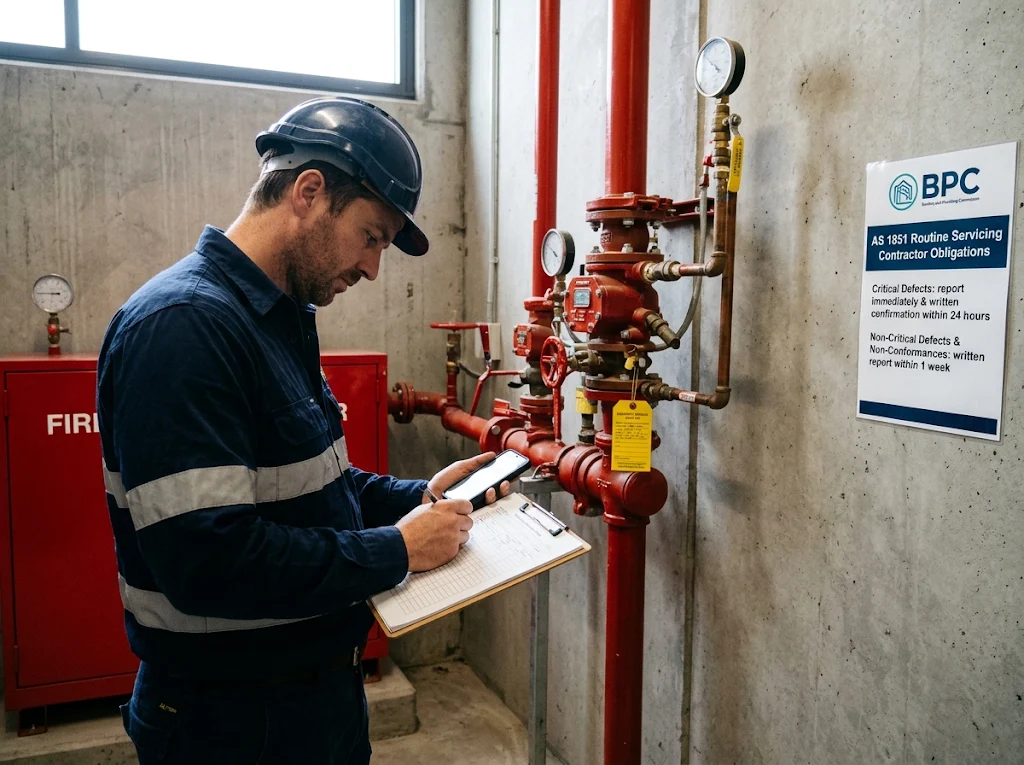
One of its most important messages concerns reporting deadlines: critical defects must be reported to the Responsible Entity before leaving the site where possible, with written confirmation within 24 hours of identification. Non-critical defects and non-conformances must be reported in writing within one week.
The presentation also addresses service logbooks, electronic records, equipment service tags, system impairments and annual reporting.
This is educational guidance from the Victorian building regulator. It does not introduce a new edition of AS 1851 or a new nationwide reporting law.
Read the official BPC Victoria PES 2026 presentation: Service Contractor Obligations.
What Does the BPC Victoria PES 2026 Presentation Cover?
The presentation, titled Service Contractor Obligations: Documents & Information to Be Provided to the Owner, was prepared by the Office of the State Building Surveyor.
It explains the documentation and notification responsibilities associated with routine servicing of fire protection systems under AS 1851–2012.
The presentation covers:
- Notifications before routine servicing begins.
- Notification of system impairments.
- Service records and acceptable documentation formats.
- Mandatory information in logbooks.
- Service tags, labels and summary records.
- Critical and non-critical defect reporting.
- Yearly Condition Reports.
- Systems interface testing records.
- Record retention responsibilities.
The information helps contractors understand what should be recorded, when reports should be provided and who must receive them.
Who Is the Responsible Entity?
The presentation defines the Responsible Entity as the owner, occupier or owner’s agent responsible for routine servicing of the fire protection systems.
The Responsible Entity is the intended recipient of the relevant service documentation and notifications.
The Service Provider or Contractor is the person or organisation engaged to carry out routine inspection, testing, preventive maintenance or surveys on behalf of the Responsible Entity.
Clear communication between these parties is essential when servicing identifies defects, system impairments or incomplete maintenance activities.
1. Critical Defect Reporting: The 24-Hour Rule
One of the most important sections of the BPC presentation concerns critical defects.
Under the presentation’s explanation of AS 1851–2012 Clause 1.17.1, a critical defect is one that renders a fire protection system inoperative.
Examples given include:
- An impaired water supply to a sprinkler system.
- An inoperative fire indicator panel.
These defects can significantly affect the ability of a fire protection system to perform its intended function.
When Must a Critical Defect Be Reported?
The BPC presentation identifies the following process:
- Notify the Responsible Entity before leaving the site.
- If notification before leaving is not possible, notify them as soon as possible.
- Confirm the defect in writing within 24 hours of identification.
- Reconfirm the defect each time it is subsequently identified.
- Recommend that the defect be rectified with minimum delay.
The written notification should clearly identify the affected system, the defect and the action required.
A critical defect should not be left only as an entry in a service logbook without the required notification.
2. Non-Critical Defects and Non-Conformances: One-Week Reporting
Not every defect makes a fire protection system completely inoperative.
The BPC presentation distinguishes between critical defects, non-critical defects and non-conformances.
| Classification | Description in the BPC guidance | Reporting timeframe |
|---|---|---|
| Critical defect | Renders a fire protection system inoperative | Notify before leaving where possible; written confirmation within 24 hours |
| Non-critical defect | Impairment that does not render the system inoperative | Written report within one week |
| Non-conformance | Missing information or an incorrect feature that does not affect operation | Written report within one week |
| Out-of-tolerance activity | Service activity not completed within the permitted tolerance period | Report within one week after the tolerance period ends |
Contractors should classify findings correctly and record sufficient detail for the Responsible Entity to understand the issue.
A useful defect report should identify the equipment, location, classification, relevant findings and any rectification completed.
The distinction between defect types is important because the notification timeframes are different.
3. Notifications Required Before Routine Servicing
The presentation refers to AS 1851–2012 Clause 1.14 when explaining notifications associated with routine servicing.
Before work begins, contractors should consider whether the planned activities could affect building occupants, normal operations or fire protection system availability.
Upcoming Service Notification
The Responsible Entity should be informed that routine servicing will take place, particularly where the work may affect building occupants or operations.
This helps the building manager prepare for activities such as testing alarms, isolating equipment or accessing occupied areas.
System Impairment Notification
Where routine servicing will impair a fire protection system, the Responsible Entity must be informed.
The notification should identify:
- The extent of the impairment.
- Which systems or functions will be affected.
- The expected duration of the impairment.
This information allows the Responsible Entity to consider appropriate alternative safety arrangements while the system is impaired.
Monitoring Service Provider Notification
Where testing may transmit alarm signals to a monitoring service provider, that provider should be notified before testing.
This helps avoid unnecessary false-alarm responses.
Restoring Systems After Servicing
At the completion of routine servicing, controls should be returned to their previous normal operating state.
If a system function remains impaired, disabled or has not been restored to normal:
- Record the condition in the system logbook.
- Notify the owner or agent immediately.
- Clearly identify the affected function and outstanding issue.
System restoration is an important part of completing the service visit.
4. AS 1851 Service Logbook and Record Requirements
The BPC presentation explains three service-record formats under AS 1851–2012.
These are:
Hardcopy Logbook
A paper record completed during servicing and left on site on the day of the visit.
Electronic Log
A digital service record supported by a printed, signed paper copy left on site at completion.
Service Tags or Labels with Summary Records
Tags or labels are attached to equipment, with a signed hardcopy summary record provided within one week.
The presentation emphasises the importance of hardcopy documentation being available on site.
However, contractors should distinguish the different documentation arrangements and timeframes described for each format.
What Information Must an AS 1851 Service Record Include?
The presentation refers to Clause 1.16.3 and identifies the following information:
- Building or site name and address.
- Date of servicing.
- Service frequency, such as monthly, six-monthly or yearly.
- System or equipment description and location.
- Activities performed.
- Recorded inspection and test results.
- Pass or fail results for relevant activities.
- Defects and non-conformances.
- Defect classification and location.
- Rectification completed.
- Responsible Entity name.
- Service person’s name, signature and date.
- Service provider’s company name.
Accurate service records allow contractors and building owners to identify what was inspected, what was found and what action was taken.
A record should be specific enough to distinguish between equipment that passed inspection, equipment with defects and equipment that was not serviced.
5. Service Tags, Labels and Summary Records
Service tags and labels provide a visible record of routine servicing for relevant equipment.
The BPC presentation refers to AS 1851–2012 Clauses 1.16.4 and 1.16.5 when explaining the information required.
The presentation identifies information such as the service-record title, servicing frequency and relevant service dates.
It also explains that equipment service tags or labels must be supported by an appropriate summary record.
When Must the Summary Record Be Provided?
Where the tag or label method is used, the signed hardcopy summary record must be provided within one week of the service date.
The summary record should identify:
- Building name and address.
- Service date and scheduled service date.
- Relevant equipment register information.
- Equipment serviced, including quantities and types.
- Equipment not serviced, including reasons.
- Defects and non-conformances.
- Rectification completed.
- Service provider and service person details.
- Relevant additional information for the equipment type.
For example, the BPC presentation identifies extinguisher manufacture or pressure-test dates and applicable hose reel flow-test information as items to include where relevant.
The summary record provides more detail than a service tag alone.
6. Defective Fire Extinguishers: Additional Reporting Requirements
The presentation includes a specific section on defective fire extinguishers, referring to AS 1851–2012 Clause 10.2.10.
Where an extinguisher must be removed because of a defect, the presentation identifies additional actions.
These include:
- Leaving a replacement of the same type and size, or a similar rating, in place.
- Providing a Defective Component Report.
- Providing an Action Required Report.
- Recording the actions in the service record.
- Obtaining the owner’s permission before destroying an extinguisher or component, arranged through the Responsible Entity.
These requirements are important for contractors servicing portable fire extinguishers in commercial buildings.
The purpose is to ensure that the removal of defective equipment is properly documented and that appropriate protection is maintained.
7. Yearly Condition Reports: What Contractors Must Include
The Yearly Condition Report is another major focus of the BPC presentation.
The presentation describes it as the principal compliance document under AS 1851–2012.
It is completed and issued by the service contractor annually to the Responsible Entity.
The report provides a formal summary of the condition of the fire protection systems and their routine servicing history.
Mandatory Content of a Yearly Condition Report
The presentation refers to AS 1851–2012 Clause 1.17.2 and identifies the following information:
- Building name and address.
- Reporting period, including start and end dates.
- Identification and location of each relevant system.
- Applicable design standard for each system.
- Outstanding defects.
- Outstanding non-conformances.
- Summary of relevant servicing records for the year.
- Statement of system condition.
- Information about whether systems remain in accordance with the approved design.
- Responsible Entity name and address.
- Service provider company details.
- Service provider representative’s name, signature and date.
The report should also identify important limitations affecting the condition of the systems.
What About Missed Service Activities?
The BPC presentation explains that the Yearly Condition Report should acknowledge service activities that were missed during the year.
It should also identify:
- Outstanding defects that render a system non-operational.
- Service activities performed by different contractors or service providers.
- Relevant unresolved non-conformances.
A Yearly Condition Report should not simply state that a system is satisfactory without addressing significant outstanding issues.
Is a Yearly Condition Report the Same as an Annual Essential Safety Measures Report?
Not necessarily.
The AS 1851 Yearly Condition Report is a routine servicing document prepared by the service contractor.
Victoria also has regulatory requirements relating to Essential Safety Measures and Annual Essential Safety Measures Reports.
The documents serve related but distinct purposes, and their responsibilities should not be confused.
Contractors and building owners should confirm the requirements applicable to their building.
8. Systems Interface Test Records
Fire protection systems may interact with other building systems.
Examples can include fire detection systems communicating with mechanical services, smoke control equipment or other building functions.
The BPC presentation refers to AS 1851–2012 Clause 1.12 and Appendix D for systems interface testing records.
The presentation identifies the following information:
- Identification of each interface tested.
- Cause-and-effect test results.
- Name and signature of the person verifying each result.
- Date and time of testing.
- Acceptance signature of the Responsible Entity’s representative.
- Details of identified interface defects.
The presentation states that hardcopy interface test records should be kept on site and available at all times.
Relevant defects should also be included in the Yearly Condition Report.
This is particularly important where the correct operation of one fire safety system depends on signals or actions from another system.
9. How Long Must AS 1851 Service Records Be Retained?
The BPC presentation states that the Responsible Entity must retain service records on site for a minimum of seven years.
Maintaining complete historical records helps building owners and contractors:
- Review previous servicing.
- Track outstanding defects.
- Identify recurring equipment problems.
- Confirm maintenance history.
- Support compliance reviews and audits.
- Prepare accurate yearly reports.
Record retention should be managed by the Responsible Entity in accordance with the applicable requirements.
The seven-year period is presented in the BPC guidance in the context of AS 1851–2012. Building owners should also check any additional recordkeeping obligations that apply under their state or territory legislation.
10. AS 1851 Contractor Documentation Checklist
The following checklist summarises the main timeframes presented by BPC Victoria.
| Document or notification | When to provide it |
|---|---|
| Planned impairment notification | Before commencing work |
| Monitoring service provider notification | Before testing that may transmit alarm signals |
| Completed service logbook or electronic record hardcopy | At completion of the service visit |
| Service tag or label | On the day of servicing |
| Summary record where tags or labels are used | Within one week |
| Notification of a system not restored to normal | Immediately on completion or identification |
| Critical defect verbal notification | Before leaving site, where possible |
| Critical defect written confirmation | Within 24 hours of identification |
| Non-critical defect or non-conformance report | Within one week |
| Out-of-tolerance activity report | Within one week after the tolerance period ends |
| Yearly Condition Report | Annually to the Responsible Entity |
| Systems interface test records | Hardcopy retained on site and available |
| Service record retention | Minimum seven years on site, as explained in the presentation |
This checklist reflects the BPC presentation and should be used alongside the relevant clauses of AS 1851 and applicable legislation.
11. Why Accurate Fire Safety Logbooks Matter
The BPC presentation reinforces an important principle: completing routine servicing is only part of a contractor’s responsibility.
The work must also be documented accurately and communicated to the Responsible Entity.
Fire protection logbooks help provide a structured record of:
- Inspection and testing activities.
- Service dates and frequencies.
- Equipment identification.
- Test results.
- Defects and non-conformances.
- Corrective actions.
- Outstanding maintenance issues.
For contractors managing multiple buildings or systems, consistent recordkeeping can make it easier to prepare defect reports, review servicing history and complete yearly condition reports.
Fire Factory Australia AS 1851 Logbooks
Fire Factory Australia supplies a range of routine service logbooks designed for fire protection professionals working with AS 1851–2012.
Relevant products include:
Fire Detection and Alarm Systems Logbook
For recording applicable inspection and testing activities, system results, defects and corrective actions.
Wet Pipe Sprinkler & Jacking Pump Systems Logbook
For documenting routine sprinkler system servicing, relevant pressure readings, test results and maintenance findings.
Mechanical Services Logbook – Fire and Smoke Control Features
For applicable mechanical services operating in fire and smoke control modes, including relevant inspection and testing records.
Passive Fire Logbook
For recording applicable routine inspection activities associated with passive fire protection elements.
Diesel and Electric Fire Pumpset Logbooks
For recording routine inspection and testing activities for relevant fire pumpsets.
Explore the Fire Factory Australia Fire Safety Logbook Range.
A suitable logbook supports service documentation, but the contractor remains responsible for completing all required records, notifications and reports. A logbook alone does not replace a separate defect notification or Yearly Condition Report where one is required.
Frequently Asked Questions
What is the BPC Victoria PES 2026 Service Contractor Obligations presentation?
It is an educational presentation published by the Building and Plumbing Commission Victoria on 27 August 2026. It explains documentation, notification and reporting obligations associated with AS 1851–2012 routine servicing.
Does the presentation introduce a new AS 1851 standard?
No. The presentation discusses AS 1851–2012. It does not announce a new edition or establish a new nationwide commencement date.
How quickly must a critical defect be reported?
The BPC presentation explains that the Responsible Entity should be notified before the contractor leaves the site, or as soon as possible if this cannot be done. Written confirmation must follow within 24 hours of identifying the critical defect.
How quickly must non-critical defects be reported?
The presentation identifies a written reporting period of one week for non-critical defects and non-conformances.
Must a hardcopy service record be left on site?
The presentation emphasises hardcopy documentation on site. It distinguishes between paper logbooks, electronic records supported by printed signed copies, and tags or labels supported by a hardcopy summary record within one week.
What is a Yearly Condition Report?
A Yearly Condition Report is an annual servicing document prepared by the service contractor and provided to the Responsible Entity. It summarises servicing activities, system condition, outstanding defects and relevant non-conformances.
How long must fire protection service records be kept?
The BPC presentation states that the Responsible Entity must retain service records on site for at least seven years.
Does this guidance apply throughout Australia?
The presentation is published by the Victorian building regulator and discusses AS 1851–2012.
Although AS 1851 is an Australian Standard, its legal application and associated reporting obligations depend on the relevant state or territory requirements and the circumstances of the building.
Contractors should not assume that every Victorian regulatory requirement applies identically throughout Australia.
Can Fire Factory logbooks replace a defect report or yearly condition report?
No. Fire Factory logbooks can support routine service recordkeeping, but separate notifications and reports must still be prepared and issued where required.
Conclusion
The BPC Victoria PES 2026 Service Contractor Obligations presentation provides a useful reminder of the documentation responsibilities associated with routine fire protection servicing under AS 1851–2012.
Its most important messages concern timely defect notification, accurate service records, system impairment reporting and annual condition reporting.
For fire protection contractors, the key priorities are to:
- Notify the Responsible Entity when systems are impaired.
- Report critical defects promptly and confirm them in writing within 24 hours.
- Report non-critical defects and non-conformances within the required period.
- Maintain accurate service logbooks and summary records.
- Prepare complete Yearly Condition Reports.
- Keep service records available for future review.
For building owners and facility managers, these records provide important information about the condition of fire protection systems and outstanding maintenance issues.
Fire Factory Australia supports fire protection professionals with AS 1851 routine service logbooks designed to help organise inspection, testing and maintenance records.
Explore our Fire Safety Logbooks or contact Fire Factory Australia for product information and B2B enquiries.
Official Source and Technical References
1. Building and Plumbing Commission Victoria – PES 2026: Service Contractor Obligations
- Publisher: Building and Plumbing Commission Victoria
- Presentation: Service Contractor Obligations: Documents & Information to Be Provided to the Owner
- Version: 1.0
- Published: 27 August 2026
View the official BPC presentation page
Download the official presentation (PDF)
2. AS 1851–2012 – Routine Service of Fire Protection Systems and Equipment
Relevant clauses referenced in the presentation include:
- Clause 1.12 – Systems interface testing.
- Clause 1.14 – Routine servicing notifications and system restoration.
- Clause 1.16 – Service records, tags, labels and summary records.
- Clause 1.17 – Defect reporting and Yearly Condition Reports.
- Clause 10.2.10 – Defective fire extinguishers.
- Appendix D – Systems interface testing records.
This article provides general industry information based on the BPC Victoria presentation. It does not replace the full Australian Standard, applicable state or territory legislation, or professional compliance advice. Requirements should be verified against the standards and legislation applicable to each building.
