Table of Contents
ToggleAFSS vs Routine Maintenance Records in NSW: What Is the Difference?
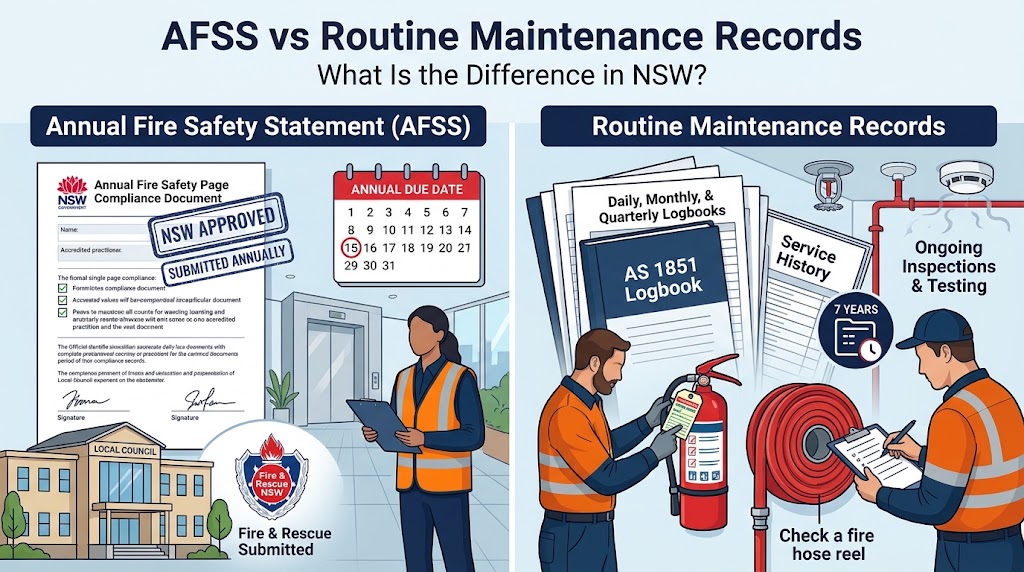
Quick Answer: The difference in AFSS vs fire maintenance records is clear: a NSW fire logbook records scheduled servicing, while the AFSS is annual compliance evidence for building fire safety schemes. A logbook does not replace the AFSS. Both support compliance records.
For fire companies, electrical contractors, building managers, and B2B buyers, the AFSS and routine maintenance records are often stored in the same compliance folder. That does not make them interchangeable. In NSW, an Annual Fire Safety Statement, or AFSS, is annual evidence that required building fire safety schemes are maintained and compliant for the statement period. A fire maintenance record, or NSW fire logbook, shows that individual equipment was inspected, tested, serviced, and repaired on schedule. The difference matters because one document answers a compliance question, while the other answers a service history question. B2B buyers can source supporting components from FireFactory.
AFSS vs Fire Maintenance Records: NSW Fire Logbook Roles
The AFSS is the formal annual statement. It is not a checklist of every extinguisher, smoke alarm, or emergency light. It relates to the building’s required fire safety schemes and provides compliance evidence for the statement period. Fire and Rescue NSW provides a service type tool to lodge a fire safety statement. That statement is separate from the day to day records created during site visits.
Maintenance records are operational documents. They may include service sheets, inspection checklists, test reports, fault reports, replacement logs, and work orders. They show what was done to a specific piece of equipment, when it was done, by whom, and what condition the equipment was left in. In a commercial facility, these records also support asset management, warranty claims, and purchasing decisions.
| Document | Primary purpose | Typical evidence | Compliance role |
|---|---|---|---|
| AFSS | Annual declaration for building fire safety schemes | Statement, supporting scheme evidence, lodgement reference | Evidence of compliance for the statement period |
| Maintenance logbook | Record of servicing and testing | Service date, equipment ID, technician, defects, parts, next due | Supports AFSS and shows equipment was maintained |
Why a NSW Fire Logbook Is Not an AFSS
A NSW fire logbook can be strong evidence that a company completed its service work. It can show that a fire extinguisher was inspected, an emergency light was tested, a smoke detector was replaced, or a fire door was checked. However, the logbook does not make the annual compliance declaration. The AFSS is the statement that the building’s required fire safety schemes are in place and meeting the required standard for the relevant period.
The practical risk is that a building may have a detailed logbook but still be noncompliant if the AFSS is missing, outdated, or not lodged. Conversely, an AFSS can be lodged while individual maintenance records are weak. Fire companies should keep the two workstreams distinct: the annual statement for building compliance, and the maintenance schedule for equipment.
Maintenance Evidence That Supports an AFSS
When a maintenance record supports an AFSS, it should be specific enough for an auditor, building manager, or insurer to trace the work. The strongest records identify the asset, not just the generic task. They show the model, serial number, location, and service interval. They also record defects, parts fitted, and the next service date.
For commercial facilities, exact model evidence is important. If a replacement smoke detector, extinguisher, emergency light, or fire door component is installed, the logbook should show the old part and the new part. This helps the fire company verify compatibility, supports the building’s asset register, and makes it easier for a B2B buyer to source future parts from a supplier such as FireFactory. The record does not need to be promotional. It needs to be accurate, dated, and linked to the asset.
Practical Steps for Fire and Electrical Companies
- Confirm the building’s required fire safety schemes before starting the annual compliance cycle.
- Keep the AFSS separate from routine service records in the building file.
- Record each inspection, test, service, and repair with enough detail to identify the asset and the work completed.
- Use exact model numbers and part references when equipment is replaced or repaired.
- Track defects and follow up on outstanding work so the logbook shows a closed service history.
- Lodge the AFSS through the Fire and Rescue NSW service type tool for the correct statement type.
Common Errors That Create Compliance Risk
- Treating the NSW fire logbook as the AFSS.
- Recording only fire safety service completed without asset model, location, or service interval.
- Losing the link between replaced parts and the equipment they were fitted to.
- Allowing maintenance defects to remain open while the annual statement is prepared.
- Mixing equipment records from multiple buildings without clear building and asset identification.
Frequently Asked Questions
Can a NSW fire logbook replace an AFSS?
No. The logbook records servicing and testing for equipment. The AFSS is the annual statement for building fire safety schemes. A logbook can support the AFSS, but it is not the same document.
What is the main difference between AFSS and fire maintenance records?
The AFSS provides annual compliance evidence for a building’s required fire safety schemes. Fire maintenance records provide service history for individual equipment, including dates, tests, defects, and replacements.
What should be included in a fire maintenance record?
The record should show the building, asset ID, model or part number, location, service date, service performed, technician, defects, parts replaced, and next due date. This level of detail supports audits and future purchasing.
Where is the AFSS lodged?
The AFSS is lodged through the Fire and Rescue NSW service type tool. The tool is used for the correct statement type for the building. Fire companies can provide supporting service records for the statement.
How does exact model evidence help B2B buyers?
Exact model evidence lets buyers identify compatible equipment, plan spares, and avoid purchasing the wrong replacement. For a supplier such as FireFactory, model numbers and part references make product selection more accurate for commercial projects.
Conclusion
Clear separation between AFSS and fire maintenance records protects compliance and reduces audit risk. Fire companies should keep the annual statement distinct from the service log, while still ensuring the log provides enough evidence to support the statement. For B2B teams, FireFactory can help source fire protection equipment and components with accurate model and part references. Contact FireFactory for product guidance and supply.