Table of Contents
ToggleACT Fire Equipment Maintenance: Which Standards Should Contractors Check?
Quick Answer: For ACT fire equipment maintenance, contractors should check the ACT ESA fire safety systems guidance, the premises approval or legal requirements, manufacturer instructions, and applicable Australian Standards. Canberra fire logbooks should record tasks, intervals, defects, and product evidence before work starts.
A contractor entering an ACT commercial site should not assume that one maintenance routine applies to every detector, extinguisher, hose, or alarm panel. The correct task list depends on the premises, the approved fire safety systems, the equipment model, and the standard referenced by the premises legal and approval requirements. This guide from FireFactory gives electrical, fire, and retail maintenance teams a practical checklist for ACT fire equipment maintenance and Canberra fire logbooks, with a focus on verification before work begins.
Why ACT fire equipment maintenance requires a standards check
Before a contractor sets a task, the site context matters. The ACT ESA explains proper maintenance standards and approved alternatives in context, so the correct standard may vary between a retail fit out, a multi storey office, and a warehouse. The key risk is not only a missing inspection, but a maintenance record that references the wrong interval, the wrong product, or an unapproved alternative. For compliance, the work order should show which requirement was checked, who approved it, and what evidence supports the product claim. This keeps the contractor defensible and gives the occupier a clear audit trail.
Core standards and documents contractors should check
Contractors should treat the following as the baseline check before maintenance begins. The ACT ESA fire safety systems guidance gives the starting point for maintenance standards and approved alternatives in the ACT context. The list below helps ensure that site specific requirements are identified early.
| Document or standard | Why it matters | What to record |
|---|---|---|
| ACT ESA fire safety systems guidance | Explains maintenance standards and approved alternatives in the ACT context | Guidance reference and context notes |
| Premises legal and approval requirements | Determines the approved system and any site conditions | Approval reference and condition notes |
| Manufacturer instructions and exact model evidence | Confirms maintenance tasks, replacement parts, and product claims | Model, part number, and revision |
| Applicable Australian Standards | Supports the method and interval where the standard is referenced | Standard citation and task method |
| Site maintenance plan or service agreement | Aligns contractor tasks with the occupier’s expected frequency | Agreed tasks and frequency |
| Canberra fire logbooks | Records completed maintenance and supports compliance evidence | Entry date, technician, and result |
Canberra fire logbooks and maintenance records
Verifying intervals and product claims
Intervals vary by standard, equipment type, and approval condition. Contractors should verify the exact interval against current official sources, the applicable standard, the premises legal requirements, and the manufacturer documentation. If a replacement component is considered, the logbook should note the exact model and the evidence that it is approved for the site. This matters because a product may be suitable for one class of use but not another, and a generic claim may not satisfy the site requirement.
Common failure points to note
Logbook entries should identify equipment that is hard to access, damaged, out of date, or operating outside its rated conditions. Common commercial facility failure points include sealed ceiling voids, storage blocking access, temporary fit outs changing the fire safety layout, and uncontrolled changes to alarm or extinguishing equipment. Recording these points helps the next technician avoid unsafe or non compliant work.
Commercial facility considerations
Retail, office, and mixed use sites often have multiple approval layers. The contractor should check whether the site has undergone recent renovation, whether the approval reflects the current layout, and whether any temporary measures are in place. The logbook should record who reviewed the current requirements, because maintenance is not only about the equipment but also about the approved system context.
Practical purchasing and selection considerations for ACT sites
Before ordering replacement parts or maintenance supplies, the contractor should confirm the exact model, compatibility, and approval evidence. FireFactory supplies Australian fire equipment for B2B customers, and contractors can use its exact model references to match the supplies required for an ACT site. The practical value is not only availability, but the ability to check specifications, compare approved alternatives, and keep records consistent. For Canberra fire logbooks, a clear product reference makes the audit trail easier to defend.
When selecting products, avoid relying on visual similarity. A detector, head, nozzle, extinguisher refill, or accessory may look interchangeable but may not meet the site standard or approval. The contractor should retain the supplier model reference and any supporting documentation that shows the item is appropriate for the intended task.
Frequently Asked Questions
What standard should a contractor check first for ACT fire equipment maintenance?
Start with the ACT ESA fire safety systems guidance and the premises legal or approval requirements. The applicable Australian Standard, manufacturer instructions, and site plan should be checked next. This order helps the contractor confirm the correct interval and approved product before work begins.
What should Canberra fire logbooks record after maintenance?
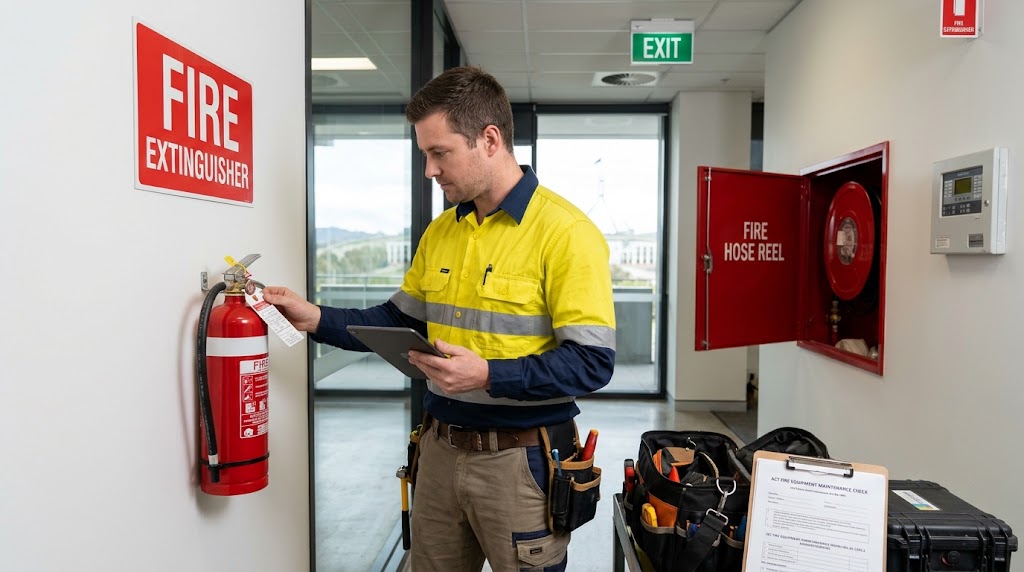
Record the date, equipment location, exact model, task performed, and the standard or instruction used. Note any defects, access issues, or approved alternatives. Keep the entry simple enough for an auditor but detailed enough to show the work was verified.
Can a contractor use a replacement product if it looks the same?
Not unless the exact model or approved alternative is verified against the site requirements and manufacturer documentation. Visual similarity is not evidence of compliance. The logbook should reference the model and the source used to confirm it.
How does a recent renovation affect maintenance checks?
A renovation can change the approved fire safety system, so the contractor should recheck the premises approval and current layout before relying on old records. If the approval or system context has changed, the maintenance tasks and intervals may also change. The logbook should record the review and the documents used.
Conclusion
Contractors can reduce compliance risk by verifying the ACT context, the premises approval, the applicable standard, and the exact model before completing maintenance. A well kept Canberra fire logbook should show what was checked, what was done, and what evidence supports the work. This approach is especially useful for commercial sites where access, fit outs, and approval changes can alter the maintenance requirement.
FireFactory supports Australian contractors with B2B fire equipment and exact model references for maintenance tasks. Contact the FireFactory team to check specifications and confirm the supplies needed for your ACT or Canberra site.