Table of Contents
ToggleWet Pipe Sprinkler & Jacking Pump Systems Logbook
A Complete Guide to AS 1851—2012 Wet Pipe Fire Sprinkler & Jacking Pump Routine Service Records
Automatic fire sprinkler systems are designed to provide an immediate response when a fire activates one or more sprinklers. Maintaining these systems requires more than simply checking sprinkler heads. Routine servicing can involve control valves, alarms, pressure gauges, water supplies, pumps, interfaces, flow switches, booster connections, pipework and many other components.
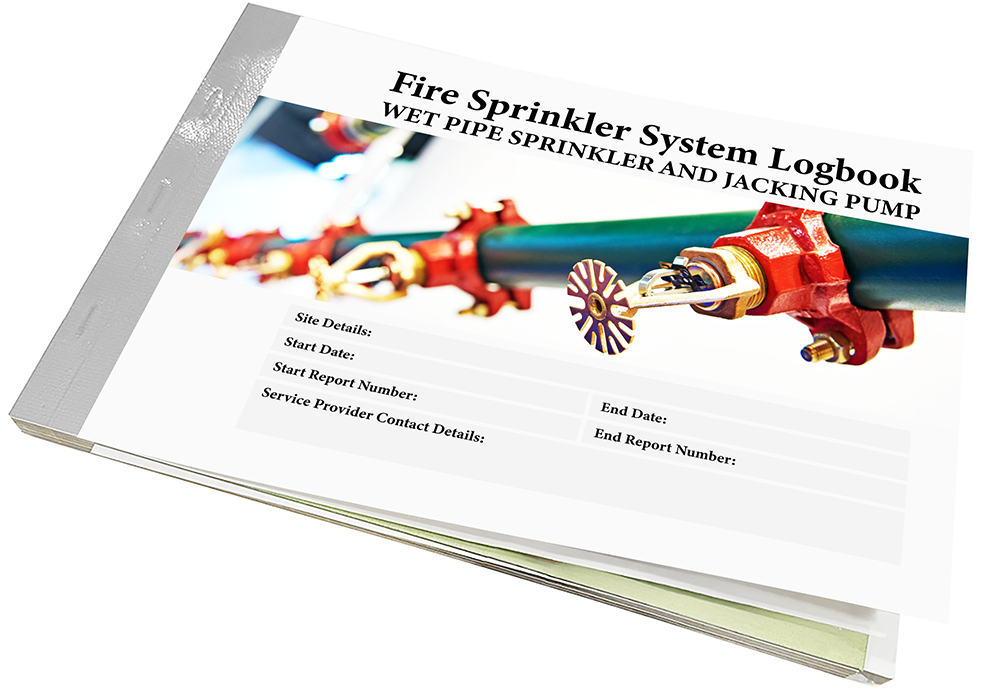
The Fire Factory Australia Wet Pipe Sprinkler & Jacking Pump Systems Logbook provides a structured hardcopy record for documenting routine service activities associated with wet pipe automatic fire sprinkler systems and associated jacking pumps.
Developed around the applicable requirements of AS 1851—2012 Routine service of fire protection systems and equipment (Incorporating Amendment No. 1), the logbook combines practical service schedules with dedicated areas for recording pressures, alarm operating times, pump cut-in and cut-out pressures, water supply test results, defects and corrective actions.
Under AS 1851—2012, automatic fire sprinkler systems are covered by Section 2, while associated pumpsets and jacking pumps are addressed under Section 3. Section 2 specifically includes wet pipe, dry pipe, deluge and water spray, and pre-action systems, with wet pipe systems having their own dedicated service schedules.
This makes the product suitable for Australian fire protection contractors and technicians searching for a Wet Pipe Sprinkler Logbook, Fire Sprinkler Logbook, AS 1851 Sprinkler Logbook, Jacking Pump Logbook, Fire Safety Logbook or Routine Service Logbook.
What Does the Wet Pipe Sprinkler & Jacking Pump Logbook Cover?
The logbook has been purpose-designed for routine service record keeping associated with wet pipe sprinkler systems and jacking pumps.
It provides structured records for areas including:
- Wet pipe automatic fire sprinkler systems
- Sprinklers and spare sprinklers
- Sprinkler control valve assemblies
- Main stop valves
- Alarm valves and alarm cocks
- Fire brigade booster connections
- Pressure switches
- Alarm signalling equipment
- Water supply valves
- Flow switches
- Valve monitoring devices
- Pressure gauges
- Main drain testing
- Water motor alarm gongs
- Sprinkler system interfaces
- Pressure-reducing valves
- Pressure-relief valves
- Water supply proving tests
- Water supply tanks, where applicable
- Foam water sprinkler systems, where fitted
- Jacking pumps
- Hydro-pneumatic accumulators
- Pump cut-in and cut-out pressures
- Sprinkler surveys
- Defects and corrective actions.
The result is a system-specific sprinkler service logbook, rather than a generic maintenance form.
Which Sections of AS 1851 Apply?
The primary applicable sections are:
| System / Equipment | AS 1851—2012 Section |
|---|---|
| Wet Pipe Automatic Fire Sprinkler Systems | Section 2 |
| Jacking / Pressure-Maintenance Pumps | Section 3 |
| Water Storage Tanks, where applicable | Section 5 |
Section 2 states that automatic sprinkler systems are subject to inspection, testing, preventive maintenance and survey requirements. It also directs pumpsets to Section 3 and water storage tanks to Section 5.
For wet pipe sprinkler systems specifically, the routine service schedules begin with Table 2.4.2.1 – Monthly Routine Service Schedule.
Wet Pipe Sprinkler Routine Service Frequencies
The Fire Factory Australia logbook provides structured records around the applicable wet pipe sprinkler routine service intervals.
| System | Monthly | Six-Monthly | Yearly | Five-Yearly | Longer-Term |
|---|---|---|---|---|---|
| Wet Pipe Sprinkler System | ✓ | ✓ | ✓ | ✓ | ✓ |
| Jacking Pump | ✓ | ✓ | —* | As applicable under sprinkler schedule | — |
*Jacking pumps have dedicated Monthly and Six-Monthly schedules under Section 3. Wet pipe sprinkler longer-term schedules may also contain particular jacking pump activities.
AS 1851 also contains Ten-Yearly, Twenty-Five-Yearly and Thirty-Yearly activities for wet pipe systems where applicable.
Monthly Wet Pipe Sprinkler Service Records
The Monthly Routine Service Record provides a detailed checklist for the accessible operational components of the wet pipe sprinkler system.
The logbook includes routine service records for checking:
- control valve assembly accessibility
- sprinkler spares and sprinkler spanners
- required signage
- fire brigade booster connection
- main stop valves
- alarm cocks
- automatic pump-start device isolating valves
- pressure switches
- alarm signalling equipment
- sprinkler system interfaces
- water supply stop valves
- valve position indicators
- pressure gauge readings
- alarm valve operation
- alarm gong operating time
- alarm signals
- DSEP / DBEP strobe indication, where fitted
- automatic pump starting
- pump cut-in pressure
- manual pump starting
- applicable water supply tanks
- foam-water sprinkler concentrate level, where fitted.
These items are organised on the actual logbook page with dedicated PASS / FAIL / N/A result fields.
Monthly Sprinkler Pressure Records
One of the practical features of the logbook is the dedicated pressure-recording table positioned directly above the Monthly Service Schedule.
The service page allows pressure readings to be recorded for multiple points, including:
- Below Stop Valve
- Water Supply 1
- Water Supply 2
- additional identified points.
The table provides fields for:
Before Test Pressure – kPa
and
After Test Pressure – kPa
This allows actual system pressures to form part of the historical service record rather than simply recording that the pressure check passed.
Alarm Valve & Gong Operation Records
The monthly sprinkler service includes operation of each alarm valve using the applicable test valve.
The Fire Factory Australia logbook provides a dedicated field for recording the alarm gong operation time in seconds.
The page identifies the applicable maximum times as:
- 180 seconds for general systems
- 90 seconds for applicable residential systems
and provides recording positions for multiple control valve assemblies.
This makes the book useful not only as a checklist but also as a measurable sprinkler alarm test record.
Automatic & Manual Pump Starting Tests
Where sprinkler pumps are associated with the system, the Monthly Schedule includes testing of automatic and manual starting arrangements.
The logbook includes activities for:
- reducing water pressure to the automatic starting device
- verifying pump operation
- recording pump cut-in pressure
- testing the manual starting device.
Where detailed pumpset service records are required, the logbook directs the technician to record those results in the relevant pumpset logbook.
This distinction helps keep the Wet Pipe Sprinkler Logbook focused on the sprinkler system while still documenting the applicable interaction with its water supply pumps.
Monthly Jacking Pump Service Records
A major advantage of this product is that it also incorporates a dedicated Jacking Pumpsets – Monthly Service Schedule.
The jacking pump record includes checks relating to:
- pump area accessibility
- storage around the pump
- lighting
- pressure-relief valve discharge arrangements
- physical damage or deterioration
- safety guards
- valve positions
- water supply tank level, where fitted
- controller main isolating switch
- controller indicator lights
- manual operation
- automatic operation
- pump cut-in pressure
- pump cut-out pressure.
These fields are based on the applicable Table 3.4.5.1 routine service activities.
Jacking Pump Cut-In & Cut-Out Pressure Records
The logbook provides dedicated fields for recording the operating pressures of two jacking pumps:
| Pump | Cut-In Pressure | Cut-Out Pressure |
|---|---|---|
| Jacking Pump 1 | kPa | kPa |
| Jacking Pump 2 | kPa | kPa |
These fields are incorporated directly into the Monthly Service Record.
This makes it easy for technicians to compare jacking pump operating pressures between successive routine service visits.
Six-Monthly Wet Pipe Sprinkler Service Records
The Six-Monthly Service Record expands the sprinkler system checks and includes the applicable monthly activities together with additional testing.
The schedule includes:
- flow switch testing
- verification of correct indication at the CIE
- underground key-operated valve operation
- subsidiary stop valve operation
- valve-monitoring device testing
- pressure gauge readings
- main drain testing
- residual water supply pressure
- pressure recovery time
- suction inlet strainers and screens.
AS 1851 explicitly requires the Six-Monthly wet pipe service to include the applicable Monthly service activities.
Main Drain Valve Test Records
The Six-Monthly Service page provides dedicated fields for the Main Drain Valve Test.
Records include:
Residual Water Supply Pressure
The residual water supply pressure is recorded with the main drain valve open.
The logbook notes that this value must be within 10% of the original recorded value.
Pressure Recovery Time
After the main drain valve is closed, the logbook provides a dedicated field for recording:
Time for Pressure Recovery – seconds
This makes it possible to retain actual main drain performance data as part of the continuing sprinkler service history.
Flow Switch & Valve Monitoring Tests
The Six-Monthly Schedule includes operation of each applicable flow switch test arrangement and verification of correct indication at the CIE — Control and Indicating Equipment.
It also requires applicable valve monitors to be tested by operating the valve and confirming the correct CIE indication.
The Fire Factory Australia logbook includes fields for recording the number checked, which can be useful on sites containing multiple monitored valves or flow switches.
Six-Monthly Jacking Pump Service
The logbook incorporates the applicable Jacking Pumpsets – Six-Monthly Service Schedule.
Where a hydro-pneumatic accumulator is fitted, the technician verifies that its air pressure is correct.
This allows the sprinkler and pressure-maintenance pump records to remain together within the same physical service book.
Yearly Wet Pipe Sprinkler Service Records
The Yearly Routine Service Record is split across two pages, allowing more detailed inspection, testing and survey information to be captured.
The first yearly page focuses heavily on system operation and measurable performance.
It includes activities relating to:
- pressure-reducing valves
- pressure-relief valves
- water supply tanks
- water supply proving tests
- favourable duty flow
- unfavourable duty flow
- static pressure
- alarm valve operation
- alarm gong operation time
- anti-freeze solution, where fitted
- sprinkler system interface control tests
- water motor alarm equipment
- Alarm Signalling Equipment batteries
- tank quick-fill testing.
The page also provides dedicated recording tables instead of requiring technicians to enter all measured values into a general comments field.
Pressure-Reducing Valve Test Records
Where pressure-reducing valves are installed, the yearly service includes operation of those valves under flow conditions.
The Fire Factory Australia logbook provides dedicated fields for:
- High Pressure Gauge – kPa
- Low Pressure Gauge – kPa
This helps maintain a historical record of actual upstream and downstream pressure values.
Pressure-Relief Valve Test Records
The yearly service page also includes a dedicated Pressure-Relief Valve Test field.
The technician can record:
Operating Pressure – kPa
alongside the relevant routine service result.
Keeping these measured values directly within the annual service record makes the logbook more useful for future comparison and review.
Annual Water Supply Proving Test
An important part of the yearly wet pipe sprinkler service is the Water Supply Proving Test.
The Fire Factory Australia logbook provides dedicated records for up to four Source/Pump positions.
For each applicable source, the technician can record:
- Static Pressure Before Test
- Favourable Duty Flow
- Pressure at Favourable Duty Flow
- Unfavourable Duty Flow
- Pressure at Unfavourable Duty Flow
- Static Pressure After Test.
The logbook records flow in L/min and pressure in kPa.
This creates a structured historical record of sprinkler water supply performance from one yearly service to the next.
Sprinkler System Interface Testing
The yearly schedule includes a functional sprinkler system interface control test.
The applicable pressure switch or flow switch is used to initiate the interface test, and each associated interfaced system is checked to verify that it functions as required.
System interface testing can be particularly important in buildings where sprinkler activation interacts with other building fire safety systems.
Alarm Signalling Equipment Battery Records
Where applicable standalone Alarm Signalling Equipment is installed, the yearly record includes battery-related checks.
If applicable ASE batteries have not been replaced within the specified period, the schedule provides for a battery discharge test.
The logbook contains fields for:
- Date Last Replaced
- Test Load Current – A
- Final Test Voltage – V
This allows the battery service history to remain associated with the yearly sprinkler service record.
Tank Quick-Fill Test Records
The Yearly Service Record also provides a dedicated Tank Quick Fill field where applicable.
The technician can record:
- Flow – L/min
- Pressure – kPa
This allows measurable quick-fill performance information to be retained directly in the sprinkler logbook.
Yearly Sprinkler Inspection & Survey
The second Yearly Service Record page focuses substantially on the physical sprinkler installation and changes that could affect system performance.
It includes checks relating to:
- accumulated spray residue
- sprinklers in kitchen hoods and ducts
- foam-water sprinkler systems, where fitted
- exposed water distribution pipework
- sprinkler damage and contamination
- paint on sprinkler operating elements
- escutcheons and cover plates
- sprinkler guards
- obstructions to sprinkler discharge
- clear space below sprinklers
- unprotected building areas
- mezzanines and platforms
- building extensions
- sprinkler spacing
- partitions and alterations
- operating characteristics
- ambient temperature changes
- external sprinkler requirements
- occupancy hazard classification
- storage categories
- storage heights
- in-rack sprinklers
- shrink wrapping or encapsulation
- block plans
- emergency instructions
- current sprinkler plans.
These are important because a sprinkler system can remain mechanically operational while changes to the building or storage configuration affect whether its original design remains appropriate.
Preliminary Yearly Survey Questions
The Fire Factory Australia logbook includes a simple set of preliminary survey questions for the occupier or owner.
These ask whether, during the previous 12 months, there have been:
- building additions or alterations
- changes in building occupancy
- alterations or major repairs to fire safety systems or equipment.
The logbook describes the survey as a visual floor-level inspection to identify changes or conditions that may affect fire system performance.
This provides technicians with useful context before completing the detailed sprinkler survey.
Foam Water Sprinkler System Records
Where a wet pipe system incorporates applicable foam-water sprinkler equipment, the logbook provides dedicated yearly fields for the foam sample.
The table includes:
- pH
- Specific Gravity
- Sediment / Visual Condition
- Expansion Ratio
- 25% Drain Time
- Overall Foam Condition.
This allows applicable foam-water system information to be documented within the same wet pipe sprinkler service record.
Five-Yearly Wet Pipe Sprinkler Service Records
The Five-Yearly Routine Service Schedule covers a significant range of preventive maintenance activities for wet pipe sprinkler systems.
The Fire Factory Australia logbook includes activities relating to:
- wet alarm valve servicing
- alarm valve seating
- main drain and test valves
- alarm cocks
- hand pumps
- jacking pumps
- retard chambers
- stop valves
- non-return valves
- water motor alarm gongs
- direct brigade alarms
- pressure gauge verification
- pressure-reducing valves
- pressure-relief valves
- tail-end systems
- anti-freeze systems
- water storage tanks
- air compressors
- foam-water sprinkler equipment.
AS 1851 requires Five-Yearly servicing to incorporate the applicable Monthly, Six-Monthly and Yearly service activities as well.
Five-Yearly Jacking Pump Service Activities
The sprinkler Five-Yearly Schedule also specifically addresses jacking pumps where fitted.
For applicable hand pumps, servicing includes inspection of seating and renewal of relevant washers and gland packing.
For electric jacking pumps, maintenance is carried out in accordance with the manufacturer’s instructions.
The Fire Factory Australia logbook includes this requirement within its Wet Pipe Sprinkler Five-Yearly Service page.
Longer-Term Sprinkler Service Records
Wet pipe sprinkler systems can also require service activities beyond the five-year interval.
AS 1851—2012 Table 2.4.2.4 includes applicable:
Five-Yearly · Ten-Yearly · Twenty-Five-Yearly · Thirty-Yearly
activities.
The Fire Factory Australia logbook includes a dedicated longer-term section relating to representative sprinkler sample testing.
For example, the logbook identifies:
- representative dry pendent sprinkler sampling at the applicable ten-year interval
- other sprinkler sampling at 25 years and subsequent applicable intervals
- laboratory test records and results.
Dedicated fields include:
- Sprinkler Type
- Number of Samples Removed
- Laboratory Test Completed
- Detailed Test Report Provided
- Comments.
This broadens the product beyond a simple monthly sprinkler checklist and provides a location for recording applicable long-term sprinkler activities.
Recording Defects & Corrective Actions
Throughout the service records, the logbook provides dedicated areas for recording:
Item No. | Defect Type | Results / Comments | Corrective Action | Completed Repairs
or equivalent structured defect and corrective-action information.
This allows technicians to record:
- what item was affected
- what was observed
- the type of defect
- action required
- repairs completed.
A useful fire sprinkler maintenance logbook should provide this context rather than simply recording a Pass or Fail result.
Site, Technician & Service Provider Records
The service pages include identification fields such as:
- Site Name
- Site Address
- Site ID
- System Location
- Work Order Number
- Report Number
- Service Provider Details
- Date
- Technician Name
- Licence Number
- Technician Signature
- Client Name
- Client Signature.
The NCR service record allocation is:
White – Owner/Occupier/Agent | Yellow – Service Provider | Red – Book Copy.
This provides a professional physical record that can be distributed and retained by the relevant parties.
Why Use a Dedicated Wet Pipe Sprinkler Logbook?
A wet pipe automatic sprinkler system requires a wide range of different inspections and tests over different service intervals.
A generic maintenance form may not provide appropriate fields for values such as:
- sprinkler system pressures
- alarm gong operation times
- pump starting pressures
- jacking pump cut-in and cut-out pressures
- residual main-drain pressure
- pressure recovery time
- pressure-reducing valve readings
- pressure-relief valve operating pressure
- water supply flow and pressure
- battery test values
- tank quick-fill results
- foam-water sample data.
The Fire Factory Australia Wet Pipe Sprinkler & Jacking Pump Systems Logbook provides dedicated recording areas for these values alongside the relevant service schedules.
This gives technicians a more organised AS 1851 sprinkler service record and creates a clearer historical record for future technicians, service providers and building managers.
What This Logbook Is — and What It Is Not
This product is specifically a Wet Pipe Sprinkler & Jacking Pump Systems Logbook.
It should not be confused with a logbook intended specifically for:
- Dry Pipe Sprinkler Systems
- Pre-Action Systems
- Deluge Systems
- Water Spray Systems.
AS 1851 gives those systems their own applicable service schedules. Wet pipe systems are specifically addressed under Clause 2.4.2, beginning with Table 2.4.2.1.
Using the correct system-specific logbook helps avoid mixing unrelated routine service schedules.
Why Are Sprinkler Service Records Important?
A sprinkler system may remain in standby condition for extended periods, yet its water supply, alarms, valves, pipework and sprinklers must continue to perform as required.
A structured fire sprinkler service logbook provides an ongoing history of:
- system inspections
- water pressures
- alarm testing
- pump starts
- jacking pump operation
- flow switch testing
- main drain tests
- water supply proving tests
- pressure-control valve tests
- system interface testing
- sprinkler condition
- building and occupancy changes
- identified defects
- corrective actions
- longer-term preventive maintenance.
This historical information can help subsequent service providers understand what has previously been tested, what results were recorded and whether defects or corrective actions have been identified.
About the AS 1851 Wet Pipe Sprinkler & Jacking Pump Systems Logbook
The Fire Factory Australia Wet Pipe Sprinkler & Jacking Pump Systems Logbook is a professional fire sprinkler service record logbook developed for documenting routine service activities associated with wet pipe sprinkler systems and related jacking pumps.
It has been designed around the applicable requirements of AS 1851—2012 Sections 2 and 3 and provides structured areas for recording applicable inspections, testing, measurements, defects and corrective actions.
Key Record Areas
- Monthly Wet Pipe Sprinkler Service
- Monthly Jacking Pump Service
- Pressure Gauge Readings
- Alarm Gong Operation Time
- Pump Starting Records
- Jacking Pump Cut-In & Cut-Out Pressures
- Six-Monthly Sprinkler Service
- Main Drain Valve Test
- Residual Water Supply Pressure
- Pressure Recovery Time
- Six-Monthly Jacking Pump Service
- Yearly Sprinkler Service
- Pressure-Reducing Valve Test
- Pressure-Relief Valve Test
- Water Supply Proving Test
- System Interface Testing
- Alarm Signalling Equipment Battery Records
- Tank Quick-Fill Test
- Sprinkler Survey
- Foam-Water Sprinkler Records
- Five-Yearly Service
- Longer-Term Sprinkler Testing
- Defects
- Corrective Actions
- Completed Repairs.
Designed to support routine service and record keeping in accordance with the relevant requirements of AS 1851—2012.
Frequently Asked Questions
What is a Wet Pipe Sprinkler Logbook?
A Wet Pipe Sprinkler Logbook is a structured service record used to document applicable routine inspection, testing, preventive maintenance and survey activities for wet pipe automatic fire sprinkler systems.
Which section of AS 1851 covers wet pipe sprinkler systems?
Automatic fire sprinkler systems are covered by Section 2 of AS 1851—2012, with wet pipe systems specifically addressed under Clause 2.4.2.
Which section covers the jacking pumps?
Associated pressure-maintenance and jacking pumps are addressed under the applicable Section 3 requirements.
What routine service frequencies are included for wet pipe sprinkler systems?
Wet pipe sprinkler systems have applicable Monthly, Six-Monthly, Yearly and Five-Yearly service schedules, together with certain Ten-Yearly, Twenty-Five-Yearly and Thirty-Yearly activities where applicable.
Does the logbook include monthly jacking pump records?
Yes. The logbook includes a dedicated Monthly Jacking Pumpsets Service Schedule together with fields for pump operation and cut-in/cut-out pressures.
Does it record Jacking Pump 1 and Jacking Pump 2 separately?
Yes. Separate cut-in and cut-out pressure fields are provided for Jacking Pump 1 and Jacking Pump 2.
Does the logbook include a main drain test?
Yes. The Six-Monthly Service Record includes dedicated fields for residual water supply pressure with the drain valve open and pressure recovery time.
Does it include a yearly water supply proving test?
Yes. The logbook provides dedicated fields for static pressure, favourable and unfavourable duty flow and flowing pressures for multiple water sources or pumps.
Are pressure-reducing and pressure-relief valve records included?
Yes. Dedicated yearly test fields are provided for pressure-reducing valve high/low pressure readings and pressure-relief valve operating pressure.
Does it include sprinkler survey records?
Yes. The Yearly Service Record includes sprinkler-system survey activities and preliminary questions relating to building alterations, occupancy changes and fire safety system modifications.
Does the logbook cover foam-water sprinkler systems?
Where applicable, the logbook includes relevant foam-water sprinkler activities and dedicated sample records including pH, specific gravity, sediment, expansion ratio and drain time.
Does it cover long-term sprinkler testing?
Yes. The logbook includes space for applicable longer-term representative sprinkler sampling and laboratory test records.
Is this the correct logbook for Dry Pipe, Pre-Action, Deluge or Water Spray systems?
No. This product is specifically for Wet Pipe Sprinkler and Jacking Pump Systems. AS 1851 provides separate additional service schedules for dry pipe, pre-action, deluge and water spray systems.
Does using this logbook guarantee AS 1851 compliance?
No. A professional logbook provides a structured means of recording applicable routine service activities. Compliance also depends on the installed system, approved design, servicing performed, test results, competent personnel, defects, corrective actions and applicable regulatory requirements.
Explore Our Complete Fire Safety Logbook Range
Looking for logbooks for other fire protection systems?
Fire Factory Australia provides a comprehensive range of AS 1851—2012 Fire Safety Logbooks for routine inspection, testing, servicing and maintenance records across a wide range of fire protection systems.
Our range includes logbooks for fire detection and alarm systems, emergency warning systems, sprinkler systems, fire pumps, hydrants, hose reels, water storage tanks, special hazard systems, passive fire protection, mechanical fire and smoke control systems, emergency and exit lighting, and other fire protection equipment.