Table of Contents
ToggleSpecial Hazard Fire Suppression Systems
A Complete Guide to AS 1851—2012 Special Hazard Fire Suppression System Routine Service Records
Special hazard fire suppression systems are designed to protect specific high-risk areas, equipment or processes where conventional fire protection methods may not provide the required form of protection.
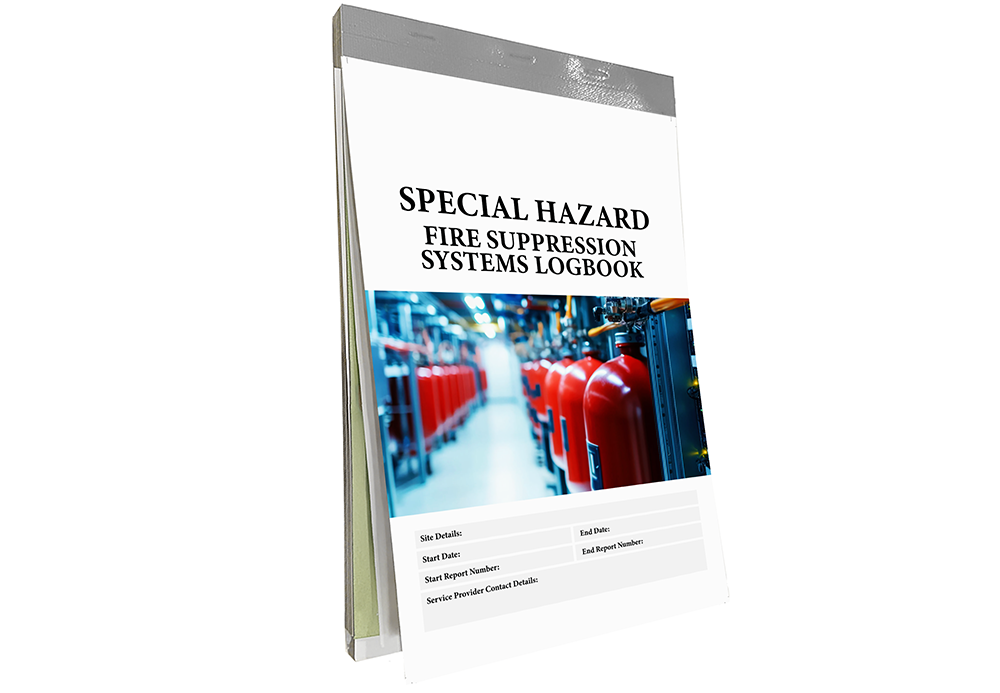
The Special Hazard Fire Suppression Systems logbook is a dedicated AS 1851 fire logbook and routine service record logbook for documenting routine service activities associated with special hazard fire suppression systems.
It has been designed to support routine service and record keeping in accordance with the relevant requirements of AS 1851—2012 (Incorporating Amendment No. 1), Section 7 – Special Hazard Systems.
AS 1851 Section 7 specifically covers routine servicing of:
- Gaseous fire suppression systems
- Fixed aerosol fire suppression systems
- Open nozzle water mist fire suppression systems
The logbook provides structured Monthly, Six-Monthly, Yearly and Ten-Yearly service records, including dedicated activities for gaseous, aerosol and water mist systems.
What Are Special Hazard Fire Suppression Systems?
Special hazard systems are fire suppression systems designed for particular hazards or protected areas.
Unlike general portable fire equipment, these systems can incorporate specialised extinguishing agents, storage containers, discharge pipework, nozzles, detection and control equipment, release mechanisms, pressure-relief arrangements and interfaces with other building systems.
Under AS 1851—2012, Section 7 combines the routine service requirements for three major types of special hazard systems:
| Special Hazard System | Typical Suppression Method |
|---|---|
| Gaseous Fire Suppression Systems | Stored gaseous extinguishing agents discharged into a protected enclosure or hazard |
| Fixed Aerosol Fire Suppression Systems | Fixed aerosol generators used to suppress fire within the protected area |
| Open Nozzle Water Mist Systems | Fine water droplets discharged through open nozzles to control or suppress fire |
The 2012 edition of AS 1851 combined what had previously been separate sections for gaseous extinguishing systems, fixed aerosol systems and water mist systems into the new Section 7 – Special Hazards.
What Does the Special Hazard Fire Suppression Systems Logbook Cover?
The Special Hazard Fire Suppression Systems logbook provides structured routine service records for applicable components and functions including:
- gaseous suppression systems
- fixed aerosol systems
- open nozzle water mist systems
- extinguishing-agent storage containers
- container pressure and charge
- mechanical and pneumatic detection
- release mechanisms
- manual release systems
- actuators
- lock-off valves
- discharge pipework
- flexible connectors and manifolds
- discharge nozzles
- directional and check valves
- pressure-relief devices
- protected-area conditions
- enclosure integrity
- ventilation dampers
- post-discharge ventilation
- system interfaces
- water mist pumps and water supplies
- water mist air compressors
- water additives
- strainers
- water containers.
The logbook also provides areas for recording Pass, Fail or N/A results, defects, comments, corrective actions and completed repairs.
Special Hazard System Routine Service Frequencies
AS 1851—2012 Section 7 specifies the following routine service frequencies:
| Service Frequency | Included in Logbook |
|---|---|
| Monthly | ✓ |
| Six-Monthly | ✓ |
| Yearly | ✓ |
| Ten-Yearly | ✓ |
These frequencies apply through the relevant Section 7 service schedules for gaseous, aerosol and open nozzle water mist special hazard fire suppression systems.
Monthly Special Hazard System Service Records
The Monthly Service Record is based on Table 7.4.2 – Monthly Routine Service Schedule – Special Hazard Systems.
The logbook provides records for checking:
- electrical detection and control system servicing
- warning signs and labels
- storage container enclosure
- storage containers
- container pressure
- system discharge indicators
- release anti-tamper seals and pull pins
- release mechanisms
- gas container valves
- actuators and drop weights
- lock-off valves
- changes to the protected risk
- aerosol generators
- aerosol generator moisture seals
- water mist pressure regulators
- water mist pumps and water supplies
- water mist air compressors and cut-in/cut-out pressures.
Storage Containers & Agent Pressure
Storage containers are an important part of many special hazard suppression systems.
The Monthly Service Record provides for checking that containers are:
- secure
- accessible
- undamaged
- correctly mounted.
Where a pressure indicator is fitted, the logbook requires verification that pressure loss is not greater than 10% of nominal charge pressure. Where no pressure indicator is fitted, the system discharge indicator is checked to confirm it has not operated.
This provides an ongoing service history for the condition and readiness of the extinguishing-agent storage arrangement.
Release Mechanisms & Lock-Off Valves
The monthly schedule includes inspection of release equipment.
The logbook provides for checking:
- anti-tamper seals
- pull pins
- container valves
- actuators
- drop weights
- accessibility of release mechanisms
- freedom from obstruction or damage.
Where a lock-off valve is installed, it is also checked for correct identification and accessibility.
Protected Area Inspection
Special hazard suppression performance can be affected by changes to the area being protected.
The Monthly Service Record therefore includes inspection of the protected area to identify changes to the risk, including changes in:
- enclosure volume
- fuel type
- use of the protected area.
This is particularly important for total flooding systems, where changes to an enclosure can affect extinguishing-agent concentration and retention.
Monthly Fixed Aerosol System Records
The logbook contains additional monthly activities specifically for Fixed Aerosol Systems.
These include checking that:
- aerosol generators have not discharged
- generators remain secure
- moisture seals remain secure.
This allows aerosol-specific checks to remain within the same Special Hazard System routine service record.
Monthly Water Mist System Records
Dedicated additional activities are also included for Water Mist Systems.
Monthly records include:
- pressure regulator condition and setting
- pumps and water supplies
- operational function of pumps and associated equipment
- air compressor operation
- compressor cut-in and cut-out pressures where air receivers form part of the water mist system.
Where pump servicing is required, the logbook directs the technician to record those activities in the relevant pump logbook.
Fire Factory Australia provides dedicated Fire Pumpset Logbooks for applicable sprinkler and hydrant pump routine service records.
Electrical Detection & Control Systems
Special hazard suppression systems may incorporate electrical fire detection and control equipment that initiates, supervises or controls the suppression system.
AS 1851 specifically states that special hazard systems incorporating electrical detection and control systems are serviced in accordance with Section 7 together with the requirements of Section 6.
For this reason, the Special Hazard logbook directs the service provider to perform applicable electrical detection and control system routine service and record those activities in the relevant logbook.
Fire Factory Australia provides the Fire Detection and Alarm Systems logbook for applicable Section 6 routine service records.
This distinction is important: the Special Hazard Fire Suppression Systems logbook records the suppression-system activities under Section 7, while applicable electrical detection and control equipment also has Section 6 requirements.
Six-Monthly Special Hazard System Service Records
The Six-Monthly Service Record is based on Table 7.4.3.
It provides records for:
- electrical detection and control systems
- mechanical detection devices
- pneumatic detection devices
- automatic mechanical detection
- fusible links
- pneumatic control piping and fittings
- manual release systems
- pipework
- flexible connectors
- manifolds
- discharge nozzles
- aerosol generators
- lock-off valves
- system-inoperative Visual Warning Devices
- pressure-relief devices
- vent valves
- directional valves
- check valves
- storage-container charge
- additional water mist activities.
Mechanical & Pneumatic Detection Systems
The Six-Monthly schedule includes inspection of mechanical and pneumatic detection equipment for conditions that may affect performance.
Automatic mechanical detection systems, such as applicable fusible-link arrangements, are functionally tested to confirm that activation produces the required warning and is capable of initiating suppression-system discharge.
Pneumatic control piping and fittings are also checked for integrity and correct operation.
Manual Release System Testing
Manual release equipment provides another means of initiating a suppression system.
The Six-Monthly Service Record includes functional testing of all applicable manual release systems.
The result can be recorded directly against the relevant service item, with any defect and corrective action documented on the same service record.
Discharge Pipework, Manifolds & Nozzles
The Six-Monthly schedule includes inspection of the suppression-system distribution arrangement.
The logbook covers:
- pipework
- flexible connectors
- manifolds
- discharge nozzles
- aerosol generators.
Pipework, connectors and manifolds are checked for damage and adequate support, while discharge nozzles are checked to confirm that they remain clear, unobstructed, correctly aimed and secure.
Storage Container Charge Records
The Six-Monthly page contains dedicated spaces for recording the charge of up to nine storage containers.
The system charge is verified by weighing or liquid-level determination where applicable.
The logbook records values in kg / mm and incorporates the applicable acceptance criteria:
- Halocarbon agent mass loss: not greater than 5% of nominal charge mass
- Carbon dioxide, water and nitrogen mass loss: not greater than 10% of nominal charge mass.
This creates a useful historical record for comparing container charge condition between service visits.
Six-Monthly Water Mist System Activities
Additional Water Mist System activities include:
- cycling the system through a complete discharge cycle
- completing applicable pump routine service
- completing applicable release, isolating and control valve routine service.
Where separate pump records are required, the appropriate pump service record should be used rather than duplicating the full pump schedule in the Special Hazard logbook.
Yearly Special Hazard System Service Records
The Yearly Service Record is based on Table 7.4.4 and provides the most detailed routine service section in this logbook.
Activities include:
- electrical detection and control system servicing
- gas-container pressure test/inspection dates
- mechanical actuators
- mechanical release systems
- mechanical detection systems
- detection-device service life
- pyrotechnic actuator service life
- nozzle and damper cleaning
- inadvertent-discharge risks
- fuel class and hazard type
- enclosure volume
- design concentration/application density
- protected-object dimensions
- enclosure integrity testing
- pressure-relief vent testing
- extinguishing-agent migration
- ventilation dampers
- HVAC interfaces
- post-discharge ventilation
- directional valves
- interfaced fire systems
- aerosol generator service life
- water mist water supply flow
- water additives
- strainers
- water containers.
Gas Storage Container Test & Inspection Dates
The Yearly Service Record provides dedicated fields for recording the last pressure test or inspection date of gas storage containers.
The logbook provides space for up to nine containers.
The service provider can identify containers that will become due for their Ten-Yearly pressure test or inspection before the next yearly service.
This is particularly useful for forward planning and avoiding overdue pressure-vessel or cylinder testing.
Mechanical Actuators, Detection & Release Systems
The Yearly schedule includes checking and, where necessary, lubricating:
- mechanical actuators
- mechanical release systems
- mechanical detection systems.
Detection devices or sensing elements that will exceed their service life before the next scheduled service are identified for replacement.
Applicable pyrotechnic actuators approaching the end of their service life are also addressed.
Hazard & Protected Area Verification
The yearly schedule goes beyond equipment condition and includes verification of the actual hazard being protected.
Records include verification of:
- fuel class
- type of hazard
- gross and net enclosure volume for total flooding systems
- design concentration or application density
- dimensions of protected objects for local application systems.
These activities help identify changes that may affect the ability of the installed suppression system to continue performing to its approved design.
Gaseous System Enclosure Integrity Testing
For applicable gaseous total flooding systems, the Yearly Service Record includes an enclosure integrity test.
Dedicated fields are provided for recording:
- Equivalent Leakage Area – m²
- Retention Time – min.
Where an integrity test cannot be conducted because of conditions such as dimensional constraints or large openings that cannot be closed, the logbook provides for enclosure integrity to be assessed through the applicable alternative inspection process.
Pressure-Relief Vent Testing
Where a pressure-relief vent is fitted, the Yearly Service Record includes testing and recording of the pressure at which it operates.
The logbook provides four dedicated recording positions in Pa.
This provides a measurable result rather than only a Pass/Fail record.
Ventilation & HVAC Interface Testing
The Yearly schedule includes several activities associated with ventilation and interfaced systems.
These include:
- automatically operated ventilation dampers
- Special Hazard System HVAC interfaces
- post-discharge ventilation
- directional valves
- functional testing with other interfaced fire systems.
For broader fire and smoke control features of mechanical services, Fire Factory Australia provides the Mechanical Services Logbook – Fire/Smoke Control Features.
System Interface Testing
Special hazard suppression systems can interact with other fire protection and building systems.
The Yearly Service Record therefore includes a functional system interface test and verification that the required interface functions operate correctly.
Examples may include detection and control equipment, ventilation systems, warning systems and other functions required by the approved system design.
AS 1851 places broader emphasis on maintaining and testing system interfaces so installed fire protection systems continue to perform as intended.
Yearly Fixed Aerosol System Activities
The Yearly Service Record includes an additional activity specifically for fixed aerosol systems.
Any aerosol generator that will exceed its specified service life before the next service is identified for replacement.
This supplements the monthly aerosol checks for generator discharge status, security and moisture seals.
Yearly Water Mist System Activities
The Yearly Service Record contains additional Water Mist System activities including:
- full flow testing to verify water supply pressure and flow
- checking water-additive concentration where applicable
- checking and cleaning line strainers
- checking nozzle strainers where their condition indicates it is necessary
- draining and inspecting the internal condition of the water container
- refilling the container, including additive where required.
Where the water mist installation incorporates pumps, the associated pump routine service activities are recorded in the relevant pump logbook.
Ten-Yearly Special Hazard System Service Records
The Special Hazard Fire Suppression Systems logbook includes a dedicated Ten-Yearly Service Record based on Table 7.4.5.
The schedule covers three significant long-term activities:
Discharge Nozzle Flow Test
Each nozzle is tested for free and unobstructed flow using a continuous flow of nitrogen or another suitable alternative.
Gas Storage Cylinders
Transport-type gas storage containers, such as cylinders, that have exceeded ten years since the last test are subject to the applicable hydrostatic pressure test.
Engineered Pressure Vessels
Storage containers configured as engineered pressure vessels, such as applicable low-pressure CO₂ vessels, are subject to internal inspection.
The logbook notes that the hydrostatic test and internal inspection are performed at 10-year intervals, with the initial timing determined from the applicable first-fill or manufacture date.
Recording Defects, Corrective Actions & Completed Repairs
Each routine service section provides structured fields for recording:
Item No. | Defect Type | Results / Comments | Corrective Action | Completed Repairs
A separate Notes page also provides:
- Associated Logbook Sheet ID / Report No.
- Activity Performed
- additional defect records
- comments
- corrective actions
- completed repairs.
This makes the logbook useful for maintaining a traceable history from initial inspection or testing through to defect identification and subsequent repair.
Site, Technician & Service Provider Records
Each service record includes identification fields for:
- Site Name
- Site Address / Location
- Site ID
- Work Order No.
- Service Provider
- Date
- Technician Name
- Licence No.
- Technician Signature
- Client Name
- Client Signature.
The NCR service sheets are identified as:
White – Owner/Occupier/Agent | Yellow – Service Provider | Red – Book Copy.
This provides a practical physical service record for the responsible entity, service provider and on-site logbook.
Related Logbooks for Special Hazard Systems
A Special Hazard System can incorporate equipment whose complete routine service requirements sit outside Section 7.
For example, the logbook itself directs technicians to use relevant separate records for electrical detection/control equipment, pumps, water supplies, valves and HVAC interfaces.
Depending on the installation, related Fire Factory Australia logbooks may include:
Fire Detection and Alarm Systems – for applicable electrical fire detection and control equipment associated with the Special Hazard System.
Fire Pumpset Logbook – Sprinkler & Hydrant Pumps (Diesel & Electric) & Jacking Pumps – where applicable fire pumpset service records are required.
Mechanical Services Logbook – Fire/Smoke Control Features – for applicable mechanical fire/smoke control and HVAC-related routine service activities.
This distinction helps avoid treating the Special Hazard logbook as a replacement for every other system-specific service record associated with an installation.
AS 1851—2012 Section 7 – Special Hazard Systems
AS 1851—2012 Section 7 establishes routine service requirements for gaseous, aerosol and open nozzle water mist special hazard fire suppression systems. It is read together with the general requirements in Section 1.
The Standard also notes that some pre-engineered special hazard systems are covered by other specific standards. Therefore, Section 7 should not automatically be treated as the sole routine service basis for every type of special hazard suppression system.
AS 1851 defines routine service as scheduled inspection, testing and preventive maintenance, while its overall objective is to help maintain fire protection systems so they continue to meet the requirements of their approved design.
AS 1851—2012 Requirements in NSW
From 13 February 2026, AS 1851—2012 became mandatory in NSW for applicable essential fire safety measures in new and existing Class 1b and Class 2–9 buildings, unless an applicable Performance Solution specifies another maintenance basis.
This does not mean every Class 1b–9 building requires a Special Hazard Fire Suppression System. The requirement is relevant where the particular Special Hazard System forms part of an applicable essential fire safety measure for the building.
NSW Government – AS 1851-2012 building fire safety requirements
Building owners should refer to their Fire Safety Schedule (FSS) and applicable fire safety documentation to determine which essential fire safety measures apply to their building.
NSW Government – Responsibilities of building owners under AS 1851-2012
Keeping Special Hazard System Service Records
Maintaining an organised Special Hazard Fire Suppression System service record logbook creates a continuous history of inspections, tests, measured values, defects and corrective actions.
AS 1851 requires records of the Section 7 service activities and results to be retained in accordance with its general service-record requirements.
In NSW, applicable AS 1851 routine service records must be retained on site in accordance with the current regulatory requirements.
NSW Government – Responsibilities of building owners under AS 1851-2012
About the AS 1851 Special Hazard Fire Suppression Systems Logbook
The Special Hazard Fire Suppression Systems logbook is a dedicated AS 1851 logbook, fire logbook, fire suppression logbook, service record logbook and routine service record logbook designed for recording applicable Special Hazard System routine service activities in Australia.
It supports structured service records for:
- Gaseous Fire Suppression Systems
- Fixed Aerosol Fire Suppression Systems
- Open Nozzle Water Mist Fire Suppression Systems
- gas storage containers
- extinguishing-agent containers
- mechanical and pneumatic detection
- release mechanisms
- actuators
- discharge pipework
- manifolds
- nozzles
- lock-off valves
- directional valves
- pressure-relief devices
- protected enclosures
- enclosure integrity
- ventilation interfaces
- system interfaces
- aerosol generators
- water mist equipment.
The logbook includes Monthly, Six-Monthly, Yearly and Ten-Yearly routine service records, together with dedicated fields for container charge measurements, enclosure leakage and retention time, pressure-relief vent operation, container inspection dates, defects, corrective actions and completed repairs.
For Australian fire protection contractors, technicians, facility managers and building managers searching for a Special Hazard Logbook, Special Hazard Fire Suppression Logbook, Gaseous Fire Suppression System Logbook, Aerosol Fire Suppression Logbook, Water Mist System Logbook, AS 1851 Logbook, Fire Logbook Australia, Service Record Logbook or Routine Service Record Logbook, this product provides a structured physical record for applicable Section 7 routine service activities.
The logbook itself correctly states that it is a practical guide and does not guarantee compliance with AS 1851—2012 or that every requirement of the Standard is contained within the publication.
Designed to support routine service and record keeping in accordance with the relevant requirements of AS 1851—2012 Section 7.
Frequently Asked Questions
What is a Special Hazard Fire Suppression Systems logbook?
It is a structured routine service record logbook for documenting applicable inspection, testing, preventive maintenance and survey activities for Special Hazard Fire Suppression Systems under AS 1851—2012 Section 7.
Which systems are covered by AS 1851 Section 7?
Section 7 covers gaseous, fixed aerosol and open nozzle water mist special hazard fire suppression systems.
What service frequencies are included?
The logbook contains Monthly, Six-Monthly, Yearly and Ten-Yearly routine service records.
Does the logbook cover gaseous fire suppression systems?
Yes. The logbook includes applicable routine service activities for gaseous systems, including storage containers, agent charge, release equipment, enclosure integrity, pressure-relief vents and Ten-Yearly container testing/inspection.
Does it cover fixed aerosol fire suppression systems?
Yes. Dedicated aerosol activities include generator condition, moisture seals and generator service life.
Does it cover water mist systems?
Yes, specifically the applicable open nozzle water mist special hazard systems covered by Section 7. Additional records include pressure regulators, pumps, air compressors, discharge cycling, water supply testing, additives, strainers and water containers.
Does it record storage container charge?
Yes. The Six-Monthly page provides dedicated positions for recording up to nine storage-container charge measurements in kg/mm.
Does it include enclosure integrity testing?
Yes. The Yearly page provides fields for Equivalent Leakage Area and Retention Time for applicable gaseous total flooding systems.
Does it include pressure-relief vent test records?
Yes. The Yearly Service Record provides four fields for recording pressure-relief vent operating pressure in Pa.
Does it include system interface testing?
Yes. The Yearly schedule includes functional testing with other interfaced fire systems and verification of the required interface functions.
Does the Special Hazard logbook also cover electrical detection and control systems?
Section 7 requires applicable electrical detection and control equipment to also be serviced under Section 6. The Special Hazard logbook therefore refers these activities to the relevant logbook. The dedicated Fire Detection and Alarm Systems logbook can be used for applicable Section 6 records.
Does it include Ten-Yearly service records?
Yes. The Ten-Yearly page covers nozzle-flow testing and applicable pressure testing or internal inspection of storage containers.
Does using this logbook automatically make a Special Hazard System compliant with AS 1851?
No. The logbook is a record-keeping tool designed to support routine servicing. Compliance depends on the applicable system, approved design, work performed, service results, competent personnel, defect rectification and relevant regulatory requirements. The product itself expressly states that it does not guarantee compliance.
Conclusion
The Special Hazard Fire Suppression Systems logbook provides a structured way to document routine service activities for gaseous, fixed aerosol and open nozzle water mist fire suppression systems under the applicable requirements of AS 1851—2012 Section 7.
With dedicated Monthly, Six-Monthly, Yearly and Ten-Yearly service records, the logbook supports documentation of storage containers, agent charge, detection and release equipment, pipework, nozzles, enclosure integrity, pressure-relief vents, ventilation functions, system interfaces, aerosol generators and water mist equipment.
It also connects logically with other system-specific records, including the Fire Detection and Alarm Systemslogbook for applicable electrical detection and control equipment and other relevant Fire Factory Australia logbooks where pumps or mechanical services require separate service records.
Designed to support routine service and record keeping in accordance with the relevant requirements of AS 1851—2012 Section 7.
Our Fire Safety Logbooks
Explore our complete range of Fire Safety Logbooks for fire protection routine service, testing, inspection and maintenance records.
- Fire Detection and Alarm Systems
- Emergency Warning & Intercom Systems
- Fire Detection & Alarm Systems and Emergency Warning & Intercom Systems
- Automatic Fire Sprinkler System Logbook – Wet Pipe Sprinkler and Jacking Pump
- Automatic Fire Sprinkler System Logbook – Dry-Pipe / Pre-Action, Deluge & Water Spray
- Special Hazard Fire Suppression Systems
- Fire Pumpset Logbook – Sprinkler & Hydrant Pumps (Diesel & Electric) & Jacking Pumps
- Diesel Fire Pumpset Logbook – Sprinkler & Hydrant Pumps & Jacking Pumps
- Electric Fire Pumpset Logbook – Sprinkler & Hydrant Pumps & Jacking Pumps
- Hose Reel & Jacking Pumps Logbook
- Fire Hydrant Systems & Jacking Pumps Logbook
- Water Storage Tanks Logbook
- Routine Service Logbook – Delivery Lay Flat Hose, Fire Hose Reels, Fire Extinguishers & Fire Blankets
- Passive Fire Logbook
- Mechanical Services Logbook – Fire/Smoke Control Features
- Emergency and Exit Lighting Maintenance Logbook