Table of Contents
ToggleHose Reel & Jacking Pumps Logbook
A Complete Guide to AS 1851—2012 Fire Hose Reel & Jacking Pump Routine Service Records
Fire hose reels are an important part of many building fire protection systems, providing an accessible water supply for first-attack firefighting.
Regular inspection, testing and preventive maintenance help confirm that fire hose reels, hoses, valves, fittings, water supply arrangements and associated pumps remain in suitable operating condition.
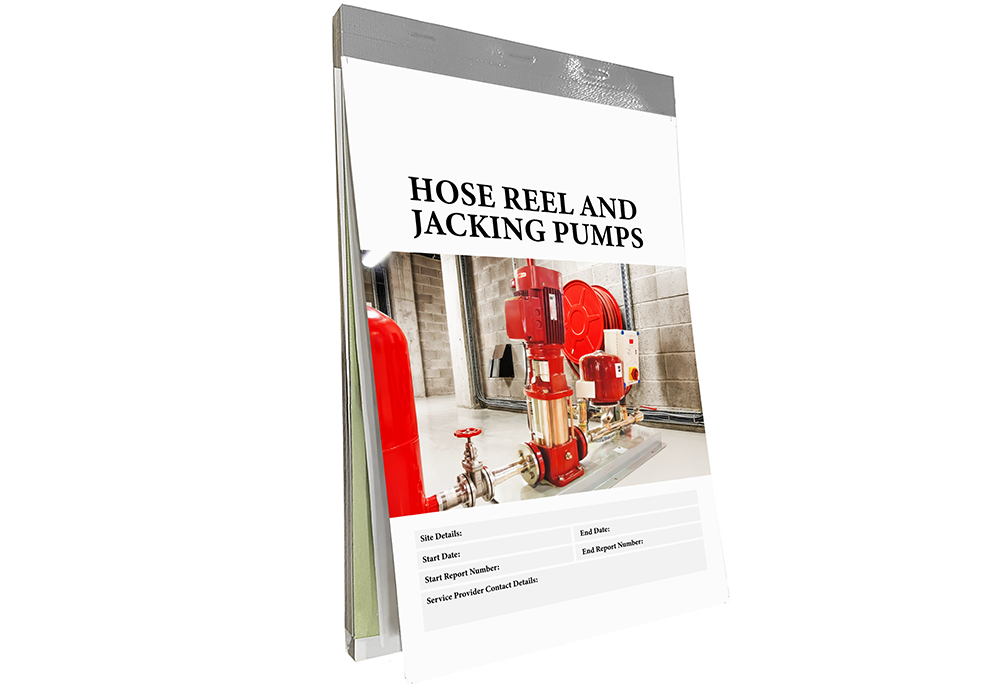
The Hose Reel & Jacking Pumps Logbook provides structured routine service records specifically for:
- Fire Hose Reels
- Hose Reel Pumps
- Pressure-Maintenance Pumps
- Jacking Pumps
The logbook has been developed around the applicable requirements of AS 1851—2012 (Incorporating Amendment No. 1).
Fire hose reel routine servicing is addressed under Section 9 of AS 1851—2012, while hose reel and pressure-maintenance / jacking pumpsets are addressed by the applicable requirements of Section 3.
The logbook provides 4 years of structured service records, allowing fire hose reel inspections, testing, pump operation, pressure readings, defects and corrective actions to be maintained together in one organised hardcopy record.
What Does the Hose Reel & Jacking Pumps Logbook Cover?
The logbook combines routine service records for fire hose reels and their associated pumps.
It provides dedicated records for:
- Fire hose reels
- Hose reel pumps
- Pressure-maintenance pumps
- Jacking pumps
- Pump controllers
- Pump valves
- Water supply tanks, where fitted
- Pressure-relief arrangements, where fitted
- Hydro-pneumatic accumulators, where fitted
- Pump cut-in pressures
- Pump cut-out pressures
- Fire hose reel inspections
- Fire hose reel flow testing
- Defects
- Results and comments
- Corrective actions
- Completed repairs
This provides technicians with a purpose-designed Fire Hose Reel Service Record rather than relying on generic maintenance forms.
AS 1851—2012 Requirements for Fire Hose Reels
Section 9 of AS 1851—2012 addresses routine servicing of fire hose reels.
It establishes applicable inspection, testing, preventive maintenance and survey activities for fire hose reel systems.
Where a pumpset is installed to provide the required water pressure to the hose reel system, the applicable pump start-up and routine service requirements are addressed under Section 3.
This relationship between Sections 9 and 3 is why the Hose Reel & Jacking Pumps Logbook brings both sets of service records together.
AS 1851—2012 Requirements for Hose Reel & Jacking Pumps
Section 3 of AS 1851—2012 addresses fire pumpsets including:
- sprinkler pumpsets
- hydrant pumpsets
- hose reel pumpsets
- automatic pressure-maintenance pumpsets
- jacking pumpsets
For hose reel and pressure-maintenance / jacking pumps, the applicable schedules include Monthly and Six-Monthly routine service activities.
Fire hose reel pumpsets are excluded from the general Yearly fire pumpset activities, so the pump records in this logbook focus on the applicable Monthly and Six-Monthly requirements.
4-Year Fire Hose Reel & Jacking Pump Service Logbook
The Hose Reel & Jacking Pumps Logbook provides 4 years of service record capacity.
This longer record period allows multiple years of fire hose reel inspections, pump tests and pressure readings to remain together in one book.
| Feature | Details |
|---|---|
| Product | Hose Reel & Jacking Pumps Logbook |
| Duration | 4 Years |
| Standard | AS 1851—2012 (Incorporating Amendment No. 1) |
| Fire Hose Reels | Section 9 |
| Hose Reel / Jacking Pumps | Section 3 |
| Fire Hose Reel Service | Six-Monthly · Yearly |
| Pump Service | Monthly · Six-Monthly |
| Format | Professional hardcopy service record |
A four-year format also makes it easier to review previous service results, pressure readings, identified defects and corrective actions.
Fire Hose Reel Routine Service Records
Fire hose reels have dedicated routine service requirements under Section 9 of AS 1851—2012.
The logbook provides records for applicable Six-Monthly and Yearly fire hose reel servicing.
Routine servicing can include inspection and testing relating to:
- hose reel accessibility
- general physical condition
- mounting and anchor points
- hose guides
- fittings and connections
- bearings
- hose condition
- ancillary equipment
- water flow
- suitability for the protected fire hazard
- changes or obstructions affecting access
- ability of the hose to reach the required area
The Yearly service incorporates the applicable Six-Monthly activities.
Fire Hose Reel Flow Testing
Water-flow testing is an important part of the Yearly fire hose reel service.
The applicable test measures water flow from the most disadvantaged hose reel with the stop valve and nozzle fully opened.
The applicable minimum flow rates identified in the source material are:
| Hose Size | Minimum Flow Rate |
|---|---|
| 19 mm hose | 0.33 L/s |
| 25 mm hose | 0.41 L/s |
Recording the applicable test results provides a historical record of fire hose reel water-flow performance.
This allows current results to be reviewed alongside previous routine service records.
Fire Hose Reel Condition & Accessibility Checks
Fire hose reel servicing involves more than checking that water is available.
The applicable routine service records include checks relating to the physical condition, installation and accessibility of the hose reel.
The Yearly service record covers items including:
- secure mounting
- anchor points
- hose guides
- hose fittings and connections
- bearings
- water flow
- hose condition
- ancillary equipment
- suitability for the protected fire hazard
- building alterations
- obstructions affecting access
- hose reach to the applicable fire hazard or risk
These records help maintain a clear history of the condition and accessibility of the installed fire hose reels.
Monthly Hose Reel & Jacking Pump Service Records
The logbook includes a dedicated Monthly Routine Service Schedule for hose reel and pressure-maintenance / jacking pumps.
The schedule covers several important operational and physical checks.
Pump Area
The pump area is checked for:
- obstruction
- inappropriate storage
- adequate illumination
Where a pressure-relief valve is fitted, the discharge arrangement is also checked.
Pump Condition
The pump and associated equipment are inspected for:
- physical damage
- deterioration
- security of applicable safety guards
Pump Valves
Applicable valves are checked for:
- correct open or closed position
- appropriate identification
- security where required
Water Supply Tank
Where fitted, the water supply tank is checked to confirm the applicable water level.
Pump Controller
The pump controller record includes checks relating to:
- main isolating switch position
- security of the isolating switch where applicable
- green power supply indication
- red warning indications
- operation of indicator lamps
Pump Operation
The pump is tested for:
- Manual Operation
- Automatic Operation
The service record also provides dedicated fields for recording pump cut-in and cut-out pressures.
Jacking Pump Cut-In & Cut-Out Pressure Records
One of the key features of the logbook is the dedicated area for recording jacking pump cut-in and cut-out pressures.
Separate fields are provided for two pumps:
| Pump | Cut-In Pressure | Cut-Out Pressure |
|---|---|---|
| Jacking Pump 1 | kPa | kPa |
| Jacking Pump 2 | kPa | kPa |
These fields provide a clear historical record of the pressures at which each jacking pump automatically starts and stops.
Recording these values over successive service visits can assist technicians in identifying changes in the operating pressure settings.
Why Record Jacking Pump Pressures?
A jacking or pressure-maintenance pump is used to maintain system pressure and reduce unnecessary operation of the main fire pump caused by small pressure losses.
Recording the cut-in and cut-out pressures provides a history of the pump’s operating settings.
Across the four-year life of the logbook, technicians can compare current pressure readings with previous service visits and investigate unexpected changes where necessary.
Six-Monthly Jacking Pump Service Records
The logbook also provides a dedicated Six-Monthly Service Schedule for hose reel and pressure-maintenance / jacking pumpsets.
The Six-Monthly service incorporates the applicable Monthly activities.
Where a hydro-pneumatic accumulator is fitted, its air pressure is also verified as part of the applicable Six-Monthly service.
Recording Fire Hose Reel Defects & Corrective Actions
The Hose Reel & Jacking Pumps Logbook provides dedicated areas for recording:
Item No. | Defect Type | Results / Comments | Corrective Action | Completed Repairs
Applicable scheduled activities also include PASS / FAIL / N/A selections.
Where an issue is identified, technicians can therefore record:
- the affected item
- defect type
- inspection or test result
- comments
- required corrective action
- completed repairs
This creates a more traceable fire hose reel and jacking pump maintenance history.
Site, Technician & Service Provider Records
Each service record includes fields for:
- Site Name
- Site Address / Location
- Site ID
- Work Order Number
- Service Provider
- Date
- Technician Name
- Licence Number
- Technician Signature
- Client Name
- Client Signature
The NCR service records are identified as:
White – Owner / Occupier / Agent
Yellow – Service Provider
Red – Book Copy
This provides a practical format for distributing and retaining routine service records.
Designed for Practical On-Site Recording
Fire protection technicians often complete service records while working directly around installed equipment and plant areas.
The Hose Reel & Jacking Pumps Logbook uses:
- structured service schedules
- dedicated pressure fields
- PASS / FAIL / N/A selections
- defect records
- corrective-action fields
- technician and client sign-off areas
The logbook also includes a writing shield, which can be positioned behind the current page to help prevent information transferring to following NCR pages.
This provides a practical hardcopy format for routine on-site servicing.
Why Use a Dedicated Fire Hose Reel & Jacking Pump Logbook?
A system-specific logbook provides several advantages over a generic maintenance notebook.
Fire Hose Reel-Specific Records
The book is organised around applicable fire hose reel inspection, testing and maintenance activities rather than blank generic maintenance pages.
4 Years of Service History
The four-year format keeps multiple years of service information together.
Dedicated Pump Pressure Records
Jacking pump cut-in and cut-out pressures can be recorded directly against the applicable pump.
Defect & Corrective Action Tracking
Service findings and corrective actions remain connected with the relevant service visit.
Professional Hardcopy Record
The physical logbook can remain with the site and provide a readily accessible history during future servicing.
Fire Hose Reel Service Tags, Labels & Supporting Records
AS 1851—2012 also contains requirements relating to service tags and labels for applicable equipment including fire hose reels.
The source material identifies:
- “1” – Six-Monthly Service
- “2” – Yearly Service
Supporting hardcopy summary records may also be required where applicable service tags or labels are used.
A dedicated Fire Hose Reel Logbook can therefore form part of the site’s organised service documentation alongside applicable equipment service tags and labels.
Who Is the Hose Reel & Jacking Pumps Logbook Designed For?
The logbook is designed for professional use within the Australian fire protection industry, including:
- fire protection contractors
- fire service technicians
- fire equipment maintenance companies
- building maintenance teams
- facility managers
- property managers
- service providers responsible for fire hose reel systems
Routine servicing itself should be carried out by appropriately competent persons in accordance with applicable requirements.
A Logbook Supports Record Keeping — It Does Not Create Compliance
Using a logbook does not by itself make a building or fire protection system compliant with AS 1851—2012.
The Hose Reel & Jacking Pumps Logbook provides a structured format for documenting applicable routine service activities and results.
Compliance can also depend on factors including:
- the installed system
- approved design
- applicable legislation
- servicing actually performed
- test results
- identified defects
- corrective work
- competency of the people carrying out the work
The logbook should therefore be described as designed to support routine service record keeping in accordance with the applicable requirements of AS 1851—2012, rather than as independently creating or guaranteeing compliance.
About the AS 1851 Hose Reel & Jacking Pumps Logbook
The Hose Reel & Jacking Pumps Logbook is a dedicated Fire Hose Reel Service Record developed for structured routine servicing of fire hose reels and associated hose reel and pressure-maintenance / jacking pumps.
Designed around the applicable requirements of AS 1851—2012 Sections 9 and 3, it provides an organised format for recording:
- fire hose reel inspections
- fire hose reel testing
- Six-Monthly fire hose reel servicing
- Yearly fire hose reel servicing
- Monthly pump servicing
- Six-Monthly pump servicing
- manual pump operation
- automatic pump operation
- jacking pump cut-in pressures
- jacking pump cut-out pressures
- hydro-pneumatic accumulator checks
- defects
- results and comments
- corrective actions
- completed repairs
Product Summary
| Feature | Details |
|---|---|
| Product | Hose Reel & Jacking Pumps Logbook |
| Duration | 4 Years |
| Standard | AS 1851—2012 (Incorporating Amendment No. 1) |
| Applications | Fire Hose Reels · Hose Reel Pumps · Pressure-Maintenance Pumps · Jacking Pumps |
| Fire Hose Reel Service | Six-Monthly · Yearly |
| Pump Service | Monthly · Six-Monthly |
| Record Type | Inspection · Testing · Pump Operation · Pressure Readings · Defects · Corrective Actions |
For Australian fire protection contractors, technicians, building managers and service providers, the product provides one organised location for maintaining applicable fire hose reel and jacking pump service records.
It can be used as a Fire Hose Reel Logbook, AS 1851 Fire Hose Reel Logbook, Hose Reel Maintenance Logbook, Hose Reel Inspection Record and Jacking Pump Service Record for the applicable service activities.
Designed to support routine service and record keeping in accordance with the relevant requirements of AS 1851—2012 Sections 9 and 3.
Frequently Asked Questions
What is a Fire Hose Reel Logbook?
A Fire Hose Reel Logbook is used to document applicable routine inspection, testing and maintenance activities for fire hose reels.
The Fire Factory Australia product also incorporates routine service records for associated hose reel and pressure-maintenance / jacking pumps.
How long does the Hose Reel & Jacking Pumps Logbook last?
The logbook provides 4 years of service records.
Which section of AS 1851 covers fire hose reels?
Fire hose reels are addressed under Section 9 of AS 1851—2012.
Which section covers hose reel and jacking pumps?
Hose reel, automatic pressure-maintenance and jacking pumpsets are addressed under the applicable requirements of Section 3.
How often are fire hose reels serviced?
The logbook provides records for applicable Six-Monthly and Yearly fire hose reel servicing.
How often are jacking pumps serviced?
The applicable hose reel and pressure-maintenance / jacking pump schedules provide for Monthly and Six-Monthly servicing.
Does the logbook record jacking pump cut-in and cut-out pressures?
Yes.
Dedicated fields are provided for the cut-in and cut-out pressures of Jacking Pump 1 and Jacking Pump 2, recorded in kPa.
Why are jacking pump cut-in and cut-out pressures recorded?
These readings provide a history of the pressures at which the pressure-maintenance pump automatically starts and stops.
They can also be compared across successive service visits.
Does the logbook include fire hose reel flow testing?
Yes.
The Yearly fire hose reel service includes applicable water-flow testing, and the service record can be used to document the relevant results.
Which hose reel is used for the applicable flow test?
The source material specifies testing from the most disadvantaged hose reel with the stop valve and nozzle fully opened.
What minimum flow rates are identified for fire hose reels?
The source material identifies:
- 19 mm hose – 0.33 L/s
- 25 mm hose – 0.41 L/s
Does a fire hose reel pump require Yearly pumpset servicing under Section 3?
The source material states that fire hose reel pumpsets are excluded from the Yearly activities in the general fire pumpset Yearly schedule.
The applicable pump records in this logbook therefore focus on Monthly and Six-Monthly servicing.
Does the logbook include defect and corrective-action records?
Yes.
Dedicated fields are provided for:
Defect Type | Results / Comments | Corrective Action | Completed Repairs
Is this an AS 1851 compliant logbook?
The logbook is designed to support routine service recording in accordance with the applicable requirements of AS 1851—2012.
Using the logbook alone does not establish compliance. Compliance depends on the system, approved design, applicable requirements, servicing performed, test results, identified defects and competency of the people carrying out the work.
Who is the logbook designed for?
It is designed for fire protection contractors, technicians, service providers, building maintenance teams and other professionals responsible for documenting applicable fire hose reel and jacking pump routine service activities.
Conclusion
The Hose Reel & Jacking Pumps Logbook provides a structured way to document routine servicing of fire hose reels and associated hose reel and pressure-maintenance / jacking pumps.
With 4 years of service record capacity, dedicated Six-Monthly and Yearly fire hose reel records, Monthly and Six-Monthly pump records, jacking pump pressure fields, defect documentation and corrective-action records, it provides a comprehensive AS 1851 Fire Hose Reel Service Record.
For fire protection contractors, technicians and building managers, the logbook provides a clear and traceable format for maintaining ongoing fire hose reel inspection, testing and maintenance history.
Designed to support routine service and record keeping in accordance with the relevant requirements of AS 1851—2012 Sections 9 and 3.
Explore Our Complete Fire Safety Logbook Range
Looking for logbooks for other fire protection systems?
Fire Factory Australia provides a comprehensive range of AS 1851—2012 Fire Safety Logbooks for routine inspection, testing, servicing and maintenance records across a wide range of fire protection systems.
Our range includes logbooks for fire detection and alarm systems, emergency warning systems, sprinkler systems, fire pumps, hydrants, hose reels, water storage tanks, special hazard systems, passive fire protection, mechanical fire and smoke control systems, emergency and exit lighting, and other fire protection equipment.