Table of Contents
ToggleFire Hydrant Systems & Jacking Pumps Logbook
A Complete Guide to AS 1851—2012 Fire Hydrant & Jacking Pump Routine Service Records
Fire hydrant systems are an important part of building fire protection infrastructure, providing firefighters with access to a reliable water supply through strategically located hydrant points throughout a building or site.
Regular inspection, testing and preventive maintenance are important for checking that hydrant valves, water supply valves, booster assemblies, pressure-control equipment, pumps, jacking pumps and associated componentsremain operational and ready for use.
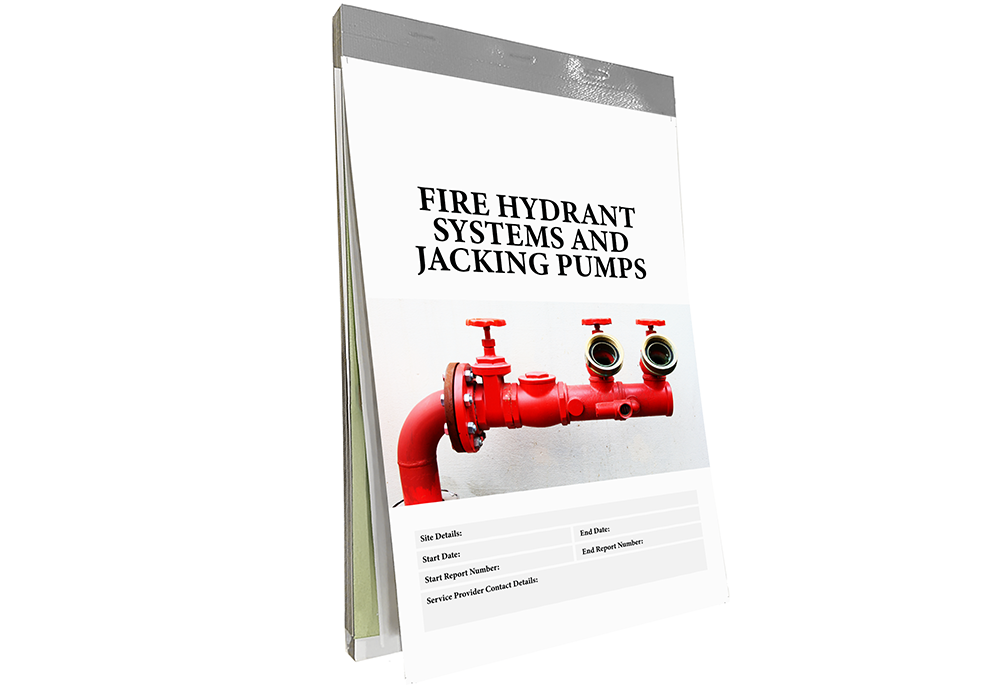
The Fire Hydrant Systems & Jacking Pumps Logbook provides structured routine service records specifically for fire hydrant systems and associated jacking pumps.
Fire hydrant system service records are based on the relevant requirements of AS 1851—2012 (Incorporating Amendment No. 1), Section 4 – Fire Hydrant Systems, while the incorporated jacking pump records are based on the applicable fire pumpset requirements of Section 3.
The logbook provides dedicated Monthly, Six-Monthly, Yearly and Five-Yearly fire hydrant service records, together with Monthly and Six-Monthly jacking pump records and dedicated fields for pressures, water supply proving tests, booster testing, defects, corrective actions and completed repairs.
What Does the Fire Hydrant Systems & Jacking Pumps Logbook Cover?
The logbook brings fire hydrant system and associated pressure-maintenance pump records together in one organised service record.
It provides records for activities associated with:
- Fire hydrant systems
- Above-ground hydrant valves
- Below-ground hydrant valves
- Hydrant water supply valves
- Booster assemblies
- Hydrant hoses and associated equipment, where fitted
- Pressure-reducing valves
- Pressure-relief valves
- Water supply proving tests
- Hydrant system interfaces
- Exposed water distribution pipework
- Jacking / pressure-maintenance pumps
- Hydro-pneumatic accumulators, where fitted
The logbook also provides dedicated fields for measured values including:
- diesel pump starting pressures
- electric pump starting pressures
- jacking pump cut-in pressures
- jacking pump cut-out pressures
- low-side pressure readings
- pressure-relief valve operating pressures
- water supply flow and pressure
- hydrostatic test pressure
- booster connection flow and pressure
This provides more than a simple inspection checklist by allowing actual fire hydrant system test and performance data to be retained.
Fire Hydrant & Jacking Pump Service Frequencies
The Fire Hydrant Systems & Jacking Pumps Logbook provides the following routine service records:
| Equipment | Monthly | Six-Monthly | Yearly | Five-Yearly |
|---|---|---|---|---|
| Fire Hydrant Systems | ✓* | ✓ | ✓ | ✓ |
| Jacking Pumps | ✓ | ✓ | — | — |
*For fire hydrant systems, the Monthly frequency relates to applicable pump-related inspection and test activities.
The logbook therefore provides separate Monthly, Six-Monthly, Yearly and Five-Yearly Fire Hydrant Service Records, with the applicable jacking pump schedules incorporated into the Monthly and Six-Monthly records.
Monthly Fire Hydrant System Service Records
The Monthly Routine Service Schedule focuses primarily on the hydrant system’s pumpset starting arrangements.
The logbook provides records for checking:
- isolating valves associated with pump-starting pressure devices
- condition and mounting of pressure switches
- protection of pressure switches against water, dust and insects
- automatic starting of diesel-driven pumpsets
- manual restarting of diesel-driven pumpsets
- diesel pump cut-in pressures
- automatic starting of electric-driven pumpsets
- manual restarting of electric-driven pumpsets
- electric pump cut-in pressures
Where pumpsets are fitted, the applicable Monthly pumpset service activities are also required to be completed and recorded in the relevant pumpset service records.
Diesel & Electric Hydrant Pump Starting Pressure Records
An important feature of the Monthly Fire Hydrant Service Record is the dedicated area for recording pump-starting pressures.
Separate fields are provided for:
Diesel Pump Starting Pressures
- Starting Pressure 1 – kPa
- Starting Pressure 2 – kPa
Electric Pump Starting Pressures
- Starting Pressure 1 – kPa
- Starting Pressure 2 – kPa
Where multiple starting devices are fitted, the service record also allows the applicable starting devices to be tested and documented over the required service intervals.
For diesel-driven pumpsets, the page also provides space for applicable battery and charger information.
Monthly Jacking Pump Service Records
The same Monthly Service Record includes a dedicated routine service schedule for jacking pumps, also known as pressure-maintenance pumps.
The record provides for checking:
- pump area condition and accessibility
- pressure-relief valve discharge arrangements
- physical damage or deterioration
- safety guards
- valve positions
- water supply tank level, where fitted
- pump controller main isolating switch
- controller indicator lamps
- manual pump operation
- automatic pump operation
- pump cut-in pressure
- pump cut-out pressure
This allows the associated jacking pumps to be documented alongside the hydrant system.
Jacking Pump Cut-In & Cut-Out Pressure Records
The logbook provides dedicated measured-value fields for two jacking pumps:
| Jacking Pump | Cut-In Pressure | Cut-Out Pressure |
|---|---|---|
| Jacking Pump 1 | kPa | kPa |
| Jacking Pump 2 | kPa | kPa |
These fields provide a historical record of the pressures at which each jacking pump automatically starts and stops.
This can assist technicians in monitoring the operating pressure settings of the pressure-maintenance system over successive service visits.
Six-Monthly Fire Hydrant System Service Records
The Six-Monthly Service Record expands beyond pump-starting arrangements to cover accessible components throughout the hydrant system.
The logbook includes applicable checks relating to:
- water supply stop valves
- above-ground hydrant valves
- below-ground hydrant valves
- hydrant accessibility
- hand-wheels
- blanking caps
- below-ground cover plates
- leakage
- booster assemblies
- booster pressure gauges
- booster connection inlet washers
- maximum system working pressure labels
- hydrant system block plans
- pumpset starting from the hydraulically disadvantaged hydrant
- compatibility with applicable fire brigade requirements
- hydrant hoses and associated equipment, where fitted
- foam concentrate and loose equipment, where provided
- hydrant and booster cabinets or enclosures
- pressure-reducing and pressure-limiting valves
The service record also includes dedicated fields for low-side pressure readings associated with applicable pressure-reducing and pressure-limiting valves.
Above-Ground & Below-Ground Fire Hydrant Checks
The Six-Monthly schedule distinguishes between above-ground and below-ground hydrant valves.
For above-ground hydrants, records include checks relating to:
- accessibility
- hand-wheel security
- blanking-cap condition
- leakage and physical condition
For below-ground hydrants, the schedule includes:
- accessibility
- blanking-cap condition
- ease of opening the cover plate
- leakage
- general condition
This allows different hydrant configurations to be documented appropriately rather than treating every hydrant point as identical.
Fire Brigade Booster Assembly Service Records
Where a fire brigade booster assembly is fitted, the Six-Monthly record provides for checking:
- accessibility
- hand-wheel security
- pressure gauges
- blanking caps
- booster connection inlet washers
- maximum system working pressure labelling
- hydrant system block plan
The condition and accessibility of hydrant and booster cabinets or enclosures can also be documented.
This provides a structured history of fire hydrant booster assembly inspection and maintenance.
Six-Monthly Jacking Pump Service Records
Jacking pumps also have a dedicated Six-Monthly Routine Service Schedule.
The logbook provides for:
- completion of the applicable Monthly jacking pump activities
- verification of the hydro-pneumatic accumulator air pressure, where applicable
This allows the hydrant system and its associated pressure-maintenance pumps to remain together within the same service history.
Yearly Fire Hydrant System Service Records
The Yearly Routine Service Schedule provides a more comprehensive inspection and performance record for the fire hydrant system.
It includes activities relating to:
- proving water is available at hydrant valves
- operation of hydrant water supply valves
- water supply valve position indicators
- valve monitoring
- non-return valves
- hydrant hoses and associated components
- pressure-reducing valves
- pressure-relief valves
- water supply proving tests
- hydrant system interface control testing
- atmospheric water supply tanks
- suction inlet strainers and screens
- exposed water distribution pipework
- hydrant access and obstructions
- changes to building arrangement, occupancy or use
- block plans
- emergency instructions
- pressure schedules
The Yearly service also incorporates the applicable Monthly and Six-Monthly service activities.
Pressure-Reducing & Pressure-Relief Valve Records
The Yearly Service Record includes dedicated test fields for applicable pressure-control equipment.
For pressure-reducing stations, the logbook provides fields for:
- Location
- Low-Side Pressure – kPa
- Pressure-Relief Valve Operating Pressure – kPa
Recording actual pressure values provides a more useful service history than simply recording a Pass or Fail result.
The applicable pressure-reducing valve can be operated under flow conditions, with the low-side pressure and pressure-relief valve operating pressure recorded directly in the logbook.
Annual Fire Hydrant Water Supply Proving Test
One of the most important parts of the Yearly Fire Hydrant Service Record is the Water Supply Proving Test.
The purpose of this test is to verify that the applicable water supply can provide the required system flow and pressure against the relevant design criteria.
The logbook provides two dedicated recording methods.
Fixed Flow Meter Test
Fields are provided for:
- Static Supply Pressure – kPa
- Flowing Pressure – kPa
- Location
Portable Test at the Most Hydraulically Disadvantaged Hydrant
Fields are provided for:
- Flow – L/s
- Pressure – kPa
- Number of Hydrants Flowing
These dedicated fields provide a historical record of fire hydrant water supply flow and pressure performance.
Hydrant System Interface Control Test
The Yearly schedule includes a functional test of applicable hydrant system interfaces or fire trips.
The test is conducted through the relevant pressure or flow switch, with the interfaced fire systems checked to verify that the required functions occur.
This provides a record that applicable hydrant system interfaces have been functionally tested as part of the Yearly service.
Yearly Fire Hydrant System Survey
The Yearly Service Record also considers whether changes to the building may affect the hydrant system.
The logbook provides for checking whether the hydrant design remains applicable to the current:
- building arrangement
- occupancy
- use
It also includes checking applicable:
- block plans
- emergency instructions
- pressure schedules
This is important because changes to the building or its use can affect the conditions under which the hydrant system was originally designed.
Five-Yearly Fire Hydrant System Service Records
The Five-Yearly Routine Service Schedule covers longer-term servicing, component renewal and system testing.
The logbook provides records for applicable activities including:
- booster assembly connection inlet washer replacement
- applicable non-return spring check valve servicing
- drain and test valve servicing
- gland packing replacement
- stop valve servicing
- spindle lubrication
- hydrant valve seating replacement
- water supply non-return valve servicing
- pressure gauge verification against a calibrated gauge
- applicable atmospheric water supply tank servicing
- booster connection flow testing
- hydrostatic pressure testing
The Five-Yearly service also incorporates the applicable Monthly, Six-Monthly and Yearly service activities.
Five-Yearly Fire Hydrant Hydrostatic Pressure Test
Where a booster is fitted, the logbook includes a dedicated Hydrostatic Test Record.
The service schedule provides for hydrostatic pressure testing of the system at the applicable test pressure required by the relevant service requirements.
Dedicated fields are provided for:
- Test Pressure – kPa
- Duration – min
The logbook also provides a structured location for retaining the hydrostatic test information alongside the other Five-Yearly fire hydrant service records.
Fire Hydrant Booster Connection Flow Test
The Five-Yearly Service Record includes a dedicated Booster Connection Flow Test where a booster is fitted.
The logbook provides fields for:
- Location
- Flow – L/s
- Pressure – kPa
The applicable booster connection flow test is carried out against the relevant design and service requirements.
Recording the results directly on the Five-Yearly Service Record provides a clear historical reference for future servicing.
Recording Fire Hydrant Defects, Corrective Actions & Repairs
Each main service record provides dedicated areas for documenting:
Item No. | Defect Type | Results / Comments | Corrective Action | Completed Repairs
Where an issue is identified, the record can therefore show:
- the affected item
- defect type
- inspection observations
- measured test results
- corrective action required
- repairs completed
This creates a clearer and more traceable fire hydrant inspection and maintenance history.
Site, Technician & Service Provider Records
The service pages provide fields for:
- Site Name
- Site Address / Location
- Site ID
- Work Order No.
- Service Provider
- Date
- Technician Name
- Licence No.
- Technician Signature
- Client Name
- Client Signature
The NCR service records are identified as:
White – Owner / Occupier / Agent
Yellow – Service Provider
Red – Book Copy
This provides a practical physical format for distributing and retaining routine service records.
Additional Notes & Service Records
The logbook includes a separate Notes section for recording additional service information.
Fields are provided for:
- Associated Logbook Sheet ID / Report No.
- Activity Performed
- Defect Type
- Results / Comments
- Corrective Action
- Completed Repairs
This allows additional servicing, repairs or information to be linked back to the relevant routine service record.
Why Are Fire Hydrant Service Records Important?
Fire hydrant systems can remain unused for extended periods but must be capable of supplying the required water flow and pressure when needed.
A structured Fire Hydrant Service Record provides an ongoing history of:
- routine inspections
- hydrant valve condition
- water supply valve operation
- pump starting pressures
- jacking pump pressures
- booster assembly condition
- pressure-reducing valve readings
- pressure-relief valve operating pressures
- water supply proving tests
- interface testing
- hydrostatic testing
- booster connection flow testing
- defects
- corrective actions
- completed repairs
Maintaining these records provides technicians and building managers with a clear history of previous fire hydrant inspection, testing and maintenance activities.
AS 1851—2012 Fire Hydrant Requirements in NSW
From 13 February 2026, requirements changed in NSW for applicable essential fire safety measures in new and existing Class 1b and Class 2 to Class 9 buildings.
Where a fire hydrant system forms part of an applicable essential fire safety measure, relevant inspection and testing must be carried out in accordance with AS 1851—2012, unless the maintenance activity is addressed by an applicable Performance Solution.
This does not mean every Class 1b–9 building has or requires a fire hydrant system.
The requirements are relevant where the fire hydrant system forms part of an applicable essential fire safety measure for the particular building.
Building owners should refer to the building’s Fire Safety Schedule (FSS) and applicable fire safety documentation to determine which measures apply.
NSW Government – Building Fire Safety Requirements under AS 1851—2012
Which Buildings Are Affected in NSW?
The NSW requirements apply to applicable essential fire safety measures in new and existing Class 1b and Class 2–9 buildings.
| Building Class | Typical Examples |
|---|---|
| Class 1b | Small boarding houses, guest houses, hostels and similar accommodation |
| Class 2 | Apartment buildings |
| Class 3 | Hotels, larger boarding houses and other residential accommodation |
| Class 5 | Office buildings |
| Class 6 | Shops, restaurants and cafés |
| Class 7 | Car parks and warehouses |
| Class 8 | Factories and laboratories |
| Class 9 | Hospitals, schools and assembly buildings |
For fire hydrant systems, these requirements are relevant where the hydrant system forms part of an applicable essential fire safety measure for the building.
Keeping Fire Hydrant Service Records in NSW
Current NSW requirements require applicable AS 1851 service records to be retained on site for at least seven yearsand made available for inspection.
Current NSW Government guidance also addresses the requirement for physical service records to be maintained on site.
For fire hydrant systems, these records can provide a history of:
- Monthly pump-related testing
- Six-Monthly hydrant inspections
- Yearly water supply proving tests
- pump starting pressures
- jacking pump pressures
- booster inspections
- pressure-control testing
- Five-Yearly hydrostatic testing
- booster flow testing
- defects and corrective actions
NSW Government – Responsibilities of Building Owners under AS 1851—2012
Who Should Carry Out Fire Hydrant System Servicing?
Fire hydrant systems can involve hydraulic, mechanical, pumping and control-system components.
Routine inspection, testing and servicing should therefore be carried out by persons with the appropriate competency and any licences or qualifications required for the work being undertaken.
Some activities may require specialist plumbing, electrical, mechanical or fire protection expertise.
Building owners and responsible persons should ensure that people carrying out the applicable service activities are appropriately competent for the work.
Why Use a Hardcopy Fire Hydrant Logbook?
A structured physical Fire Hydrant Logbook provides an accessible history of the hydrant system’s routine servicing and performance.
The service history can include:
- Monthly pump-related testing
- Six-Monthly hydrant inspections
- hydrant valve condition
- booster assembly inspections
- pump starting pressures
- jacking pump pressures
- pressure-reducing valve readings
- annual water supply proving tests
- interface testing
- Five-Yearly hydrostatic testing
- booster connection flow testing
- defects
- corrective actions
Keeping these records together makes it easier for technicians, building managers and future service providers to review previous servicing and identify when longer-term activities are due.
About the AS 1851 Fire Hydrant Systems & Jacking Pumps Logbook
The Fire Hydrant Systems & Jacking Pumps Logbook is a dedicated AS 1851 Fire Hydrant Service Record for documenting inspection, testing, preventive maintenance and performance information associated with fire hydrant systems and jacking pumps.
Designed around the applicable requirements of AS 1851—2012 Section 4, together with the applicable Section 3 jacking pump requirements, it provides structured records for:
Fire Hydrants · Water Supply Valves · Booster Assemblies · Pressure-Control Equipment · Pumpset Starting Arrangements · Jacking Pumps
The logbook provides records for:
- Monthly fire hydrant pump-related servicing
- Monthly jacking pump servicing
- diesel and electric pump starting pressures
- jacking pump cut-in and cut-out pressures
- Six-Monthly fire hydrant servicing
- Six-Monthly jacking pump servicing
- hydrant and booster inspections
- low-side pressure readings
- Yearly fire hydrant servicing
- water supply proving tests
- pressure-reducing station testing
- pressure-relief valve operating pressures
- hydrant system interface testing
- Five-Yearly fire hydrant servicing
- hydrostatic pressure testing
- booster connection flow testing
- defects
- corrective actions
- completed repairs
For Australian fire protection contractors, fire hydrant technicians, building managers and facility managers, the logbook provides one organised location for maintaining applicable fire hydrant and jacking pump routine service records.
The product can be used as a Fire Hydrant Logbook, AS 1851 Hydrant Logbook, Fire Hydrant Maintenance Logbook, Hydrant Inspection Record and Jacking Pump Service Record for applicable Section 4 and Section 3 activities.
Designed to support routine service and record keeping in accordance with the relevant requirements of AS 1851—2012 Sections 4 and 3.
Frequently Asked Questions
What is a Fire Hydrant Systems & Jacking Pumps Logbook?
A Fire Hydrant Systems & Jacking Pumps Logbook is used to document applicable inspection, testing, preventive maintenance and performance information for fire hydrant systems and associated jacking pumps.
Which section of AS 1851 applies to fire hydrant systems?
Fire hydrant systems are addressed under Section 4 of AS 1851—2012.
Which section applies to the jacking pump records?
The jacking pump schedules incorporated into the logbook are based on the applicable Section 3 fire pumpset requirements.
What service frequencies are included for fire hydrant systems?
The logbook provides Monthly pump-related, Six-Monthly, Yearly and Five-Yearly fire hydrant service records.
What service frequencies are included for jacking pumps?
The logbook provides Monthly and Six-Monthly jacking pump service records.
Does the logbook record jacking pump cut-in and cut-out pressures?
Yes.
Dedicated fields are provided for the cut-in and cut-out pressures of Jacking Pump 1 and Jacking Pump 2.
Does the logbook record diesel and electric hydrant pump starting pressures?
Yes.
The Monthly Service Record includes separate fields for diesel and electric pump starting pressures.
Does the logbook include a Yearly water supply proving test?
Yes.
The Yearly Service Record includes dedicated fields for either a Fixed Flow Meter Test or a Portable Test at the Most Hydraulically Disadvantaged Hydrant.
What values can be recorded during the water supply proving test?
Depending on the test method, fields are provided for:
Static Supply Pressure | Flowing Pressure | Location | Flow | Pressure | Number of Hydrants Flowing
Does the logbook include pressure-reducing valve records?
Yes.
Dedicated fields are provided for low-side pressure readings and applicable pressure-relief valve operating pressures.
Does the logbook include Fire Brigade Booster records?
Yes.
The service schedules include applicable inspections and tests relating to booster assemblies, pressure gauges, inlet washers, labelling, block plans and booster connection flow testing.
Does the logbook include Five-Yearly hydrostatic testing?
Yes.
Where applicable, the Five-Yearly Service Record provides fields for recording the hydrostatic test pressure and duration.
Does it include a booster connection flow test?
Yes.
The Five-Yearly Service Record includes dedicated fields for location, flow and pressure for applicable booster connection flow testing.
Can defects and corrective actions be recorded?
Yes.
Dedicated fields are provided for:
Defect Type | Results / Comments | Corrective Action | Completed Repairs
Is AS 1851—2012 mandatory in NSW?
For applicable essential fire safety measures, NSW requirements changed from 13 February 2026.
Where a fire hydrant system forms part of an applicable essential fire safety measure, relevant maintenance activities must be carried out in accordance with AS 1851—2012 unless an applicable Performance Solution addresses the maintenance activity.
How long must applicable AS 1851 records be retained in NSW?
Current NSW requirements require applicable AS 1851 records to be retained on site for at least seven years and made available for inspection.
Does using this logbook automatically make a fire hydrant system compliant with AS 1851—2012?
No.
The logbook provides a structured format for recording applicable routine service activities.
Compliance also depends on the actual system, approved design, servicing performed, competent personnel, test results, identified defects, corrective work and applicable regulatory requirements.
Conclusion
The Fire Hydrant Systems & Jacking Pumps Logbook provides a structured way to document routine servicing of fire hydrant systems and associated jacking pumps.
With Monthly pump-related, Six-Monthly, Yearly and Five-Yearly fire hydrant service records, Monthly and Six-Monthly jacking pump records, dedicated pressure fields, water supply proving tests, booster inspections, hydrostatic test records and defect documentation, it provides a comprehensive AS 1851 Fire Hydrant Service Record.
For fire protection contractors, fire hydrant technicians and building managers, the logbook provides a clear and traceable format for maintaining ongoing fire hydrant inspection, testing, performance and maintenance history.
Designed to support routine service and record keeping in accordance with the relevant requirements of AS 1851—2012 Sections 4 and 3.
Explore Our Complete Fire Safety Logbook Range
Looking for logbooks for other fire protection systems?
Fire Factory Australia provides a comprehensive range of AS 1851—2012 Fire Safety Logbooks for routine inspection, testing, servicing and maintenance records across a wide range of fire protection systems.
Our range includes logbooks for fire detection and alarm systems, emergency warning systems, sprinkler systems, fire pumps, hydrants, hose reels, water storage tanks, special hazard systems, passive fire protection, mechanical fire and smoke control systems, emergency and exit lighting, and other fire protection equipment.