Table of Contents
ToggleEmergency Warning & Intercom Systems
A Complete Guide to AS 1851—2012 Emergency Warning & Emergency Intercom System Routine Service Records
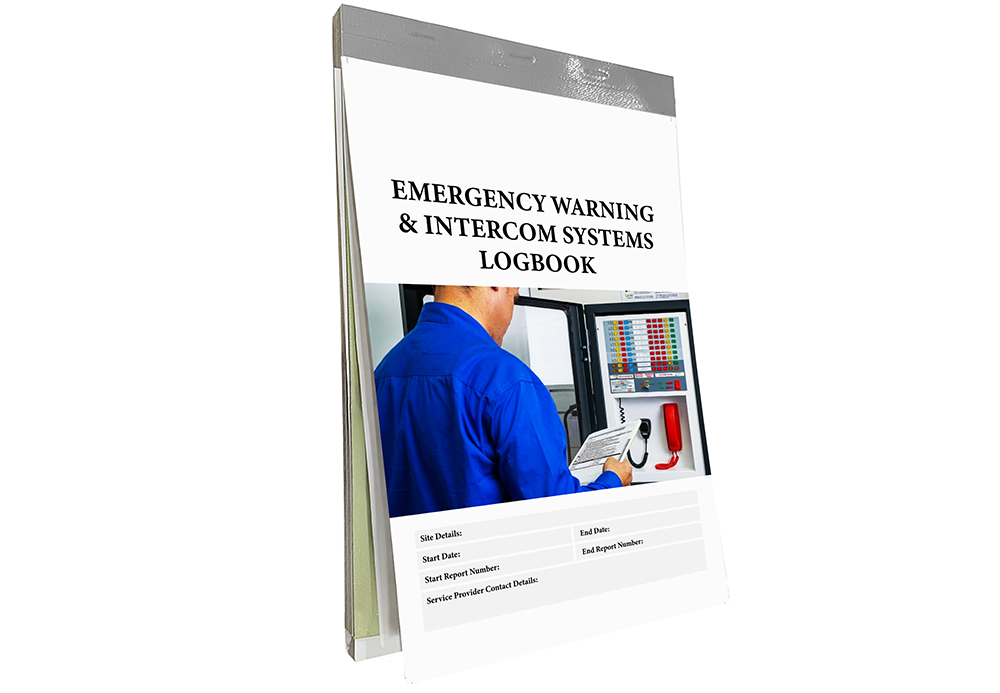
Emergency warning and intercom systems are important components of a building’s emergency communication and evacuation arrangements. They provide warning signals to occupants and, where emergency intercom equipment is installed, communication between the emergency control point and Warden Intercom Points throughout the building.
The Emergency Warning & Intercom Systems logbook provides structured routine service records based on the applicable requirements of AS 1851—2012 (Incorporating Amendment No. 1), Section 6.
The logbook is designed specifically for recording routine servicing of:
- Emergency Warning Systems (EWS)
- Emergency Intercom Systems (EIS)
- Emergency Warning Panels
- Emergency Call Points
- Visual Warning Devices
- Warden Intercom Points (WIPs)
- Warning system speakers and speaker circuits
- System batteries
- Interfaces with other fire and building systems
It provides Monthly, Yearly and Five-Yearly Emergency Warning System service records, together with a Yearly Emergency Intercom System service record.
Designed as a practical fire logbook, emergency warning system logbook, emergency intercom logbook, service record logbook and routine service record logbook, it provides dedicated areas for recording inspection results, functional tests, battery information, sound measurements, speaker-circuit readings, defects, corrective actions and completed repairs.
What Does the Emergency Warning & Intercom Systems Logbook Cover?
The logbook combines two related emergency communication systems:
Emergency Warning System
The Emergency Warning System records cover warning panels, warning signals, emergency call points, speakers, visual warning devices, batteries, system interfaces, audibility and other warning-system functions.
Emergency Intercom System
The Emergency Intercom System records cover the intercom panel, Warden Intercom Points, incoming and outgoing WIP calls, visual and aural indicators, system batteries, controls, faults and interfaced systems.
AS 1851 places both systems within Section 6, with Emergency Warning Systems addressed under Clause 6.4.3 and Emergency Intercom Systems under Clause 6.4.4. The Standard specifies a dedicated Five-Yearly schedule for Emergency Warning Systems and a Yearly schedule for Emergency Intercom Systems.
Emergency Warning & Intercom System Service Frequencies
The service frequencies represented in this logbook are:
| System | Monthly | Yearly | Five-Yearly |
|---|---|---|---|
| Emergency Warning System | ✓ | ✓ | ✓ |
| Emergency Intercom System | — | ✓ | — |
This distinction is important. The Emergency Warning System has dedicated Monthly, Yearly and Five-Yearly schedules, while the Emergency Intercom System is recorded under its dedicated Yearly schedule.
Monthly Emergency Warning System Service Records
The Emergency Warning & Intercom Systems logbook begins with a dedicated Emergency Warning System – Monthly Routine Service Schedule, based on Table 6.4.3.1.
The Monthly Service Record includes:
- zone block plans
- supplementary zone drawings
- warning system panel
- panel visibility
- accessibility
- dust and contamination
- panel-door labelling
- Manual Call Point replacement elements
- vented battery enclosure
- battery enclosure corrosion
- simulated alarm condition
- confirmation that required warning signals operate.
The Standard similarly identifies Table 6.4.3.1 as the Monthly Service Schedule for Emergency Warning Systems.
Warning System Panel Inspection
The Emergency Warning Panel is one of the key pieces of equipment covered by the monthly routine service record.
The logbook provides for checking that the panel is:
- clearly visible
- readily accessible
- free from dust and contaminants
- correctly identified where obscured behind a door.
Where applicable Manual Call Points use replaceable frangible elements, the availability of the required replacement element and tool is also checked.
These records help create a consistent history of the physical condition and accessibility of the Emergency Warning System control equipment.
Monthly Emergency Warning System Alarm Test
The Monthly Service Record also includes simulation of an alarm condition.
The test is used to confirm that the required warning signals operate.
This provides a regular recorded check that the Emergency Warning System responds when an alarm condition is initiated.
Yearly Emergency Warning System Service Records
The Yearly Emergency Warning System service page contains a considerably more detailed set of inspection, testing and survey activities.
The Emergency Warning & Intercom Systems includes records for:
- emergency call points
- Visual Warning Devices
- other warning devices
- as-installed drawings
- automatic warning-system operation
- speaker-circuit faults
- emergency call-point circuit faults
- Visual Warning Device circuit faults
- EWP fault indications
- FIP fault indications
- SIP fault indications where applicable
- aural indicators
- panel switches
- keypad controls
- visual indicators
- alphanumeric displays
- battery capacity
- ancillary control functions
- warning-system audibility
- non-emergency signal override
- interfaced systems
- battery condition
- structural changes
- occupancy changes.
Emergency Call Point Testing
The yearly schedule includes inspection and testing of emergency call points.
The logbook provides for:
- inspecting all emergency call points for conditions that could adversely affect operation
- testing the operation of each emergency call point.
This provides a clear service record showing that individual emergency call points have been inspected and functionally tested.
Visual Warning Device Testing
Where Visual Warning Devices (VWDs) are installed, the Yearly Service Record includes:
- functional testing of each device
- inspection for damage or conditions affecting operation
- verification that required labels are clear and correct.
Other alarm-indicating warning devices are also tested and inspected where applicable.
Emergency Warning System Fault Testing
The yearly service schedule includes simulated fault testing of several warning-system circuits.
The logbook covers simulated circuit faults for:
- speakers
- emergency call points
- Visual Warning Devices
The test confirms that applicable fault conditions are indicated at the:
- Emergency Warning Panel (EWP)
- Fire Indicator Panel (FIP)
- corresponding Sub-Indicator Panel (SIP), where applicable.
This is important because routine servicing needs to verify not only normal warning operation but also the system’s ability to recognise and report faults.
Emergency Warning System Battery Capacity Records
The Yearly Service Record provides dedicated fields for Emergency Warning System battery information.
The logbook records:
- Quiescent Current (IQ) – A
- Alarm Current (IA) – A
- Battery Capacity – Ah.
The yearly schedule requires measurement of the quiescent and alarm currents and verification that the installed battery meets the calculated required capacity.
This gives the Emergency Warning & Intercom Systems logbook an important role as a long-term battery service record logbook as well as an Emergency Warning System maintenance record.
Emergency Warning System Battery Condition
The logbook also contains a dedicated Battery Condition section.
Records include:
- Date Last Replaced
or - Test Load Current – A
- Final Test Voltage – V.
Where batteries are more than two years old, the yearly schedule provides for a battery discharge test and verification of battery condition in accordance with the applicable AS 1851 battery-testing requirements.
Emergency Warning System Audibility
The yearly service schedule includes testing of the Emergency Warning System to confirm that warning signals are distinctly audible in all areas of the building.
The record also checks that the emergency alarm signal overrides non-emergency audible signals.
This is particularly important where the warning system shares speakers or audio infrastructure with other building communication functions.
System Interface Testing
Emergency Warning Systems may be required to interact with other fire protection or building systems.
The yearly schedule includes a functional system test with other interfaced systems to confirm that applicable interfaces operate as required.
AS 1851 places significant emphasis on testing system interconnections so that systems respond as intended when an emergency signal is transmitted.
Building & Occupancy Survey
The Yearly Service Record also incorporates survey activities relating to changes in the building.
The logbook provides for inspection to determine whether:
- structural changes may affect evacuation zones
- occupancy changes may affect system performance.
This recognises that even when the Emergency Warning System itself has not been modified, changes to a building or its use can potentially affect the way the system needs to perform.
Yearly Emergency Intercom System Service Records
The Emergency Warning & Intercom Systems includes a separate Emergency Intercom System – Yearly Routine Service Schedule, based on Table 6.4.4.1.
The service record covers:
- Emergency Intercom Panel
- visual indicators
- alphanumeric displays
- aural indicators
- panel switches
- keypad controls
- WIP circuit fault indication
- reset function
- warden indicators
- Warden Intercom Points
- WIP accessibility
- WIP identification
- mechanical condition
- battery enclosure
- outgoing WIP calls
- incoming WIP calls
- all-call function
- stand-alone battery capacity
- interfaced systems
- battery discharge testing
- structural changes
- occupancy changes
- evacuation-zone WIP provision.
AS 1851 identifies this as the dedicated Yearly Service Schedule for Emergency Intercom Systems.
Emergency Intercom Panel Testing
The Yearly Service Record includes inspection of the Emergency Intercom Panel to ensure that it is:
- clearly visible
- readily accessible
- free from dust and contaminants
- correctly labelled where obscured by a door.
The logbook then provides for testing:
- visual indicators
- alphanumeric displays
- aural indicators
- required panel switches
- keypad controls
- reset functions
- warden indicators and controls.
Warden Intercom Point (WIP) Inspection
The Warden Intercom Point (WIP) is a major component of the Emergency Intercom System.
The yearly service record includes inspection of all WIPs to confirm:
- clear visibility
- ready accessibility
- correct door labelling where obscured
- absence of mechanical damage.
This allows WIP condition to be documented as part of the building’s annual Emergency Intercom System service history.
Incoming & Outgoing WIP Communication Tests
The logbook includes functional communication testing in both directions.
Outgoing WIP Test
A call is initiated from each WIP and the technician confirms that:
- the WIP indicates correctly
- clear communication is possible with the intercom panel operator.
Incoming WIP Test
A call is initiated to each WIP and the technician confirms:
- correct indication
- clear communication with the intercom panel operator.
These records help verify that the Emergency Intercom System can provide the two-way communication required during an emergency.
Emergency Intercom All-Call Test
The yearly schedule also includes operation of the all-call address function.
The logbook provides for checking that:
- the visual indicator for all WIP phones activates
- the address can be heard at all WIP phones.
This helps verify the ability of the intercom operator to communicate simultaneously with multiple Warden Intercom Points.
WIP Circuit Fault Testing
The Emergency Intercom System schedule includes simulation of a WIP circuit fault.
The test confirms that the fault condition is correctly indicated at the Emergency Intercom Panel.
This verifies that wiring or circuit faults can be identified by the system rather than remaining undetected.
Emergency Intercom Battery Capacity Records
Where a stand-alone Emergency Intercom System is used, the logbook provides dedicated battery records.
Fields include:
- Quiescent Current – A
- Alarm Current – A
- Battery Capacity – Ah
- Nominal Capacity – Ah.
The service schedule requires measurement of the applicable currents and verification that the installed battery meets the calculated required capacity.
Emergency Intercom Battery Condition
For stand-alone intercom systems with batteries more than two years old, the logbook includes battery condition testing.
The record provides for:
- Date Last Replaced
or - Battery Capacity – Ah.
The applicable yearly activity includes conducting a battery discharge test in accordance with Appendix F and verifying battery condition.
Emergency Intercom System Building Survey
The Yearly Service Record includes survey activities to identify building or occupancy changes that could affect the Emergency Intercom System.
These include:
- structural changes affecting zones
- occupancy changes affecting audibility of the warden call signal
- checking evacuation zones to confirm that at least one WIP is installed where required.
Five-Yearly Emergency Warning System Service Records
The Emergency Warning & Intercom Systems contains a dedicated Five-Yearly Emergency Warning System service page.
The Five-Yearly schedule includes:
- Speech Intelligibility testing
- Sound Pressure Level measurement
- Emergency Warning System speaker-circuit impedance measurement.
The Standard confirms that the Five-Yearly Emergency Warning System schedule also requires completion of the applicable Monthly and Yearly service activities.
Speech Intelligibility Records
The Five-Yearly record includes dedicated fields for speech intelligibility.
The logbook provides for:
- Location
- Reference CIS
- Recorded CIS.
Tests are undertaken in areas of the building where speech intelligibility is required.
This is particularly useful for sites where voice messages form part of the emergency warning strategy.
Sound Pressure Level Records
The Five-Yearly schedule requires sound pressure level measurement from at least one reference point for each amplifier used.
The logbook records:
- Location
- Reference SPL
- Measured SPL
- dBA.
The measured value can then be compared with the reference sound pressure level for that location.
Emergency Warning System Speaker Circuit Impedance
The Five-Yearly page also includes a dedicated speaker-circuit table.
Fields are provided for:
Circuit | Required Impedance | Measured Impedance
The logbook provides space for eight speaker circuits.
The applicable service requirement checks that speaker-circuit impedance has not changed by more than 15% from the previous test and has not exceeded the rated output applicable to the amplifier.
Recording Defects, Corrective Actions & Repairs
Each service page provides dedicated areas for recording:
Item No. | Defect Type | Results / Comments | Corrective Action | Completed Repairs
The Notes page also provides fields for:
- Associated Logbook Sheet ID / Report No.
- Activity Performed
- additional defect and corrective-action records.
This allows the service record logbook to maintain a traceable history from the original inspection or test through to defect identification and completed repair.
Site, Technician & Service Provider Records
The service records include fields for:
- Site Name
- Site Address / Location
- Site ID
- Work Order No.
- Service Provider
- Date
- Technician Name
- Licence No.
- Client Name
- Technician Signature
- Client Signature
The NCR service records are identified as:
White – Owner/Occupier/Agent | Yellow – Service Provider | Red – Book Copy.
This provides a practical format for distributing and retaining Emergency Warning and Intercom routine service records.
Why Are Emergency Warning & Intercom Service Records Important?
Emergency Warning and Intercom Systems can play a critical role in communicating emergency information and coordinating evacuation.
A structured Emergency Warning System service record logbook helps maintain an ongoing history of:
- warning panel inspections
- warning signal tests
- emergency call-point tests
- Visual Warning Device testing
- circuit fault testing
- battery capacity
- battery condition
- system interface testing
- warning-system audibility
- building and occupancy surveys
- speech intelligibility
- Sound Pressure Level
- speaker-circuit impedance
For Emergency Intercom Systems, the logbook records:
- Intercom Panel operation
- WIP inspections
- incoming calls
- outgoing calls
- all-call operation
- circuit faults
- battery capacity
- interfaces
- building and occupancy changes
The product itself states that it has been prepared as a practical guide to assist routine service recording under AS 1851—2012 and that the logbook itself does not guarantee compliance with every requirement of the Standard.
AS 1851—2012 Requirements in NSW
From 13 February 2026, AS 1851—2012 became mandatory in NSW for applicable essential fire safety measures in new and existing Class 1b and Class 2 to Class 9 buildings, unless an applicable Performance Solution specifies another maintenance basis.
This does not mean that every Class 1b–9 building necessarily has an Emergency Warning System or Emergency Intercom System.
The requirements are relevant where the Emergency Warning System or Emergency Intercom System forms part of the applicable essential fire safety measures for the particular building.
NSW Government – Building fire safety requirements under AS 1851-2012
Which Buildings Are Affected in NSW?
The NSW Government’s AS 1851 requirements apply to applicable essential fire safety measures in new and existing Class 1b and Class 2 to Class 9 buildings.
| Building Class | Typical Examples |
|---|---|
| Class 1b | Small boarding houses, guest houses, hostels and similar accommodation |
| Class 2 | Apartment buildings |
| Class 3 | Hotels, larger boarding houses and other residential accommodation |
| Class 5 | Office buildings |
| Class 6 | Shops, restaurants and cafés |
| Class 7 | Car parks and warehouses |
| Class 8 | Factories and laboratories |
| Class 9 | Hospitals, schools and assembly buildings |
For Emergency Warning and Intercom Systems, these requirements are relevant where the relevant system forms part of the building’s applicable essential fire safety measures.
Building owners should refer to their Fire Safety Schedule (FSS) and applicable fire safety documentation to determine which measures apply to their building.
NSW Government – Responsibilities of building owners under AS 1851-2012
Keeping Emergency Warning & Intercom Service Records in NSW
Current NSW Government requirements place responsibility on building owners for retaining applicable routine service records and making them available for inspection.
For Emergency Warning and Intercom Systems, an accessible physical fire logbook provides a useful history of:
- monthly EWS servicing
- yearly EWS servicing
- yearly EIS servicing
- battery tests
- WIP tests
- system interface tests
- Five-Yearly acoustic measurements
- defects
- corrective actions
NSW Government – Responsibilities of building owners under AS 1851-2012
Who Should Carry Out Emergency Warning & Intercom System Servicing?
Emergency Warning and Intercom Systems contain specialised electrical, communication, control and fire-safety equipment.
Building owners should engage appropriately competent and, where required, appropriately licensed personnel for the relevant routine service activities.
The required competency may vary depending on whether the work involves:
- testing
- electrical work
- system programming
- acoustic measurements
- battery testing
- system interfaces
- repairs or alterations.
NSW Government – Good Practice Guide for Implementing AS 1851-2012
About the AS 1851 Emergency Warning & Intercom Routine Service Record Logbook
The Emergency Warning & Intercom Systems logbook is a dedicated fire logbook, Emergency Warning System logbook, Emergency Intercom System logbook, service record logbook and routine service record logbook for documenting applicable inspection, testing, preventive maintenance and survey activities.
Designed around the relevant requirements of AS 1851—2012 Section 6, it provides structured records for:
- Emergency Warning Systems
- Emergency Intercom Systems
- Emergency Warning Panels
- Emergency Call Points
- Visual Warning Devices
- warning-system speakers
- speaker circuits
- Warden Intercom Points
- incoming WIP communication
- outgoing WIP communication
- all-call functions
- system batteries
- interfaced systems
- building and occupancy surveys
The logbook includes:
- Monthly Emergency Warning System service records
- Yearly Emergency Warning System service records
- Yearly Emergency Intercom System service records
- Five-Yearly Emergency Warning System service records
- battery capacity records
- battery condition records
- warning-system fault tests
- WIP communication tests
- system interface testing
- Speech Intelligibility records
- Sound Pressure Level records
- speaker-circuit impedance records
- defects
- corrective actions
- completed repairs
For Australian fire protection contractors, technicians, facility managers and building managers searching for an Emergency Warning System logbook, EWIS logbook, Emergency Intercom System logbook, EWS logbook, EIS logbook, fire logbook Australia, service record logbook or routine service record logbook, this product provides a structured location for maintaining applicable Emergency Warning and Intercom service history.
Designed to support routine service and record keeping in accordance with the relevant requirements of AS 1851—2012 Section 6.
Frequently Asked Questions
What is an Emergency Warning & Intercom Systems logbook?
It is a routine service record logbook designed for documenting applicable inspection, testing, preventive maintenance and survey activities for Emergency Warning and Emergency Intercom Systems under AS 1851—2012 Section 6.
Which systems does this logbook cover?
It covers Emergency Warning Systems (EWS) and Emergency Intercom Systems (EIS).
Which section of AS 1851 applies to Emergency Warning and Intercom Systems?
Both are addressed under Section 6 of AS 1851—2012, with Emergency Warning Systems under Clause 6.4.3 and Emergency Intercom Systems under Clause 6.4.4.
How often is an Emergency Warning System serviced?
This logbook contains dedicated Monthly, Yearly and Five-Yearly Emergency Warning System service records.
How often is an Emergency Intercom System serviced?
The logbook contains a dedicated Yearly Emergency Intercom System service record in accordance with Table 6.4.4.1.
Does the logbook include Warden Intercom Point testing?
Yes. It includes inspection and functional testing of Warden Intercom Points (WIPs), including incoming calls, outgoing calls and the all-call function.
Does it include Emergency Warning System battery records?
Yes. The logbook includes records for quiescent current, alarm current, battery capacity, replacement date, test load current and final test voltage.
Does it include Emergency Intercom battery records?
Yes. Dedicated stand-alone intercom battery capacity and battery-condition records are provided.
Does it include Speech Intelligibility testing?
Yes. The Five-Yearly Emergency Warning System record includes dedicated Speech Intelligibility testing and recording fields.
Does it include Sound Pressure Level testing?
Yes. The Five-Yearly page includes Reference SPL and Measured SPL records in dBA.
Does the logbook record speaker-circuit impedance?
Yes. Dedicated records are provided for Required Impedance and Measured Impedance for Emergency Warning System speaker circuits.
Does it include system interface testing?
Yes. Both the Emergency Warning and Emergency Intercom Yearly schedules contain applicable functional tests of interfaced systems.
Can defects and corrective actions be recorded?
Yes. Dedicated fields are provided for Defect Type, Results / Comments, Corrective Action and Completed Repairs.
Does using this logbook automatically make an Emergency Warning or Intercom System compliant with AS 1851?
No. The logbook provides a structured format for recording routine service activities. Compliance depends on the system, approved design, work performed, personnel competency, test results, identified defects, rectification and applicable regulatory requirements. The product itself also states that the logbook is a guide and does not guarantee compliance.
Conclusion
The Emergency Warning & Intercom Systems logbook provides a structured way to document routine servicing of Emergency Warning Systems and Emergency Intercom Systems under the applicable requirements of AS 1851—2012 Section 6.
It combines Monthly, Yearly and Five-Yearly Emergency Warning System records with a comprehensive Yearly Emergency Intercom System record, including battery testing, WIP communication testing, system interfaces, Speech Intelligibility, Sound Pressure Level and speaker-circuit impedance.
For contractors and technicians searching for an EWS logbook, EIS logbook, EWIS logbook, Emergency Warning System service record logbook, Emergency Intercom System logbook, fire logbook Australia or routine service record logbook, it provides a clear and traceable format for maintaining ongoing service history.
Designed to support routine service and record keeping in accordance with the relevant requirements of AS 1851—2012 Section 6.
Our Fire Safety Logbooks
Explore our complete range of Fire Safety Logbooks for fire protection routine service, testing, inspection and maintenance records.
- Fire Detection and Alarm Systems
- Emergency Warning & Intercom Systems
- Fire Detection & Alarm Systems and Emergency Warning & Intercom Systems
- Automatic Fire Sprinkler System Logbook – Wet Pipe Sprinkler and Jacking Pump
- Automatic Fire Sprinkler System Logbook – Dry-Pipe / Pre-Action, Deluge & Water Spray
- Special Hazard Fire Suppression Systems
- Fire Pumpset Logbook – Sprinkler & Hydrant Pumps (Diesel & Electric) & Jacking Pumps
- Diesel Fire Pumpset Logbook – Sprinkler & Hydrant Pumps & Jacking Pumps
- Electric Fire Pumpset Logbook – Sprinkler & Hydrant Pumps & Jacking Pumps
- Hose Reel & Jacking Pumps Logbook
- Fire Hydrant Systems & Jacking Pumps Logbook
- Water Storage Tanks Logbook
- Routine Service Logbook – Delivery Lay Flat Hose, Fire Hose Reels, Fire Extinguishers & Fire Blankets
- Passive Fire Logbook
- Mechanical Services Logbook – Fire/Smoke Control Features
- Emergency and Exit Lighting Maintenance Logbook