Table of Contents
ToggleDry Pipe, Pre-Action, Deluge & Water Spray Systems Logbook
A Complete Guide to AS 1851—2012 Specialised Sprinkler System Service Records
Automatic fire sprinkler systems use different operating arrangements depending on the fire risk, protected environment and system design.
Unlike conventional wet pipe sprinkler systems, dry pipe, pre-action, deluge and water spray systems may incorporate pressurised air or nitrogen, specialised control valves, compressors, electrical detection, solenoid valves and automatic release arrangements.
These additional components require system-specific inspection, testing and maintenance records.
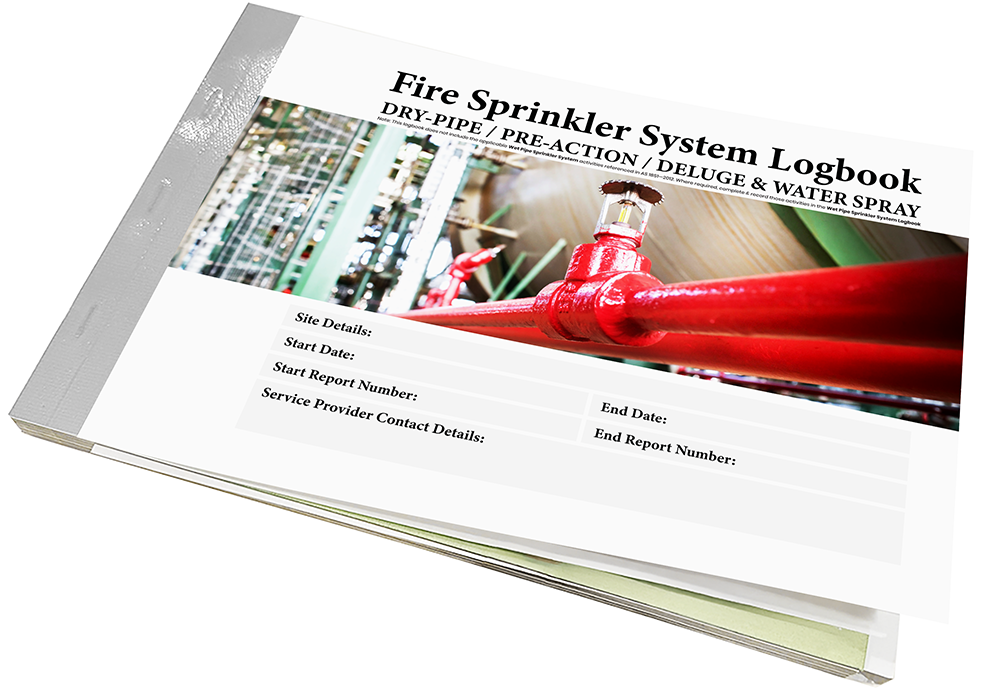
The Dry Pipe, Pre-Action, Deluge & Water Spray Systems Logbook provides dedicated hardcopy service records for these specialised automatic sprinkler systems.
Developed around the applicable requirements of AS 1851—2012 (Incorporating Amendment No. 1), Section 2, the logbook provides structured schedules for Monthly, Six-Monthly, Yearly and Five-Yearly servicing.
Dedicated recording fields are provided for:
- System air and supervisory pressures
- Compressor cut-in and cut-out pressures
- Low-air-pressure alarms
- Nitrogen cylinder pressures
- Alarm operating times
- Solenoid valve and release-system testing
- Full discharge testing
- Foam quality testing
- Defects and corrective actions
The logbook keeps the different service schedules for dry pipe, pre-action, deluge and water spray systems organised within one purpose-designed record.
Important: Applicable wet pipe sprinkler activities must also be completed and recorded in the relevant logbook. This product does not replace those associated service records.
What Systems Does This Logbook Cover?
The logbook combines dedicated service records for three sprinkler-system categories under AS 1851—2012.
| System Category | Systems Covered |
|---|---|
| Dry Pipe Systems | Dry pipe automatic fire sprinkler installations |
| Pre-Action Systems | Pre-action sprinkler installations |
| Deluge & Water Spray Systems | Deluge and water spray installations |
Although these systems are all addressed within Section 2, their operating arrangements and service activities differ.
The logbook therefore provides separate schedules for each category rather than combining every activity into a generic sprinkler checklist.
Which AS 1851 Clauses Apply?
The relevant clauses are:
| System | AS 1851—2012 Clause |
|---|---|
| Dry Pipe Systems | 2.4.3 |
| Deluge & Water Spray Systems | 2.4.4 |
| Pre-Action Systems | 2.4.5 |
These specialised sprinkler schedules also require applicable wet pipe activities to be completed.
Associated equipment may have additional service requirements under other sections of AS 1851.
| Associated Equipment | Relevant Section |
|---|---|
| Wet Pipe Sprinkler Activities | Section 2, Clause 2.4.2 |
| Fire Pumpsets | Section 3 |
| Water Storage Tanks | Section 5 |
| Electrical Detection & Alarm Equipment | Section 6 |
The relevant records should be completed in the appropriate logbooks.
Routine Service Frequencies
The logbook provides dedicated records for the following intervals.
| System | Monthly | Six-Monthly | Yearly | Five-Yearly |
|---|---|---|---|---|
| Dry Pipe Systems | ✓ | ✓ | ✓ | ✓ |
| Pre-Action Systems | ✓ | ✓ | ✓ | ✓ |
| Deluge & Water Spray Systems | ✓ | ✓ | ✓ | ✓ |
AS 1851 Section 2 also contains applicable longer-term sprinkler activities at Ten-Yearly, Twenty-Five-Yearly and Thirty-Yearly intervals.
This particular logbook focuses on the dedicated dry pipe, pre-action, deluge and water spray schedules.
Applicable wet pipe and associated equipment records must be maintained separately where required.
Monthly Dry Pipe System Service Records
Dry pipe sprinkler systems normally contain pressurised air within the sprinkler pipework rather than water.
Their routine servicing therefore includes checks relating to air pressure, compressors, low-pressure alarms and dry pipe alarm valve operation.
The Monthly Dry Pipe Service Record includes activities covering:
- Applicable Monthly wet pipe activities
- System air pressure
- Air desiccator or dryer
- Desiccant condition
- Air compressor oil level
- Compressor cut-in pressure
- Compressor cut-out pressure
- Low-air-pressure alarms
- Visual and audible alarm indications
- Dry pipe alarm valve simulation
- Local alarm operation
- Fire brigade alarm operation
- Alarm Signalling Equipment activation
- Air receiver condensate drainage
The logbook provides a dedicated PASS / FAIL / N/A schedule together with fields for recording measured values.
Dry Pipe System Air Pressure Records
Maintaining the appropriate air pressure is an important part of dry pipe sprinkler system operation.
The Monthly Service Record provides dedicated fields for:
System Air Pressure – kPa
Readings can be recorded for multiple systems or valve assemblies.
These measurements create a historical record of supervisory air pressure across successive service visits.
Dry Pipe Air Compressor Pressure Records
The Monthly Dry Pipe Service Schedule includes verification of compressor operating pressure settings.
Dedicated fields are provided for two compressors.
| Compressor | Cut-In Pressure | Cut-Out Pressure |
|---|---|---|
| Compressor 1 | kPa | kPa |
| Compressor 2 | kPa | kPa |
Recording these values allows technicians to compare compressor operating pressures over time.
Changes in the recorded settings can be investigated where necessary.
Dry Pipe Low-Air-Pressure Alarm Records
The Monthly Dry Pipe Service Schedule includes verification that low-air-pressure alarms operate at their predetermined pressure levels.
The logbook provides fields for:
Low Air Pressure Alarm – kPa
It also includes checks for the associated visual indicators and audible sounders.
These records allow the actual alarm operating pressure to be documented rather than relying only on a Pass or Fail result.
Monthly Deluge & Water Spray Service Records
Deluge and water spray systems may use open sprinklers or spray nozzles together with specialised release arrangements.
Depending on the installation, they may also incorporate electrical detection, pilot lines, compressors and foam equipment.
The Monthly Deluge & Water Spray Service Schedule includes:
- Applicable Monthly wet pipe activities
- Pressure gauge readings
- Pilot line pressure
- Diaphragm line pressure
- Pressure below the stop valve
- Air compressor oil level, where fitted
- Compressor regulator position
- Electrical detection, where fitted
- Detector sprinkler line valves
- Compressor cut-in and cut-out pressures
- Solenoid valve operation
- Low-air-pressure alarms
- Alarm Signalling Equipment testing
- Local alarms
- Fire brigade alarm operation
The schedule includes dedicated fields for the applicable pressure measurements.
Deluge & Water Spray Pressure Records
The Monthly Service Record provides separate fields for:
| Measurement | Unit |
|---|---|
| Pilot Line Pressure | kPa |
| Diaphragm Line Pressure | kPa |
| Below Stop Valve Pressure | kPa |
These measurements provide a historical record of the operating pressures associated with the deluge or water spray installation.
Deluge Air Compressor Records
Where an air compressor forms part of the system, the logbook provides fields for recording its operating pressures.
| Compressor | Cut-In Pressure | Cut-Out Pressure |
|---|---|---|
| Compressor 1 | kPa | kPa |
| Compressor 2 | kPa | kPa |
All values are recorded in kPa.
The Monthly Service Schedule also includes applicable compressor condition and regulator checks.
Deluge Low-Air-Pressure Alarm Records
Where low-air-pressure alarms are installed, their operation is verified at the predetermined pressure levels.
The logbook provides dedicated fields for recording the alarm operating pressures across multiple system positions.
This allows alarm test measurements to remain part of the deluge or water spray system’s service history.
Electrical Detection & Solenoid Valve Testing
Some deluge and water spray systems depend on electrical detection to initiate system release.
Where electrical detection is fitted, the Monthly Schedule directs the relevant equipment to be inspected and tested under Section 6 of AS 1851—2012.
Those results must be recorded in the appropriate detection and alarm service logbook.
The deluge and water spray schedule also includes testing of applicable solenoid valves for correct operation.
This distinction ensures that sprinkler service records do not replace the separate records required for associated electrical detection equipment.
Monthly Pre-Action System Service Records
Pre-action sprinkler systems incorporate a separate detection or release arrangement and may use supervisory air or nitrogen within the sprinkler piping.
The Monthly Pre-Action Service Schedule includes activities relating to:
- Applicable Monthly wet pipe activities
- Supervisory pressure
- Diaphragm line pressure
- Pressure below the stop valve
- Air compressor oil level
- Compressor regulator
- Electrical detection
- Compressor cut-in and cut-out pressures
- Nitrogen supply, where fitted
- Nitrogen cylinder pressure
- Nitrogen regulator
- Solenoid valve operation
- Low-air-pressure alarms
- Alarm Signalling Equipment
- Local alarms
- Fire brigade alarm operation
These activities are based on the applicable requirements of Clause 2.4.5.
Pre-Action Nitrogen Cylinder Pressure Records
Where a pre-action system incorporates a nitrogen supply, the Monthly Service Schedule includes checking cylinder contents using the pressure gauge.
The logbook provides dedicated fields for:
Nitrogen Cylinder Pressure – kPa
Readings can be recorded for multiple system positions.
The schedule also includes verification that the nitrogen regulator remains correctly set and locked.
Pre-Action Pressure Gauge Records
The Monthly Pre-Action Service Record provides dedicated fields for:
| Measurement | Unit |
|---|---|
| Supervisory Pressure | kPa |
| Diaphragm Line Pressure | kPa |
| Below Stop Valve Pressure | kPa |
These measurements form part of the ongoing pre-action sprinkler service history.
Pre-Action Air Compressor Records
Where air compressors are installed, the Monthly Schedule includes verification of their cut-in and cut-out pressures.
Separate fields are provided for:
- Compressor 1 – Cut-In Pressure
- Compressor 1 – Cut-Out Pressure
- Compressor 2 – Cut-In Pressure
- Compressor 2 – Cut-Out Pressure
All values are recorded in kPa.
Six-Monthly Dry Pipe System Service Records
The Six-Monthly Dry Pipe Service Schedule incorporates the applicable wet pipe activities and provides additional dry-pipe-specific testing.
The schedule includes:
- Applicable Six-Monthly wet pipe servicing
- Isolation above the alarm valve, where fitted
- Operation of the dry pipe alarm valve by releasing system air
- Alarm operation checks
- Accelerator or exhauster operation
- Alarm gong operating time
- Fire brigade alarm operation
- Restoration of system air pressure
- Verification that the alarm valve has reseated
- Restoration of FIP / ASE operation
- Pressure gauge readings
- Correct positioning and security of valves and alarm cocks
The logbook identifies a maximum applicable alarm gong operating time of 180 seconds for this test.
Dry Pipe Alarm Gong Time Records
The Six-Monthly Service Record provides dedicated fields for:
Alarm Gong Time – seconds
Multiple dry pipe systems or valve assemblies can be recorded.
This creates a measurable history of alarm response times across successive service visits.
Six-Monthly Deluge & Water Spray Service Records
The Six-Monthly Deluge & Water Spray Schedule includes:
- Applicable Six-Monthly wet pipe activities
- Isolation of the valve outlet, where fitted
- Operation of each deluge valve through each installed release method
- Alarm operation checks
- Fire brigade alarm testing
- Alarm Signalling Equipment activation
- Deluge valve resetting
- Restoration of detector sprinkler line pressure
- Restoration of electrical control equipment
- Pressure gauge readings
- Correct valve and alarm cock positioning
The applicable alarm operating time identified in the source schedule is 30 seconds.
This differs from the 180-second limit identified for the applicable dry pipe and pre-action tests.
Deluge & Water Spray Alarm Operation Time Records
The Six-Monthly Service Record includes dedicated fields for:
Alarm Operation Time – seconds
Readings can be recorded for multiple deluge or water spray systems.
These measurements provide a historical record of the system’s release and alarm response.
Six-Monthly Pre-Action Service Records
The Six-Monthly Pre-Action Schedule includes:
- Applicable Six-Monthly wet pipe activities
- Isolation above the pre-action valve, where fitted
- Release through the electrical detection subsystem
- Alarm operation
- Alarm operating time
- Fire brigade alarm operation
- Alarm Signalling Equipment activation
- Pre-action valve resetting
- Restoration of supervisory air pressure
- Restoration of electrical control equipment
- Pressure gauge readings
- Correct positioning and security of valves and alarm cocks
The source schedule identifies a maximum applicable alarm operating time of 180 seconds.
Six-Monthly Pressure Gauge Records
Separate pressure-recording tables are provided for the three system categories.
| System | Recording Fields |
|---|---|
| Dry Pipe | Installation Pressure; Below Stop Valve; Water Supply 1; Water Supply 2 |
| Deluge & Water Spray | Supervisory Pressure; Diaphragm Line Pressure; Below Stop Valve |
| Pre-Action | Supervisory Pressure; Diaphragm Line Pressure; Below Stop Valve |
These dedicated fields allow measured values to be retained alongside the relevant service results.
Yearly Dry Pipe System Service Records
The Yearly Dry Pipe Schedule incorporates the applicable Monthly, Six-Monthly and Yearly wet pipe activities.
It also includes dry-pipe-specific requirements relating to:
- Replacement of the system air desiccator or dryer
- Verification that the water distribution pipework is correctly pitched to drain
These activities address the additional air supply and drainage characteristics of dry pipe sprinkler systems.
Yearly Deluge & Water Spray Service Records
The Yearly Deluge & Water Spray Schedule includes system-specific performance testing and physical inspections.
The logbook provides records for:
- Applicable Yearly wet pipe activities
- Full discharge testing, where practicable
- Checking open sprinklers and nozzles for obstruction
- Verifying discharge coverage
- Foam concentrate or premix sampling, where applicable
- Foam concentrate strainer cleaning
- Pilot line strainer cleaning
- Applicable electrical detection servicing under Section 6
- Pipe hanger inspections
- Open sprinkler and spray nozzle condition
- Nozzle dust plugs or caps
- System configuration
- Coverage of the protected hazard
- Nozzle alignment
These activities are based on the applicable requirements of Clause 2.4.4.
Full Discharge Testing
Where practicable, the Yearly Deluge & Water Spray Service Schedule includes a full discharge operation test.
The test is used to check that:
- Open sprinklers and nozzles are unobstructed
- Discharge occurs correctly
- The required coverage is provided
This is an important system-specific activity and one reason a dedicated deluge and water spray service record is useful.
Foam Concentrate & Premix Records
Where foam forms part of the deluge or water spray system, the Yearly Service Schedule includes applicable sampling and condition checks.
The source material identifies the following measurements:
| Foam Sample Record |
|---|
| pH |
| Specific Gravity |
| Sediment |
| Expansion Ratio |
| 25% Drain Time |
The logbook provides space for recording applicable foam-related service results.
Yearly Pre-Action System Service Records
The Yearly Pre-Action Schedule incorporates applicable wet pipe activities and adds system-specific inspection and survey requirements.
These include:
- Draining condensate from the condensate trap
- Draining condensate from the air compressor receiver
- Checking that sprinkler piping is properly secured
- Checking that detection installations are properly secured
- Checking that sprinkler protection covers the full extent of the special hazard area
These activities are identified in the source material under Clause 2.4.5.
Five-Yearly Dry Pipe System Service Records
The Five-Yearly Dry Pipe Schedule includes applicable wet pipe activities together with longer-term dry pipe valve maintenance.
The logbook provides records for:
- Replacement of dry pipe valve seats
- Replacement of seals
- Replacement of the faceplate gasket
- Accelerator or exhauster servicing
- Fitting new seals where applicable
- Cleaning and checking the operating mechanism
These activities provide a record of preventive maintenance beyond normal recurring inspections and tests.
Five-Yearly Deluge & Water Spray Service Records
The Five-Yearly Deluge & Water Spray Schedule includes:
- Applicable Five-Yearly wet pipe activities
- Replacement of deluge valve seats and seals
- Cleaning and checking the deluge operating mechanism
- Replacement of the faceplate gasket
- Diaphragm replacement, where applicable
- Foam quality testing
The source schedule identifies foam quality measurements including:
- Proportioning Ratio
- 25% Drainage Time
- Expansion Ratio
These activities can be documented within the dedicated Five-Yearly service record.
Five-Yearly Pre-Action Service Records
The Five-Yearly Pre-Action Schedule includes applicable wet pipe activities together with maintenance of the pre-action valve assembly.
The logbook provides records for:
- Replacement of pre-action valve seats
- Replacement of seals
- Cleaning and checking the operating mechanism
- Replacement of the valve cover plate gasket
These activities are identified under the applicable requirements of Clause 2.4.5.
Important: Applicable Wet Pipe Service Records Are Also Required
The Dry Pipe, Pre-Action, Deluge & Water Spray Systems Logbook does not replace the applicable Wet Pipe Sprinkler Logbook.
The product cover specifically instructs users to complete and record relevant wet pipe routine service activities in the appropriate logbook.
This is because the specialised sprinkler schedules build on applicable wet pipe activities.
Depending on the installation, additional records may also be required for:
- Fire pumpsets
- Water storage tanks
- Electrical detection and alarm systems
Technicians should use the relevant system-specific service records for these associated components.
Recording Defects & Corrective Actions
The logbook provides structured defect and corrective-action fields within the applicable service records.
These include:
Item No. | Type | Results / Comments | Corrective Action | Completed Repairs
A separate Notes section also provides fields for:
- Associated Logbook Sheet ID / Report No.
- Activity Performed
- Defect Type
- Results / Comments
- Corrective Action
- Completed Repairs
This allows additional findings and rectification work to be linked to the relevant service activity.
Site, Technician & Service Provider Records
The main service pages provide fields for:
- Site Name
- Site Address
- Site ID
- System Location
- Work Order Number
- Report Number
- Service Provider Details
- Date
- Technician Name
- Licence Number
- Technician Signature
- Client Name
- Client Signature
The three-part NCR records are identified as:
White – Owner / Occupier / Agent
Yellow – Service Provider
Red – Book Copy
This provides a practical format for distributing and retaining service documentation.
Why Use a Dedicated Dry Pipe, Pre-Action & Deluge Logbook?
These specialised sprinkler systems require measurements and tests that may not appear in a conventional wet pipe service checklist.
Examples include:
- System air pressure
- Supervisory pressure
- Diaphragm line pressure
- Nitrogen cylinder pressure
- Low-air-pressure alarm settings
- Compressor cut-in and cut-out pressures
- Dry pipe alarm gong time
- Deluge alarm operation time
- Pre-action alarm operation time
- Electrical detection and solenoid valve testing
- Foam quality measurements
- Full discharge testing
The Dry Pipe, Pre-Action, Deluge & Water Spray Systems Logbook provides dedicated fields for these results.
This allows technicians to maintain a more organised service history without relying entirely on general comments fields.
Who Is This Logbook Designed For?
The logbook is intended for professional use by:
- Fire protection contractors
- Sprinkler service technicians
- Fire system maintenance companies
- Facility maintenance teams
- Building managers
- Property managers
- Service providers responsible for specialised sprinkler systems
It is particularly relevant to installations with dry pipe, pre-action, deluge or water spray systems requiring additional testing and measurements beyond conventional wet pipe servicing.
Routine servicing should be performed by appropriately competent personnel in accordance with applicable requirements.
What This Logbook Does Not Cover by Itself
This product should not be treated as a complete service record for every associated component of a fire protection installation.
Depending on the system, separate records may be required for:
| Associated System | Relevant AS 1851 Section |
|---|---|
| Applicable Wet Pipe Sprinkler Activities | Section 2, Clause 2.4.2 |
| Fire Pumpsets | Section 3 |
| Water Storage Tanks | Section 5 |
| Electrical Detection & Alarm Systems | Section 6 |
The appropriate records should be maintained for each applicable system.
About the AS 1851 Dry Pipe, Pre-Action, Deluge & Water Spray Systems Logbook
The Dry Pipe, Pre-Action, Deluge & Water Spray Systems Logbook is a dedicated routine service record for specialised automatic sprinkler systems.
Developed around the applicable requirements of AS 1851—2012 Section 2, it provides separate schedules for:
Dry Pipe Systems · Pre-Action Systems · Deluge Systems · Water Spray Systems
| Service Category | Included Records |
|---|---|
| Monthly Dry Pipe | Air pressure, compressor operation and low-pressure alarms |
| Monthly Deluge & Water Spray | Pressure readings, compressor operation, detection and release arrangements |
| Monthly Pre-Action | Supervisory pressure, nitrogen supply, compressors and alarms |
| Six-Monthly Dry Pipe | Alarm valve testing and alarm gong time |
| Six-Monthly Deluge & Water Spray | Release testing and alarm operation time |
| Six-Monthly Pre-Action | Detection-initiated release and alarm operation |
| Yearly Dry Pipe | Air dryer replacement and drainage checks |
| Yearly Deluge & Water Spray | Full discharge testing, nozzle inspection and foam records |
| Yearly Pre-Action | Condensate drainage and system survey |
| Five-Yearly Service | Applicable valve maintenance and component replacement |
| Additional Records | Defects, corrective actions and completed repairs |
The logbook provides one organised hardcopy record for documenting applicable dry pipe, pre-action, deluge and water spray routine service activities.
Applicable wet pipe sprinkler activities must also be completed and recorded in the relevant logbook.
Designed to support routine service and record keeping in accordance with the relevant requirements of AS 1851—2012 Section 2.
Frequently Asked Questions
What systems does this logbook cover?
It provides dedicated routine service records for Dry Pipe, Pre-Action, Deluge and Water Spray automatic sprinkler systems.
Which section of AS 1851 applies?
These systems are addressed under Section 2 of AS 1851—2012.
Which clause covers Dry Pipe Systems?
Dry pipe systems are addressed under Clause 2.4.3.
Which clause covers Deluge & Water Spray Systems?
Deluge and water spray systems are addressed under Clause 2.4.4.
Which clause covers Pre-Action Systems?
Pre-action systems are addressed under Clause 2.4.5.
What service frequencies are included?
The logbook contains dedicated Monthly, Six-Monthly, Yearly and Five-Yearly service records for all three system categories.
Does this product replace the Wet Pipe Sprinkler Logbook?
No.
Applicable wet pipe routine service activities must also be completed and recorded in the relevant logbook.
This requirement is stated on the product cover.
Does the logbook record dry pipe system air pressure?
Yes.
Dedicated fields are provided for recording system air pressure in kPa.
Can compressor cut-in and cut-out pressures be recorded?
Yes.
Separate fields are provided for applicable compressors associated with dry pipe, pre-action, deluge and water spray systems.
Does the logbook include nitrogen cylinder pressure records?
Yes.
The Monthly Pre-Action Service Record includes nitrogen cylinder pressure fields where a nitrogen supply is fitted.
Can alarm operating times be recorded?
Yes.
Dedicated fields are provided for:
- Dry Pipe Alarm Gong Time
- Deluge & Water Spray Alarm Operation Time
- Pre-Action Alarm Operation Time
What maximum alarm operating time is identified for the Deluge test?
The source schedule identifies a maximum of 30 seconds for the applicable Six-Monthly Deluge & Water Spray test.
What maximum alarm operating time is identified for Dry Pipe and Pre-Action tests?
The source schedules identify a maximum of 180 seconds for the applicable tests.
Does the logbook include full discharge testing?
Yes.
The Yearly Deluge & Water Spray Schedule includes full discharge operation testing where practicable.
Does the logbook include foam quality testing?
Yes.
Applicable foam records include pH, specific gravity, sediment, expansion ratio, drainage time and proportioning ratio, depending on the service activity.
Does this logbook include fire pumpset servicing?
No.
Associated fire pumpsets have separate applicable service requirements under Section 3.
The relevant pumpset service records should be completed where required.
Does the logbook cover electrical detection servicing?
The schedules identify applicable electrical detection activities, but detailed detection and alarm servicing must be completed and recorded under the relevant Section 6 requirements.
Can defects and corrective actions be recorded?
Yes.
The logbook includes dedicated fields for defects, results, corrective actions and completed repairs.
Does using this logbook guarantee compliance with AS 1851—2012?
No.
The logbook provides a structured format for recording applicable routine service activities.
Compliance also depends on the installed system, approved design, servicing performed, test results, competent personnel, identified defects, corrective actions and applicable regulatory requirements.
The product itself is described as a practical guide and does not guarantee compliance with every requirement of AS 1851—2012.
Conclusion
The Dry Pipe, Pre-Action, Deluge & Water Spray Systems Logbook provides dedicated service records for specialised automatic sprinkler systems with additional air, nitrogen, detection, valve and release arrangements.
With separate Monthly, Six-Monthly, Yearly and Five-Yearly schedules, dedicated pressure tables, compressor records, alarm operating times, full discharge testing and foam quality records, the logbook provides a structured history of inspection, testing and preventive maintenance.
For fire protection contractors, sprinkler technicians and building managers, it brings relevant system-specific service results, defects and corrective actions together in one organised hardcopy record.
Designed to support routine service and record keeping in accordance with the relevant requirements of AS 1851—2012 Section 2.
Applicable wet pipe sprinkler and associated equipment service records must also be maintained separately where required.
Explore Our Complete Fire Safety Logbook Range
Looking for service records for other fire protection systems?
Fire Factory Australia provides a range of AS 1851—2012 Fire Safety Logbooks for sprinkler systems, fire pumps, hydrants, water storage tanks, fire detection systems, passive fire protection, mechanical services and other fire protection equipment.