Table of Contents
ToggleFire Detection & Alarm Systems and Emergency Warning & Intercom Systems
A Complete Guide to AS 1851—2012 Fire Detection, Alarm, Emergency Warning & Intercom Routine Service Records
Fire detection, alarm, emergency warning and intercom systems are critical parts of a building’s fire safety and emergency communication infrastructure. Routine inspection, testing and record keeping help verify that these systems continue to operate in accordance with their approved design and that faults, defects and changes affecting system performance are identified and documented.
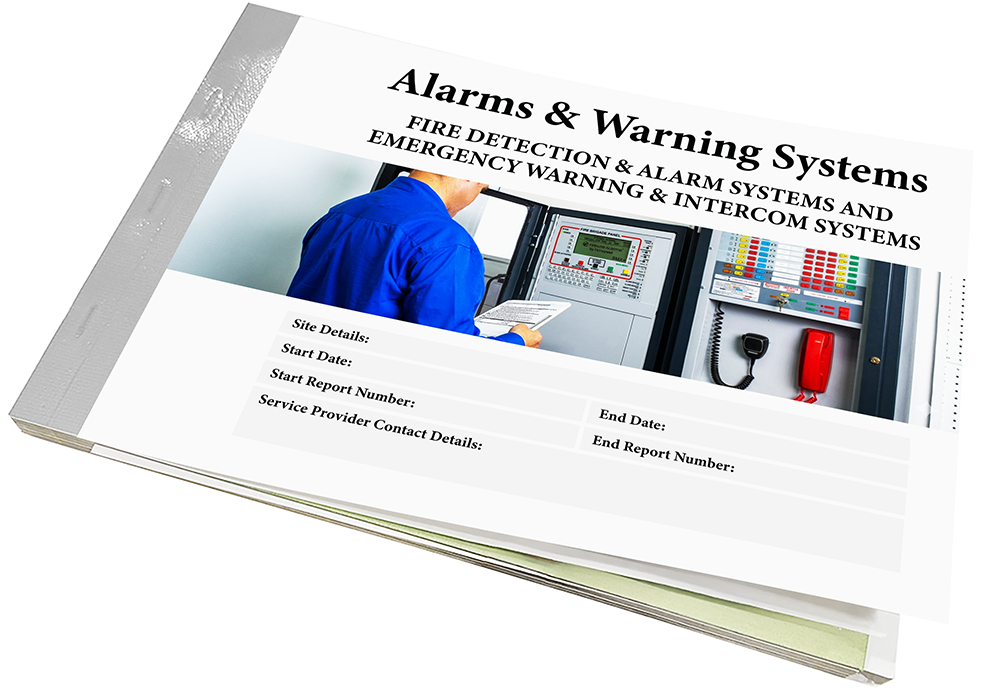
The Fire Detection & Alarm Systems and Emergency Warning & Intercom Systems logbook combines multiple AS 1851—2012 Section 6 routine service records into one comprehensive fire logbook.
Rather than maintaining separate books for closely related systems, this combined service record logbook provides structured records for applicable:
- Fire Detection and Alarm Systems
- Smoke Alarms and Heat Alarms
- Fire Detection and Control Equipment associated with Special Hazard Systems
- Smoke Hazard Management Systems
- Emergency Warning Systems
- Emergency Intercom Systems
- system interfaces
- batteries
- fire detectors and sampling points
- occupant warning functions
- Warden Intercom Points (WIPs)
The product is designed to support Monthly, Six-Monthly, Yearly and Five-Yearly routine service records, depending on the applicable system and service schedule. The actual combined logbook includes these systems within common service pages while retaining their relevant AS 1851 schedule references.
For sites that do not require the combined format, Fire Factory Australia also provides dedicated Fire Detection and Alarm Systems and Emergency Warning & Intercom Systems logbooks.
Why Use a Combined Fire Detection, Alarm, Warning & Intercom Logbook?
Many buildings contain interconnected fire detection, occupant warning and emergency communication systems.
A fire alarm condition may originate at the Fire Indicator Panel (FIP), activate occupant warning equipment, communicate with an Emergency Warning System and initiate other interfaced building systems.
Maintaining related routine service records in one fire service record logbook can make it easier to maintain a continuous service history for the overall installation.
The Fire Detection & Alarm Systems and Emergency Warning & Intercom Systems logbook is particularly useful where a site contains both fire detection and emergency warning/intercom equipment and the service provider wants a consolidated record rather than separate logbooks.
For installations requiring only fire detection and alarm records, the dedicated Fire Detection and Alarm Systems logbook may be more suitable.
Where only emergency warning and emergency intercom records are required, the dedicated Emergency Warning & Intercom Systems logbook provides the more focused option.
What Does the Combined Logbook Cover?
The combined logbook incorporates routine service schedules and dedicated recording areas for several system groups covered by AS 1851—2012 Section 6.
| System / Equipment | Records Included |
|---|---|
| Fire Detection and Alarm Systems | Monthly, Yearly & Five-Yearly |
| Smoke & Heat Alarms | Six-Monthly & Yearly |
| Special Hazard Fire Detection & Control Equipment | Six-Monthly & Yearly |
| Smoke Hazard Management Systems | Yearly |
| Emergency Warning Systems | Monthly, Yearly & Five-Yearly |
| Emergency Intercom Systems | Yearly |
| Fire Detectors & Sampling Points | Dedicated detector test records |
| System Interfaces | Applicable functional/interface testing |
| Batteries | Capacity and condition records |
| Speaker Circuits | Five-Yearly impedance records |
This consolidated approach reflects the structure of AS 1851—2012, which brought fire detection, alarm, sound and intercom system routine servicing together within Section 6.
Routine Service Frequencies
The combined routine service record logbook provides different frequencies depending on the particular system.
| System | Monthly | Six-Monthly | Yearly | Five-Yearly |
|---|---|---|---|---|
| Fire Detection & Alarm Systems | ✓ | — | ✓ | ✓ |
| Smoke & Heat Alarms | — | ✓ | ✓ | — |
| Special Hazard Fire Detection & Control Equipment | — | ✓ | ✓ | — |
| Smoke Hazard Management Systems | — | — | ✓ | — |
| Emergency Warning System | ✓ | — | ✓ | ✓ |
| Emergency Intercom System | — | — | ✓ | — |
This makes the combined logbook suitable for maintaining several Section 6 service schedules within a single physical AS 1851 fire logbook.
Monthly Fire Detection & Alarm System Service Records
The Monthly Fire Detection and Alarm System schedule is based on Table 6.4.1.2.
The combined logbook provides records for activities including:
- external alarm bell/strobe inspection
- FIP, SIP, repeater, FBP, mimic panel and FFCP inspection
- panel visibility and accessibility
- dust and contaminants
- panel-door identification
- Manual Call Point replacement elements and tools
- battery enclosure corrosion
- simulated alarm conditions
- visual and audible indications
- alarm signalling equipment
- occupant warning system operation
- Visual Warning Devices
- isolate/disable indications
- monitoring-service indications where applicable
- visual indicators
- zone block plans and supplementary drawings.
These activities provide an ongoing record of the basic operational condition of the Fire Detection and Alarm System.
For sites that require these records without the Emergency Warning and Intercom schedules, see the dedicated Fire Detection and Alarm Systems logbook.
Fire Indicator Panel & Control Equipment Records
The Fire Indicator Panel is central to the Fire Detection and Alarm System.
The monthly routine service records provide for inspection of applicable:
- Fire Indicator Panels (FIP)
- Sub-Indicator Panels (SIP)
- repeater panels
- Fire Brigade Panels (FBP)
- mimic panels
- Fire Fan Control Panels (FFCP).
The service activities include checking that relevant panels are visible, accessible, appropriately identified and free from conditions such as dust or contaminants that may affect operation.
Fire Alarm Simulation & Occupant Warning Testing
The Monthly Fire Detection and Alarm System record includes simulation of an alarm condition to confirm required visual and audible indications and external alarms operate.
Where the system is monitored, the service record also addresses activation of the alarm signalling equipment.
The logbook additionally provides for confirmation that the occupant warning system and applicable Visual Warning Devices (VWDs) activate during the simulated alarm condition.
This is particularly relevant in a combined logbook because fire detection and occupant warning functions may form part of the same overall fire alarm response.
Monthly Emergency Warning System Service Records
Emergency Warning Systems have a dedicated Monthly schedule within the same combined fire logbook.
The logbook includes records for:
- zone block plans
- supplementary zone drawings
- warning system panel
- panel visibility
- accessibility
- cleanliness
- panel labelling
- spare frangible elements and replacement tools where required
- vented battery enclosure corrosion
- simulated alarm condition
- operation of required warning signals.
For buildings that require only these warning/intercom records, Fire Factory Australia also provides the dedicated Emergency Warning & Intercom Systems logbook.
Six-Monthly Smoke & Heat Alarm Service Records
The combined logbook contains a dedicated Six-Monthly schedule for Smoke & Heat Alarms.
It includes inspection of smoke and heat alarms for conditions such as:
- physical damage
- dust
- battery indication
- mains power conditions that may affect operation.
The alarm test function is activated to verify correct audible indication, and other sensory warning devices are inspected where fitted.
This makes the product useful not only as a conventional fire detection logbook, but also for sites where applicable smoke and heat alarm routine service records need to be maintained.
Six-Monthly Special Hazard System Records
The combined logbook also incorporates applicable fire detection and control equipment associated with Special Hazard Systems.
The Six-Monthly schedule includes activities associated with:
- Local Control Stations (LCS)
- Visual Warning Devices
- discharge inhibit controls
- auto/manual controls
- manual initiate switches
- system-inoperative indications
- discharge actuator circuit faults
- lock-off valves where fitted
- manual inhibit switches where fitted
- supervised actuator circuits
- actuator functions
- system logic.
Importantly, this section relates to the applicable detection and control equipment within Section 6; it should not be interpreted as replacing all routine service records required for the Special Hazard suppression system itself.
Yearly Fire Detection & Alarm System Service Records
The Yearly Fire Detection and Alarm System schedule provides a more comprehensive examination and functional test of the installation.
Records include activities relating to:
- Manual Call Points
- warning devices
- panel switches and keypads
- visual indicators
- alphanumeric displays
- system batteries
- fire detectors
- occupant warning systems
- Sound Pressure Levels
- alarm acknowledgement facilities
- alarm investigation facilities
- battery condition
- detector/equipment service life
- changes or damage to the system
- detection device suitability
- nuisance alarm conditions
- exposed cabling and conduits
- Control and Indicating Equipment
- system interfaces.
Fire Detector Testing
Fire detector testing is an important component of the Yearly Fire Detection and Alarm System routine service schedule.
The logbook includes dedicated Fire Detector & Sampling Point Test Records associated with Appendix G of AS 1851—2012.
The record provides fields including:
- Date
- Loop No.
- Alarm Zone
- detector/sampling point result
- detector type
- lower response limit
- upper response limit
- reference information.
This provides a dedicated location for maintaining detector testing history rather than attempting to fit individual detector results into the main yearly service checklist.
Fire Detection System Battery Capacity
The Yearly Service Record contains a dedicated battery section.
Fields include:
- Quiescent Current (IQ)
- Maximum Alarm Current (IA)
- Calculated Capacity
- Installed Capacity.
The schedule includes measuring system quiescent and maximum alarm currents and checking that the nominal capacity of the installed batteries is not less than the calculated required capacity.
Fire Detection System Battery Condition
Where applicable, the logbook also provides records for:
- Date Last Replaced
- Test Load Current
- Final Test Voltage.
The yearly schedule includes battery-condition verification by discharge testing where the battery exceeds two years since replacement.
This provides useful historical information for technicians reviewing previous battery tests and replacement dates.
Occupant Warning System Sound Pressure Level
The combined logbook includes a dedicated table for recording Occupant Warning System Sound Pressure Level.
Fields are provided for:
Location of Reference Point | Required SPL | Measured SPL
with measurements recorded in dBA.
The Yearly Service Schedule requires the occupant warning system to be tested and includes recording sound pressure levels at applicable reference points.
Fire System Interface Testing
Modern fire detection systems frequently interact with other building systems.
The combined logbook provides a dedicated interface recording area covering functions such as:
- Fire Door Release
- Security Door Release
- Roof Vents
- Warning System / Intercom
- Plant Shutdown
- Fuel Shut-off
- Elevator Override
- Exit Pressurisation
- Smoke Control
- Smoke Exhaust
- Air Handling / HVAC
- CIE Fault Indication
- Special Hazards
- Notification / Alert Systems
- other applicable interfaces.
The Yearly schedule includes simulation of alarm conditions and verification that interface transmission paths initiate corresponding systems as required.
This is one of the advantages of using a combined routine service record logbook, because the relationship between detection, warning and other interfaced systems can be recorded within the same service record framework.
Smoke Hazard Management System Records
The combined logbook includes applicable yearly records for Smoke Hazard Management Systems associated with Section 6 fire detection and control functions.
These include checking functions associated with:
- FFCP fire-mode operation
- manual override ON-AUTO-OFF control
- airflow fault indication
- air-handling equipment interconnecting cable faults
- electricity phase-fail indication
- fan-running indication
- fan-stopped indication
- fan-fault indication.
These records relate to the applicable Section 6 control and indication functions and should not be confused with the broader routine servicing of mechanical fire and smoke control features under Section 13.
For those mechanical service records, the appropriate product is the Mechanical Services Logbook – Fire/Smoke Control Features.
Yearly Special Hazard Detection & Control Records
The Yearly Service Record also contains applicable Special Hazard detection and control activities, including:
- testing suppression-system status monitored functions
- confirming monitored functions indicate at the suppression-system control panel
- simulation of system operation
- electrical directional valve operation
- system discharge sequence
- time-delay recording
- agent-release detection
- FIP indication of agent release.
Again, these are the Section 6 detection/control records associated with the Special Hazard System rather than a substitute for the complete suppression-system routine service requirements.
Yearly Emergency Warning System Service Records
The Emergency Warning System Yearly schedule includes a detailed range of inspection and testing activities.
The combined Fire Detection & Alarm Systems and Emergency Warning & Intercom Systems logbook provides records for:
- Emergency Call Points
- Visual Warning Devices
- other warning devices
- as-installed drawings
- automatic warning operation
- speaker-circuit faults
- emergency call-point circuit faults
- Visual Warning Device circuit faults
- Emergency Warning Panel indications
- FIP/SIP indications
- aural indicators
- panel switches
- keypad controls
- visual indicators
- alphanumeric displays
- battery capacity
- ancillary control functions
- audibility
- non-emergency signal override
- interfaced systems
- battery condition
- building changes
- occupancy changes.
Emergency Warning System Battery Records
The Emergency Warning System section provides fields for:
- Quiescent Current (IQ)
- Alarm Current (IA)
- Battery Capacity
- Date Last Replaced
- Test Load Current
- Final Test Voltage.
These records provide a clear history of battery capacity and condition alongside the other Emergency Warning System service activities.
Yearly Emergency Intercom System Service Records
A dedicated Yearly Emergency Intercom System schedule is also included.
The logbook covers:
- Emergency Intercom Panel
- visual indicators
- alphanumeric displays
- aural indicators
- panel switches
- keypad controls
- WIP circuit faults
- reset function
- warden indicators and controls
- Warden Intercom Points
- WIP visibility and accessibility
- WIP mechanical condition
- battery enclosure
- outgoing WIP calls
- incoming WIP calls
- all-call function
- stand-alone intercom battery capacity
- system interfaces
- battery condition
- structural changes
- occupancy changes
- evacuation-zone WIP provision.
For sites that only need Emergency Warning and Intercom records, these activities are also available in the dedicated Emergency Warning & Intercom Systems logbook.
Warden Intercom Point (WIP) Testing
The Emergency Intercom schedule includes both physical inspection and communication testing of Warden Intercom Points.
WIPs are inspected for:
- visibility
- accessibility
- identification
- mechanical damage.
Functional testing includes outgoing and incoming calls, confirming correct indication and clear communication between each WIP and the intercom panel operator.
The all-call address function is also tested to confirm activation of the applicable visual indication and that the address can be heard at the WIP phones.
Emergency Intercom Battery Capacity
For applicable stand-alone Emergency Intercom Systems, dedicated records are provided for:
- Quiescent Current
- Alarm Current
- Battery Capacity
- Nominal Capacity
- battery replacement/condition information.
The schedule also addresses discharge testing of applicable batteries more than two years old.
Five-Yearly Fire Detection & Alarm System Service Records
The Five-Yearly Fire Detection and Alarm System schedule includes deeper functional verification activities.
The combined logbook provides records for:
- supervised input and output circuits
- FIP circuit faults
- required visual and audible fault indications
- Alarm Signalling Equipment where applicable
- short-circuit isolation
- power-supply supervision
- collective fire-detection circuits
- system interfaces
- loudspeaker circuit impedance
- monitoring-link faults
- alarm verification facilities.
Five-Yearly Emergency Warning System Records
The Emergency Warning System Five-Yearly schedule includes three important measurement areas:
Speech Intelligibility
Tests are undertaken in applicable areas where speech intelligibility is required.
The logbook records:
Location | Reference CIS | Recorded CIS
Sound Pressure Level
The logbook records:
Location | Reference SPL | Measured SPL
with sound pressure recorded in dBA.
Speaker Circuit Impedance
The logbook records:
Circuit | Required Impedance | Measured Impedance
for Emergency Warning System speaker circuits.
The schedule requires the speaker circuit impedance to be measured and recorded and checks whether it has changed by more than 15% from the previous test or exceeded the applicable rated amplifier output.
Recording Results, Defects & Corrective Actions
Throughout the combined logbook, technicians are provided with dedicated areas for recording:
Item No. | Defect Type | Results / Comments | Corrective Action | Completed Repairs
This is an important feature of a professional service record logbook, because a routine service history should document more than a simple Pass or Fail result.
The record can show:
- what was inspected or tested
- whether a defect was identified
- comments or measured results
- required corrective action
- whether repairs were subsequently completed.
The combined pages also retain site, service provider, technician and client information.
One Combined Logbook or Two Separate Logbooks?
Fire Factory Australia provides both approaches.
The Fire Detection & Alarm Systems and Emergency Warning & Intercom Systems logbook is designed for sites where both system groups are installed and a consolidated routine service record is preferred.
Alternatively:
Fire Detection and Alarm Systems
A dedicated logbook for Fire Detection and Alarm Systems and associated Section 6 records.
Emergency Warning & Intercom Systems
A dedicated logbook for Emergency Warning Systems and Emergency Intercom Systems.
This allows building owners, facility managers and fire service providers to select a record format appropriate to the systems installed at the particular site.
AS 1851—2012 Section 6
AS 1851—2012 is the Australian Standard for Routine service of fire protection systems and equipment. The uploaded edition incorporates Amendment No. 1.
Section 6 covers Fire Detection and Alarm Systems. The 2012 revision consolidated requirements previously spread across fire detection, alarms, sound systems and intercom systems, while fire detection and control equipment associated with Special Hazard Systems and Smoke Hazard Management Systems was also relocated into Section 6.
The Standard uses inspection, testing, preventive maintenance and survey activities together with service records and reporting to assess ongoing system performance against the approved design.
AS 1851—2012 Requirements in NSW
From 13 February 2026, AS 1851—2012 became mandatory in NSW for applicable essential fire safety measures in new and existing Class 1b and Class 2–9 buildings, unless an applicable Performance Solution specifies another maintenance standard.
This requirement does not mean that every building in those classifications necessarily contains all of the systems covered by this combined logbook. The relevant fire safety measures depend on the particular building and its applicable fire safety documentation.
NSW Government – Building fire safety requirements under AS 1851-2012
Which Buildings Are Affected in NSW?
The NSW requirements apply to applicable essential fire safety measures in new and existing Class 1b and Class 2 to Class 9 buildings.
Examples include apartment buildings, hotels and other residential accommodation, offices, shops, restaurants, car parks, warehouses, factories, laboratories, hospitals, schools and assembly buildings.
For this combined fire logbook, the relevant question is whether the Fire Detection and Alarm System, Emergency Warning System, Emergency Intercom System or another applicable system recorded in the book forms part of the fire safety measures applicable to that particular building.
Building owners should refer to the building’s Fire Safety Schedule and other applicable fire safety documentationto identify the measures that apply.
NSW Government – Responsibilities of building owners under AS 1851-2012
About the AS 1851 Combined Fire Detection, Alarm, Emergency Warning & Intercom Logbook
The Fire Detection & Alarm Systems and Emergency Warning & Intercom Systems logbook is a comprehensive AS 1851 fire logbook, service record logbook and routine service record logbook designed for Australian fire protection service records.
It brings together routine service documentation for:
- Fire Detection and Alarm Systems
- Smoke & Heat Alarms
- Emergency Warning Systems
- Emergency Intercom Systems
- Fire Detection & Control Equipment associated with Special Hazard Systems
- Smoke Hazard Management System control functions
- Fire Indicator Panels
- Manual Call Points
- Fire Detectors
- Sampling Points
- Occupant Warning Systems
- Visual Warning Devices
- Emergency Call Points
- Emergency Warning Panels
- Warden Intercom Points
- system batteries
- system interfaces
- speaker circuits.
The logbook provides Monthly, Six-Monthly, Yearly and Five-Yearly service record sections according to the applicable system schedule, together with detector test records, battery records, sound pressure measurements, speech intelligibility results, speaker circuit impedance, defects and corrective actions.
For fire protection companies, fire technicians, facility managers and building managers searching for an AS 1851 logbook, fire logbook Australia, fire alarm logbook, fire detection logbook, EWIS logbook, EWS logbook, EIS logbook, service record logbook or routine service record logbook, the combined format provides one structured location for maintaining multiple related Section 6 routine service records.
Designed to support routine service and record keeping in accordance with the relevant requirements of AS 1851—2012 Section 6.
Frequently Asked Questions
What is the Fire Detection & Alarm Systems and Emergency Warning & Intercom Systems logbook?
It is a combined AS 1851 routine service record logbook for maintaining applicable Fire Detection and Alarm, Emergency Warning and Emergency Intercom service records, together with several associated Section 6 system records.
What is the advantage of the combined logbook?
It allows sites containing both Fire Detection/Alarm and Emergency Warning/Intercom systems to maintain related routine service records within one physical fire logbook instead of using two separate books.
Can I purchase a Fire Detection and Alarm logbook separately?
Yes. If the site does not require the combined version, the dedicated Fire Detection and Alarm Systems logbook is available separately.
Can I purchase the Emergency Warning & Intercom logbook separately?
Yes. Fire Factory Australia also provides a dedicated Emergency Warning & Intercom Systems logbook.
Which section of AS 1851 applies?
The systems covered by this combined product are primarily associated with AS 1851—2012 Section 6 – Fire Detection and Alarm Systems. The 2012 Standard consolidated fire detection, alarm, sound and intercom system requirements within Section 6.
Which routine service frequencies are included?
Depending on the system, the combined logbook contains Monthly, Six-Monthly, Yearly and Five-Yearly routine service records.
Does the logbook cover smoke and heat alarms?
Yes. It includes dedicated Six-Monthly and Yearly service activities for applicable Smoke and Heat Alarms.
Does it include Special Hazard Systems?
It includes applicable fire detection and control equipment associated with Special Hazard Systems within the Section 6 records. This should not be interpreted as replacing all routine service records for the suppression system itself.
Does it include Smoke Hazard Management Systems?
Yes, applicable Section 6 control and indication functions are included. Broader mechanical fire and smoke control servicing is covered separately under Section 13 and can be recorded in the Mechanical Services Logbook – Fire/Smoke Control Features.
Does the combined logbook include fire detector test records?
Yes. Dedicated Fire Detector & Sampling Point Test Records are included for detector testing associated with Appendix G.
Does it include battery records?
Yes. The logbook includes applicable battery capacity and battery-condition records for Fire Detection, Emergency Warning and stand-alone Emergency Intercom systems.
Does it include Warden Intercom Point testing?
Yes. The Emergency Intercom schedule includes WIP inspection, incoming call testing, outgoing call testing and the all-call function.
Does it include Speech Intelligibility and Sound Pressure Level records?
Yes. The Five-Yearly Emergency Warning System section contains dedicated fields for Speech Intelligibility (CIS)and Sound Pressure Level (SPL) measurements.
Does it include speaker circuit impedance records?
Yes. The Five-Yearly records include Required Impedance and Measured Impedance for applicable Emergency Warning System speaker circuits.
Does it include system interface testing?
Yes. Applicable system interface testing and recording are included in the service schedules.
Does using the logbook automatically mean the system complies with AS 1851—2012?
No. A logbook is a record-keeping tool. Compliance depends on the applicable system, approved design, routine service work performed, test results, defects and rectification, competent personnel and relevant regulatory requirements.
Conclusion
The Fire Detection & Alarm Systems and Emergency Warning & Intercom Systems logbook provides a consolidated solution for sites that need to maintain multiple AS 1851—2012 Section 6 routine service records.
By bringing Fire Detection and Alarm Systems, Smoke & Heat Alarms, applicable Special Hazard and Smoke Hazard Management controls, Emergency Warning Systems and Emergency Intercom Systems together, the logbook reduces the need to maintain separate service books for closely related systems.
For sites requiring only one system group, Fire Factory Australia also offers the dedicated Fire Detection and Alarm Systems and Emergency Warning & Intercom Systems logbooks.
Whether used as an AS 1851 logbook, fire logbook, fire alarm service logbook, service record logbook or routine service record logbook, the combined format provides a structured and traceable record of inspection, testing, measurements, defects and corrective actions.
Designed to support routine service and record keeping in accordance with the relevant requirements of AS 1851—2012 Section 6.
Our Fire Safety Logbooks
Explore our complete range of Fire Safety Logbooks for fire protection routine service, testing, inspection and maintenance records.
- Fire Detection and Alarm Systems
- Emergency Warning & Intercom Systems
- Fire Detection & Alarm Systems and Emergency Warning & Intercom Systems
- Automatic Fire Sprinkler System Logbook – Wet Pipe Sprinkler and Jacking Pump
- Automatic Fire Sprinkler System Logbook – Dry-Pipe / Pre-Action, Deluge & Water Spray
- Special Hazard Fire Suppression Systems
- Fire Pumpset Logbook – Sprinkler & Hydrant Pumps (Diesel & Electric) & Jacking Pumps
- Diesel Fire Pumpset Logbook – Sprinkler & Hydrant Pumps & Jacking Pumps
- Electric Fire Pumpset Logbook – Sprinkler & Hydrant Pumps & Jacking Pumps
- Hose Reel & Jacking Pumps Logbook
- Fire Hydrant Systems & Jacking Pumps Logbook
- Water Storage Tanks Logbook
- Routine Service Logbook – Delivery Lay Flat Hose, Fire Hose Reels, Fire Extinguishers & Fire Blankets
- Passive Fire Logbook
- Mechanical Services Logbook – Fire/Smoke Control Features
- Emergency and Exit Lighting Maintenance Logbook