Table of Contents
ToggleSelf-testing LED exit lights are becoming an important consideration for Australian buildings where safety systems must be reliable, visible and properly documented. These fittings check aspects of their own emergency operation at scheduled intervals, helping maintenance teams identify faults that may remain hidden during normal mains-powered use.
For facility managers, electricians and fire-protection contractors, the appeal is practical. Automated checks can improve oversight across large sites, but they do not make emergency lighting maintenance-free. Their value lies in combining smarter equipment with disciplined inspection, record-keeping and timely repairs.
What Are Self-Testing LED Exit Lights?
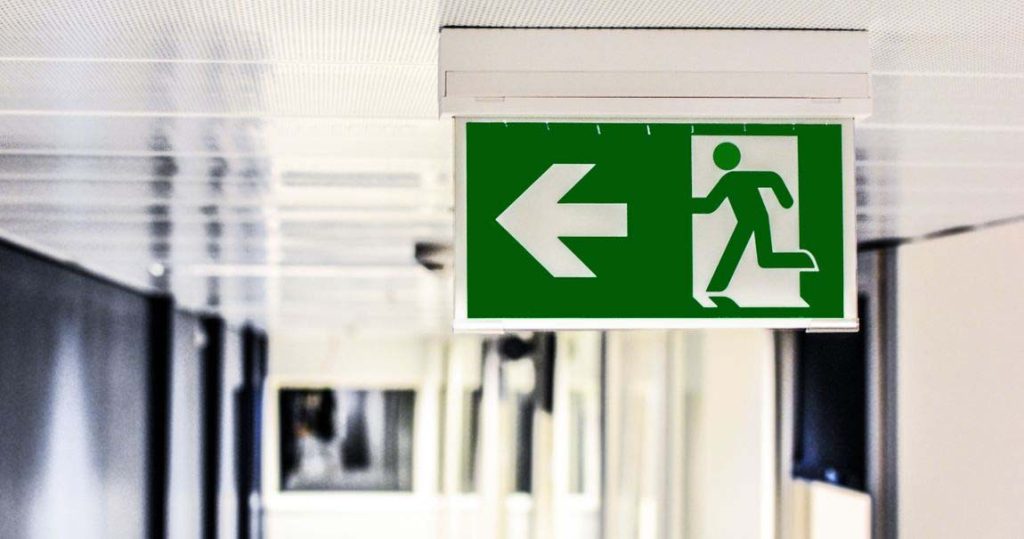
A conventional exit sign remains illuminated and uses a backup battery when mains power fails. A self-testing model adds programmed diagnostic functions. Depending on the fitting or system, it may run functional checks, test emergency operation for a set period and use indicator lights or monitoring software to report a fault.
This makes the technology useful in offices, warehouses, retail centres, hotels, healthcare facilities and other buildings with numerous emergency fittings. Rather than relying only on a technician to discover every problem during a scheduled visit, the fitting can provide earlier warning that a battery, lamp, charger or internal component needs attention.
Fire Factory’s range of LED exit lights includes self-test quick-fit options, blade signs, black exit lights and larger-viewing-distance models for different commercial settings.
Compliance Is a System, Not a Product Claim
Emergency lighting compliance in Australia involves more than buying an exit sign labelled compliant. The fitting must be appropriate for the building, correctly positioned, installed according to applicable requirements and maintained throughout its service life.
The standards framework is also developing. Standards Australia published AS/NZS 2293.1:2026 in June 2026, covering the design, installation and operation of emergency lighting and illuminated exit-sign systems. AS/NZS 2293.3:2026 addresses the design, construction, performance and testing of emergency luminaires and exit signs. Project teams should confirm which edition applies under the relevant code, approval pathway and contract before specifying equipment.
Self-testing technology can support this framework, but it cannot correct poor placement, an obstructed sign, an unsuitable viewing distance or an incomplete evacuation route. Those issues still require competent design and physical inspection.
How Self-Testing LED Exit Lights Improve Compliance
The strongest case for automatic testing of emergency exit lights is consistency. A programmed test does not overlook a fitting because it is above a difficult stairwell, inside a seldom-used plant room or located in another tenancy. It can make emerging faults more visible and allow maintenance teams to prioritise repairs.
This is especially valuable in buildings where manual testing involves hundreds of fittings. A clearer fault picture can reduce time spent locating failures, minimise disruption and make maintenance records easier to reconcile with the equipment on site.
Self-testing can also expose a common weakness in emergency systems. A sign may look normal while connected to mains power, even though its battery cannot support emergency operation. Diagnostic testing gives building managers another layer of information before an outage occurs.
However, results must be reviewed and acted upon. A fault indicator that remains unnoticed is not a compliance solution. The process still requires assigned responsibility, accurate records and prompt replacement of failed components.
Self-Testing Does Not Mean Maintenance-Free
Even advanced self-testing exit lights for commercial buildings require physical attention. Signs can be damaged, covered by new partitions, obscured by stock or left pointing towards an outdated route after refurbishment. Dust, moisture, heat and building work can also affect performance.
Routine inspection should consider the whole installation, not just the diagnostic status. Maintenance personnel need to check visibility, condition, mounting, directional legends, battery performance and site records. Fire Factory’s guide to testing emergency lights explains the importance of functional checks, discharge testing and documented repairs.
Qualified professionals should investigate reported failures and confirm that replacement products remain suitable for their location. Self-testing reduces uncertainty, but it does not replace competent inspection or electrical work.
When Is an Upgrade Worth Considering?
An upgrade may be practical when an existing system is ageing, producing frequent battery failures or consuming substantial labour during scheduled tests. It can also make sense during a fit-out, switchboard upgrade, tenancy change or broader fire-safety review.
Before ordering, consider viewing distance, mounting method, directional inserts, colour, environmental exposure and compatibility with the existing system. A warehouse may need a different solution from a small office corridor, while a damp or exposed area may require a specialised fitting.
Building managers searching for LED exit lights Sydney should also consider local stock availability and support when replacements are urgent. Working with an emergency lighting supplier NSW can make it easier to compare specifications, source accessories and maintain consistency across a property portfolio.
A Smarter Tool for a Continuing Obligation
Self-testing technology represents a useful shift from reactive maintenance towards earlier fault detection. It can make complex sites easier to manage and provide better visibility over the condition of emergency fittings. Its success, however, depends on what happens after the test.
At Fire Factory Australia, we supply LED and emergency lighting for electricians, fire-protection businesses, facility teams and commercial projects across Australia. Explore our range or contact Fire Factory Australia for help comparing self-test exit lights, mounting options and products suited to your next installation.